Returning to our old hobby horse of higher education, I recommend that you read this excerpt in The Chronicle of Higher Education from Robert Samuels’ latest book, Why Public Higher Education Should be Free: How to Decrease Cost and Increase Quality at American Universities (Rutgers UP, 2013). I haven’t read the full book yet, but I plan to soon. Bob is someone I worked with, and I respect his opinions on how to make higher education better and a better deal for students, particularly those who don’t swim in gold coins like Scrooge McDuck. Although I am not sure that making public colleges entirely free is the best idea, I do think we could streamline the way public money ends up getting spent on education to bring costs down to reasonable levels (i.e., take the ridiculous and predatory loan system out of it). Any move toward tuitionless higher ed would have to come with really stringent guidelines about who schools could let in and what students would have to do to stay enrolled, as simply providing universities a per-pupil payment seems like an invitation for administrators hungry to replicate themselves to let in completely unprepared kids just for the government cash they represent, only to dump them in ever-expanding classes taught by bedraggled adjuncts and grad students. Honestly, that wouldn’t be good for anyone, save the new Vice Deans of Provostial Studies.
Now, I’d wager this potential problem of free public colleges being overwhelmed by students who aren’t prepared could be solved by radically reforming K-12 education. If we actually focus on making a K-12 education system that hones essential critical thinking, language, writing, quantitative, technological, cultural, and interpersonal skills, we might end up with a population that is prepared at 18 to either enter a tech-heavy workforce (everything from Silicon Valley to auto repair) or go to college. This will require more, not less, personal attention given to each student, active engagement by parents in the lives of their kids and local schools, the toppling of the “testing” and AP regimes, the firing of teachers who (after being given multiple chances and the tools to succeed) have proven not up to the task of educating, and the end of schools being run by administrators rather than the best teachers. No small task, I know, but so many of our problems in higher ed are the result of our largely failed K-12 system. So let’s fix it before we’re a nation of people with 4.4 GPAs who can’t write a coherent sentence in English, Spanish, French, or any other language.
It is either comforting or not at all comforting to know that Silicon Valley didn’t invent the temple of life-hacking, the ruinous belief that one might perfect oneself and master existence: to know that this conceit is much older, basically post-Enlightenment modernity’s favorite way of doing things. Perfected under American Protestantism, given a cozy sheen by the techno-progressivism that emerged from Western research institutions after World War II, and now distinguished by a frantic strain indicative of life’s realities after the Great Recession, the only difference is that now there are more media platforms for spreading it. Dr. Oz and Bill Gates are winning the game. Why aren’t you? Get thee to a library, and check out some Horatio Alger.
Artists have done their bit of pushing back. Wallace Stevens put his shoulder to the wheel with “The Poems of Our Climate” (1937-1942), which emphasizes that a life of “complete simplicity,” an existence stripped of all ambiguity and uncertainty and longing, would be pretty awful. Or rather, striving for a life like that is awful, because only a lunatic would try to get it.
I. Clear water in a brilliant bowl, Pink and white carnations. The light In the room more like a snowy air, Reflecting snow. A newly-fallen snow At the end of winter when afternoons return. Pink and white carnations – one desires So much more than that. The day itself Is simplified: a bowl of white, Cold, a cold porcelain, low and round, With nothing more than the carnations there.
II. Say even that this complete simplicity Stripped one of all one’s torments, concealed The evilly compounded, vital I And made it fresh in a world of white, A world of clear water, brilliant-edged, Still one would want more, one would need more, More than a world of white and snowy scents.
III. There would still remain the never-resting mind, So that one would want to escape, come back To what had been so long composed. The imperfect is our paradise. Note that, in this bitterness, delight, Since the imperfect is so hot in us, Lies in flawed words and stubborn sounds.
If you haven’t seen the YouTube series Live from Daryl’s House, do yourself a favor and watch as many of the performances as you can. Let me back up. You like Hall & Oates, right? If you don’t, stop reading and listen to this. All of it. Then watch Live from Daryl’s House, which is basically Daryl Hall getting semi-famous-ish musicians and a bunch of brilliant hired guns to come up to his barn to play Hall & Oates songs with him. Think about that for a second. People come to Daryl Hall’s barn to play songs he wrote like 30 years ago with him. That’s respect, folks.
My favorite performance is this rendition of “I Can’t Go for That (No Can Do)” with Chromeo, an otherwise kind of silly band. But they just kill this song, and you can tell that everyone in the room (er, barn) is having a great time. This is what playing live music should be about. Hell, it’s what music should be about. Full stop. So go for this and enjoy your weekend, folks!
On a certain level, this is the beautiful inverse of Koyaanisqatsi. And there must be some economic potential in turning shoes and tampons into crumbly stuff. You could dominate the lucrative Pacific Rim crumb markets.
We’re officially in the dead of summer, and it feels like it here in southern California. Actually, it has felt more like summer in Louisiana here in L.A. for the past couple weeks. Just gross and humid. Still, I realize that most people in America have it much worse, so for today’s topical verse I’ve chosen a poem that celebrates both summer and place, William Blake’s “To Summer.” If you haven’t read much Blake, go to your local used bookstore and hunt around until you uncover an edition of his poems that also contains some of his etchings and drawings. Then, find your nearest pleasure garden, post up under a good shade tree, and read until you fall asleep nestled up against summer’s bosom. This is what this lazy weather is for, folks.
To Summer
O thou who passest thro’ our valleys in
Thy strength, curb thy fierce steeds, allay the heat
That flames from their large nostrils! thou, O Summer,
Oft pitchedst here thy golden tent, and oft
Beneath our oaks hast slept, while we beheld
With joy, thy ruddy limbs and flourishing hair.
Beneath our thickest shades we oft have heard
Thy voice, when noon upon his fervid car
Rode o’er the deep of heaven: beside our springs
Sit down, and in our mossy valleys, on
Some bank beside a river clear, throw thy
Silk draperies off, and rush into the stream:
Our valleys love the Summer in his pride.
Our bards are famed who strike the silver wire:
Our youth are bolder than the southern swains:
Our maidens fairer in the sprightly dance:
We lack not songs, nor instruments of joy,
Nor echoes sweet, nor waters clear as heaven,
Nor laurel wreaths against the sultry heat.
Mick Jagger turns 70 today, and boy, does “70” sound way older than “69.” In Sir Michael’s honor, here are the Stones before they turned into geriatric corporate wax figures: when they were the grimy, crude, ecstatic maniacs you should listen to at least once a month. Happy weekend, everybody.
Stressed out by our posts on the sea of troubles in which American higher education is flailing? Relax. That’s one of the main things gardens have been for since there have been gardens (besides the whole growing-food aspect).
● Although binge-spending on campus amenities is problematic in a lot of infuriating and scary ways, it does mean that many American schools (at least those that end up on the dumb ranking lists barfed out by Forbes and US News and other magazines every year) have remained passable facsimiles of Arcardia. Yes, I’m being aesthetically charitable, but schools with competitive admission profiles spend major funds on landscaping for a reason: an environment distinguished by transplanted ornamental trees, machine-shorn lawns, stone fountains, ivy wired to buildings, and other postmodern-bucolic stuff is meant to evoke the repose necessary for deep thought and complex scholarship. That’s why Plato taught in an olive grove. Also, it entices prospective students with all sorts of green nooks for smoking weed in.
● Read all about the above, and more, in Robert Pogue Harrison’s magisterial Gardens: An Essay on the Human Condition. It’s actually more of a book than an essay. If the untamed side of things is more your style, he also wrote a book called Forests: The Shadow of Civilization. It is also good.
● Maybe grab a couple other garden tomes? None of us read enough anyway. These would be the Oxford Companion to the Garden (wonderful even though the British origin makes you put up with lots of colour and vigour and missing commas) and Michael Pollan’s Second Nature: A Gardener’s Education. Contra the ad pitch on Pollan’s website, it is not “a modern Walden,” because it doesn’t have any boring stretches where you want to die or go read Emerson instead. Built upon an autobiographical foundation (there is great stuff about lawn care on suburban Long Island after World War II), the text is ultimately a hybrid of cultural history, botanical inquiry (the stuff about weeds is rhapsodic and sensible at the same time), gardening advice, and ethical meditation. Pollan’s central claim is that gardening, unlike (say) American wilderness worship or a vague feeling for the poor Amazon, reminds us, over and over, that human experience takes place within a life-world that we must simultaneously exploit, care for, and love deeply.
● Staying with the literary angle, refresh yourself with Andrew Marvell’s “The Garden.” Over the years critics have gone at it with all kinds of ideological crowbars, but you shouldn’t forget Philip Larkin’s remark that the poem might be best understood as “a good description of the mind of someone half-asleep under the summer trees in a garden” (“The Changing Face of Andrew Marvell,” collected in his Required Writing).
● Rich people usually have nice land around their homes. Often that land bears complicated gardens. And if rich people go broke and then go crazy, they sometimes do it in high style, as Grey Gardens reminds us. I’ve seen this documentary three or four times, and it never ceases to be demonically compelling. Don’t call it a “cult classic.” It’s just a classic. Man, WASPs have some weird genes.
● Merely eccentric wealthy people tend to be a lot more functional, and one of them, Madame Ganna Walska, left behind the coolest, most variegated, enchanting garden I have ever been to, Lotusland in Montecito, California. If you are ever in the Santa Barbara area and have a few hours, go. It is absolutely worth the steep admission fee ($35). They sometimes do free-tour days, but those are tough to get.
● I have a little kitchen garden, and bugs and weeds get in it all the time, which MAKES ME SO ANGRY. These people can help: the University of California Integrated Pest Management Program. Caution: this site’s mesmerizing level of visual and written detail, along with its intense dedication to helping you do the practical stuff that keeps a garden functional, will take up lots of your free time, if you garden.
● Aesthetics aside, we also need more working gardens in urban neighborhoods that lack decent grocery stores. Gardens are nice to walk through and look at, but they can also help bring down America’s catastrophic rates of obesity and diabetes, scourges that are concentrated in the places where poor people live. From the LA Times, here is a touching story about how kids in a scruffy part of Los Angeles are maintaining local garden clubs.
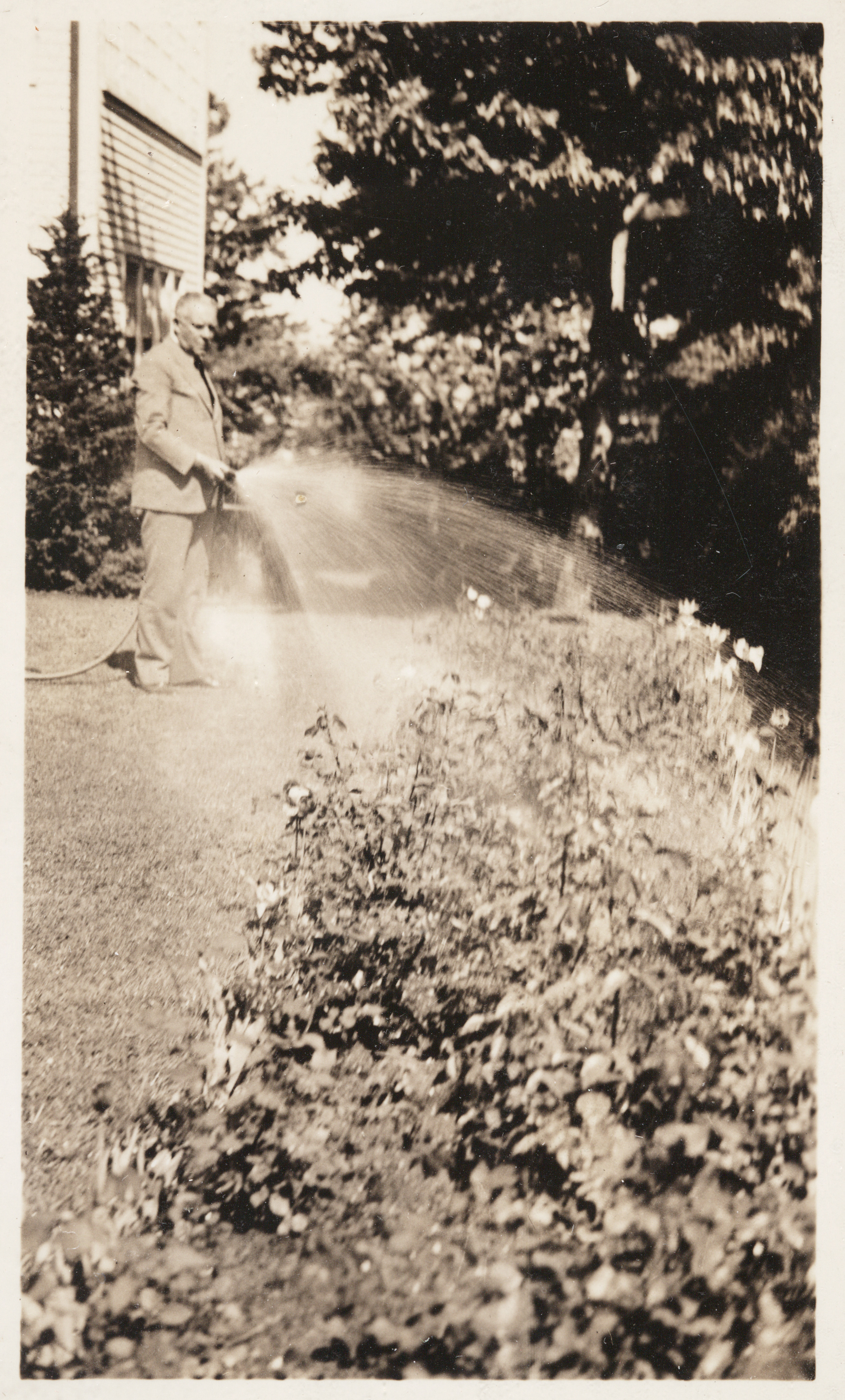
● Here is a snapshot of Wallace Stevens watering his rose garden in West Hartford, Connecticut sometime in the 1930s. Note that he is wearing a suit. The image is housed in the archives of The Huntington Library in Pasadena, which also happens to maintain some astonishing gardens; the photographer is unknown.
● And here is that scene from Disney’s version of Alice in Wonderland that has inspired thousands of budding artists and similar weirdos, and subtly terrified millions of children more.
● We’ll leave you with some more music. Have a listen to the Stone Temple Pilots’ corny but energizing “Wicked Garden” (the garden seems to be a metaphor for something). Kind of fun to mute the Alice clip above and play this:
● . . . or maybe you should just stick with Beethoven’s 6th, the “Pastoral” symphony:
Jonathan Chait has dashed off a piece in New York Magazine that’s a perfect example of how uninterested most MOOC boosters are in actually improving the quality of higher education. His post is a response to an article by Jonathan Rees (two Jonathans will enter, but only one will survive!) in Slate about how MOOCs are a bad deal for both students and professors. Predictably, Chait mostly focuses on the part where Rees bemoans what MOOCs threaten to do to the the employment prospects of faculty members. Most people are unsympathetic to the idea that we should preserve the current structure of higher education to keep a bunch of eggheads in their houses. Hell, I’m not even very sympathetic to that argument, and I have a vested economic interest in supporting it!
But Chait basically ignores everything Rees writes about why MOOCs will be a disaster if what one cares about is ensuring that people actually learn useful skills in college courses. Rees writes:
How do you teach tens of thousands of people anything at once? You don’t. What you can do over the Internet this way is deliver information, but that’s not education. Education, as any real teacher will tell you, involves more than just transmitting facts. It means teaching students what to do with those facts, as well as the skills they need to go out and learn new information themselves…
What makes this possible is that MOOCs, at least from an educational standpoint, are designed to run themselves. The lectures are pre-recorded. The grading is done either by computer or by other students in the class, should they choose to do the assignments at all. The average drop-out rates for existing MOOCs is about 90 percent, so while Coursera may offer access to higher education anywhere in the world where potential students can get the Internet, it offers no guarantee that anybody will actually learn anything…
While MOOCs may serve a purpose as nerdy edu-tainment for people who are so inclined, a workforce trained without close contact with professors of any kind might as well not attend college at all. Going to the library and reading a bunch of books would be equally effective, and probably a whole lot cheaper.
To which Chait responds:
But, uh – are we sure the only way to teach people what to do with facts is face-to-face? This seems like something that could at least conceivably be taught to more than one person at once. I can remember lots of professors teaching me what to do with facts via lectures in extremely large auditoriums, which is not that different than a lecture you watch online. Nobody claims that the technical barrier has been solved, but it’s amazing that Rees is already declaring it unsolvable…
The goal of the system ought to be making higher education effective and affordable for students. Rees waxes poetic about the joys of in-person liberal education, and I greatly enjoyed my classic college experience, with the gorgeous campus green and intramural basketball and watching campus protestors say interestingly crazy stuff at rallies. But insisting that’s the only way a student ought to be able to get a degree, in an economy where a college degree is necessary for a middle-class life, is to doom the children of non-affluent families to crushing college debt, or to lock them out of upward mobility altogether.
Chait’s equation of MOOCs, which are supposed to replace entire courses, with lectures is instructive; it reveals something that few of the MOOC boosters like to discuss: lectures and the information they transmit are only one small component of any college class worth its salt. The careful, personal evaluation by trained professionals of the material produced by students is why college is useful as anything more than a simple credentialing process. Even Rees referring to this as “grading” misses the point. The development of rhetorical, quantitative, and creative skills requires that someone who knows what s/he’s talking about explains to the student not just that they have done something incorrectly, but how and why they have done so, and how they can fix this going forward. Doing this well takes a lot of time per pupil, and this is why small class sizes are essential is some disciplines (any course that has a significant writing component, higher math, advanced science courses, art). Why do you think people send their kids to small, insanely expensive liberal arts colleges?
But the quality of the education received by students doesn’t really matter to Chait and other MOOC maniacs. He never defines “effective” because it’s only important that people get credentialed. Whether they can write or reason their way out of a paper bag is immaterial, so long as they have a BA. If Chait (and President Obama, for that matter) actually cared about improving the quality of higher education, they would understand that the solution to colleges offering too many large impersonal lectures for credit is not to make courses even larger and more impersonal. Information has never been more accessible than it is today. This is great, and everyone should take advantage of the internet to become more informed people. But information does not an education make. If we want education to have any real value we must invest in it, not in techno-fads masquerading as education.
 The General Reader
