Long-Weekend Beats

History first: Chrissie Hynde is publicly OK with Rush Limbaugh featuring this Veterans Day weekend’s amazing song prominently (and for years!) on his hate-talk show. She went through some real casuistry to get there, but she still got there. That is gross, because the republic has enough problems without a xenophobic cyst like Rush, and good music is always in relatively short supply. (Fact: as a nerdy and eager pre-teen, I purchased and [twice] read RL’s seminal release See, I Told You So, thanks to lobbying from older relatives, but I have since made peace with that.)

Yet as a snob like me has to constantly remind himself, art doesn’t belong to anyone. That is why the Romantics could so intentionally misread Paradise Lost and decide that Lucifer was a hero and good guy after all; that is why the twentieth century’s most important poem, T.S. Eliot’s “The Waste Land,” so carefully appropriates and distorts the West’s detritus; that is how chains of theft can clear pasture for genius (cf. the Stones & Zeppelin/the blues, The Ramones/British punk, Greek sculpture/Apple’s matte products); and unfortunately that is how somebody like the aforementioned demagogue can share tastes with you, me, and all manner of progressives who like “vinyl,” coffee made in French presses, and Lou Reed.

But whatever. Just listen, maybe comment, then click back out into the Internet.

Seriously, isn’t this track fantastic? Are you not moving a hip or two? That bassline is in the empyrean with cuts like “Another One Bites the Dust” and “Hypnotize.” It is a thick existential burden, a rich man’s text. Go forth and prosper, y’all.

Sunday Links

For most people, not reading is just about the easiest thing in the world to do. But if you’re someone who visits this site, you aren’t one of these people. We try to give you good writing, whether ours or written by others, to feed the need. So once again, here are some pieces we think are worth reading with your Sunday morning coffee (or whenever you get around to it).

  • This Newsweek (yeah, I didn’t know it still existed either) profile of the writer William T. Vollmann reveals that the FBI kept (and possibly still keeps) tabs on him and suspected that he might have been the Unabomber. I must confess to never having read an entire Vollmann book, but the excerpts I have read are outstanding. I never would have thought of him as a contender for the Nobel, but given his politics production, the suggestion actually makes sense.
  • Two of the most interesting pieces I’ve read on the Richie Incognito affair couldn’t come from more different sources: Grantland and The National Review. Brian Phillips takes on the contrived (and frankly offensive) warrior culture of football in his Grantland article, writing: “Because this — this idea that Jonathan Martin is a weakling for seeking emotional help — this is some room-temperature faux-macho alpha-pansy nonsense, and I am here to beat it bloody and leave it on the ground. Every writer who’s spreading this around, directly or by implication; every player who’s reaction-bragging about his own phenomenal hardness; every pundit in a square suit who’s braying about the unwritten code of the locker room — every one of these guys should be ashamed of himself, and that’s it, and it’s not a complicated story.” I tend to agree with this sentiment, but Daniel Foster offers another take over at NRO: “Phillips affectingly writes of America as a ‘nation of gentle accountants and customer-service reps who’ve retained this one venue’ — the National Football League — ‘where we can air-guitar the berserk discourse of a warrior race.’ But he says that like it’s a bad thing. On the contrary, this compartmentalization and channeling of destructive impulses into less harmful endeavors — recognized in Freud’s concept of sublimation and William James’s ‘moral equivalent of war’ — is the hallmark of a civilized people. Every institutional order needs it. The Amish need their Rumspringa, Europe needs Amsterdam, and a nation of gentle accountants needs the National Football League.” Like I said, I agree with Phillips that the less we tolerate meathead culture the better, but I don’t think Foster is wrong to suggest that if we want that, we might need to accept the end of football.
  • I probably don’t need to tell you how awesome the Paris Review is, but it bears repeating: The Paris Review is awesome. Check out this interview with Nabokov and try to tell me otherwise.
  • Helen Vendler’s review of Linda Leavell’s new biography/study of the works of Marianne Moore will get your excited to read the works of one of America’s least obviously weird and radical poets.
  • And finally, if you have not checked out my friend Drew’s multi-platform project Artbound, this video and article will give you a sense of the kinds of fascinating stories you are missing out on.

The $10K Race to the Bottom

In a recent article, adjunct activist Rebecca Schuman wrote about the sham $10,000 BAs and “competency models” that Republican governors are trying to push as solutions to the outrageous cost of going to college. As usual, Schuman provides the kinds of insights that only those of us whose primary job is actually teaching undergrads can. She writes:

[T]he $10,000 B.A.—which, again, does not include room, board, books, transportation, or child care for the many college students who are single parents—is largely a chimera. But even if it did exist, what kind of message does it send students, or potential employers, that there is now another stratification of college degree: elite private, public flagship, public regional, and now public regional cut-rate? And besides, if a college education can be given for $10,000, why isn’t it available to everyone?

…A semester-long course is not just the (temporary) accumulation of (dubious) knowledge or skills—it’s a journey in which, if it’s a good class, students come out different than they were when they started. They not only learn course material, but also develop as thinkers, readers, writers, mathematicians, experimenters, useful humans. I guess you have to hand it to the competency model for giving up entirely on the prospect of growing as a person and instead just offering diplomas you can buy.

The push to get people advanced degrees by any means necessary is, as Ryan and I have noted many times, bipartisan, and President Obama is as guilty as anyone of repeating the fallacy that getting any college degree means that money suddenly appears in your pockets. When I was driving home the other night, I heard a story on NPR about community colleges in Michigan that are scouring their records to find students who have qualified for but, for whatever reason, not yet received their Associates degree. Sounds like a great public service, right? Well, there’s this:

[A]ccording to the U.S. Bureau of Labor Statistics, workers with an associate degree on average earn $132 more per week than someone with just a high school diploma. People with degrees are also less likely to be laid off.

Lots of community colleges are getting into the act now, trying to lure back students who’ve dropped out or moved on.

…And there’s another payoff: As colleges and universities face pressure to boost graduation rates, finding former students who are ready to graduate right now — but don’t know it — is an easy way to do that.

Hooray for easy! Actually preparing students to be able to graduate (or even keep track of their credits) is soooooo hard! And if people having AAs means that they will earn $132 more per week, why don’t we just give everyone AAs instead of high school diplomas? Problem solved! We look forward to the President awarding TGR the Medal of Freedom at his earliest convenience.

But I digress. Of all of the $10,000 BA programs, one that Schuman’s article doesn’t mention stands out to me as the most awful. Anya Kamenetz has made a name for herself as a mouthpiece for the creative destruction of traditional higher education. She’s trying to build better MOOCtraps and consorts with people dubbed “Edupunks” (how edgy!). She’s the kind of “education” expert folks in Silicon Valley and the editors at Reason Magazine love to quote, in spite of the fact that I can’t find evidence that indicates she’s ever been on the faculty at any college or university.

Kamanetz’s “$1 Trillion and Rising: A Plan for a $10K Degree” was published by the Third Way Foundation, a nominally center-left think tank that apparently turns full neoliberal when it comes to education policy. To be fair, a couple of Kamanetz’s proposals in this paper make sense, and they’re ones that TGR (and just about every other sane observer of higher ed, including Schuman) has advocated: ending administrative bloat and drastically reducing spending on college campus amenities. Both of these things need to happen, like yesterday. Just about everything else Kamanetz proposes though, is pure technocrat crap, and I will tackle each of her six proposals below.

Reduce and Restructure Personnel: Thomas Frank is right when he says that “the business side of the university has been captured by a class of professionals who have nothing to do with the pedagogical enterprise itself.” Kamanetz acknowledges as much, and proposes cutting the amount of money spent on administration. We agree! However, instead of explaining how universities will function with fewer deans, benefits officers, and staff members, she leaps into a plan to reduce and restructure the faculty at universities. I fail to see what this really has to do with cutting administrative bloat. Rather, even in this first step, Kamanetz’s inner utopian comes out.

At her $10K university, there will apparently be three kinds of employees: Advisors, Instructors/Instructional Technologists (such a creepy term), and Professors/Instructional Designers (again, creepy). “Professors” in this model basically exist to produce MOOCs that can be disseminated throughout the university system. “Instructors” are basically glorified TAs who spend 20 hours a week in the classroom helping kids figure out how to do stuff with said MOOCs. And “Advisors” email kids and keep track of their progress via “a computer system.” Are you noticing a trend here? Nowhere in her explanation does she mention who will be responsible for grading and commenting on essays and other assignments. I bet she has a computer in mind for that too.

End the Perk Wars: On this point, I mostly agree with Kamanetz’s suggestion that if it comes down to spending money on education or something else, then something else needs to go. However, her plan to do away with residential facilities entirely strikes me as unwise. Making spartan dorms for first-year students available at a reasonable cost seems like a solid compromise, as the residential experience is often an important way that students begin forming adult social networks that will help them “win the future” at least as much as their BAs will.

Focus on College Completion: Here’s where things start getting nasty. Kamanetz and Third Way are your standard credentialists, as they seem more concerned with people getting BAs as quickly as possible than with them actually learning anything in college. As such, Kamanetz wants to count EVERYTHING for college credit. And if your goal is to graduate people, not teach them, lower standards inevitably follow, and tests that measure competency seem like a great way to simply pass on ill-prepared students who might be able to regurgitate some content once, but without the formal knowledge of how to apply that content later. People graduating from college is a great thing, but only if they actually deserve to graduate.

Scale Up Blended Learning: It seems to genuinely pain Kamanetz that MOOCs have thus far been a total disaster. But rather than look at the data and think, “Hey, maybe it’s kind of a good idea for professors to write their own lectures and cater them to the students and conditions in their classrooms,” and, “Hey, maybe there’s value in students having to actually get themselves to a class and pay attention for an hour straight,” she’s continuing to push for MOOCs as a primary conveyor of content, with professors (or technologists, or whatever the hell weird thing she calls them) serving as a kind of support staff for students. She uses another (equally stupid) acronym for this model: SPOC (Small, Private Online Course).

Anyone who teaches college already “blends” by using course management software. I put all of my readings and handouts up on a school-run website, and my students print them out as needed. Other teachers I know use the site for message boards, chats, and peer review. It’s a wonderful supplemental tool, but not a substitute for what goes on in the classroom and office hours, where students get to know one another, say things they regret but then learn from, debate real breathing people (not avatars), and cultivate important non-cognitive skills, like being attentive to others and NOT multitasking (RIP, Clifford Nass).

Streamline Offerings: The fact that Kamenetz wants to reduce the number of majors isn’t very controversial. I tend to agree that there are a lot of departments on any college campus that could be eliminated by allowing students to specialize within the traditional fields of the liberal arts and sciences. But let’s look carefully at what Kamenetz actually proposes:

[T]he $10K BA should offer challenging interdisciplinary majors in economics (including the practice of entrepreneurship), accounting, and rhetoric (English Language Arts and communication).

The remaining “long tail” of undergraduate majors, and the full universe of learning beyond that, should be covered at the flagships and available for independent study throughout the system. In choosing what degree paths to offer and support from year to year, the system should follow a “vote with your feet” or “student election” model where a critical mass of signups directs resources toward a particular path or paths. The university community will continue to be responsible for developing and updating the full MOOC course catalogue to serve these needs.

More MOOCs, of course, but the bolded line is the real humdinger. Theoretically, funding for one’s major could be cut by a popular vote, leaving students at the mercy of their peers. This would also mean zero job security for any faculty members, as they might get voted off the island if their department is deemed unnecessary (or if they don’t inflate their grades). They’d effectively be adjuncts, which Kamenetz claims her Instructional Technologists wouldn’t be. Any college with no institutional memory or intellectual ethos doesn’t deserve to be called one.

Rethink College Architecture: No, Kamenetz is not talking about knocking down Brutalist buildings. It’s so much worse than that. Kamenetz’s public university system is a four-tiered model of “Cohort Colleges” (basically community colleges), “Adult Online Universities” (basically University of Phoenix), “Flagship Institutions” (more on these in a second) and “”Micro/Pop-Up Schools” (basically Apple Stores of “knowledge”). The Silicon Valley Speak is laid on thickest in this section of the paper. Check out this passage describing the role of “Flagships”:

In a $10K BA plan, the flagship universities most resemble their previous historical role. Each consists of a physical teaching and learning campus maintaining a large professional payroll of faculty engaged in both research and teaching. Prominent among the interdisciplinary departments will be a robust research faculty, combining the latest in cognitive science, artificial intelligence, data analysis, human-computer interaction, psychology of motivation, user interface design, and other components of technology-enabled teaching and learning.

This is Google’s dream university, where teaching people to read, think, and write is less important than doing cool things with analytics. But the worst is yet to come:

Flagship institutions in the $10K BA plan will have different entrance requirements than the old top-tiers. In recent years, flagships like UC Berkeley have had low acceptance rates, around 20%. In a few short years, however, the MOOC model has allowed millions of students from hundreds of nations and all backgrounds to experience classes as taught by professors at Stanford, Harvard, and MIT. A few of these students have proven themselves as able as any one of the undergraduates at these ultraselective campuses. Accordingly, $10K flagships will focus on openness, not exclusion.

While there is certainly a place for excellent students at the flagships, there needs to be significant cognitive, social, and economic diversity, because the flagships will be serving as testbeds for the learning technology that is disseminated far and wide. The freshmen admissions process will take into consideration not only the typical transcripts and test scores, but students’ demonstrated ability to create and participate in engaging learning experiences. In addition, the students who excel in the other learning models will be offered the opportunity to rotate through the flagship campus to complete their degrees.

This is, to my mind, absolutely unconscionable. What she’s basically doing here is making the gap between public universities and elite private schools wider. Anyone who knows even a little bit about higher ed can tell you that the professors at Harvard aren’t what make it an elite school. They have the same degrees (PhDs from great universities) that professors at San Jose State have. The difference is that Harvard’s selectivity creates a hothouse environment of motivated, competitive students who challenge one another to do better work. By saying that “Flagship” universities must let in just about anyone who applies, Kamenetz is ensuring that the excellent students in a public system aren’t getting an excellent education. They’re getting a mixture of MOOCs (some of which are just recycled from elite private schools with their AMAZING professors), huge courses filled with wildly unevenly talented and motivated peers, and some facetime with an Instructional Technologist (maybe even an Instructional Designer!). Excellent students who graduate from $10K UCLA will no longer be thought of as on par with Ivy League students, because they won’t be. And while I don’t want to imply that Kamenetz has anything other than pure motives in trying to dismantle traditional modes of public education, it must be noted that she graduated from Yale. She should know that high admissions standards lead to better educational environments, and she should want that for public school students.

But as I said earlier, better educational environments aren’t what Kamenetz and Third Way really care about. They care about credentialing people, and if that’s your ambition, letting everyone in and focusing on getting people through as quickly as possible is the best way to do it. Standards are so pre-internet. Now, I will concede that there may be some crazy logic to all of this. Perhaps by degrading higher education so much the $10K University will help force the necessary changes at the K-12 level that will make it so people don’t need fake credentials to get jobs that don’t require a college education. But seeing as Kamenetz never mentions any K-12 reforms, I don’t get the impression that she really understands what our most pressing educational problems actually are. Maybe she should listen to some of her own parting words:

Acting to create a radically low-cost version of public university education is risky. The primary unintended consequence would be the use of the model as a pretext to continue to defund public education and to exacerbate and reproduce existing social inequalities. The focus of the redesign is to bring the highest quality education possible to as many people as possible, which the current system does not do.

What’s that saying about the road to hell?

Monday Links

  • Your humble editors were lucky to have some good teachers in graduate school. One of them, Stephanie LeMenager, is about to publish her second book, Living Oil: Petroleum Culture in the American Century. If you’d like to see an example of weight and erudition merged with readability, consider it. I am looking your way, university libraries.
  • Britain’s perfectly OK version (I kid, I kid) of the New York Times, the Guardian, recently posted a good 15-minute interview with David Simon, who created The Wire. It complements his role in a 2012 documentary on the drug war, The House I Live In.
  • Thomas Frank has a poignant, righteous essay in The Baffler. It is about US higher education. It is reality-centric. It anticipates what will become a significant literary posture over the next decade: melancholy shame at how we all, but especially the Baby Boomers, constitute one big benumbed “generation that stood by gawking while a handful of parasites and billionaires smashed it for their own benefit,” “it” being the incredible public-university system America put together in the mid-twentieth century with the goal of sustaining a vibrant middle class. Which the system did. For a while. A vibrant middle class being the basis of political and cultural modernity. Then billionaires.
  • Big Ghost is one of the web’s best music critics. I hope his gritty urban slang and frequent aversion to commas don’t upset my progressive white friends. (Hi, almost every reader!) Here is BG’s viciously profane, incisive reading of a Drake album.
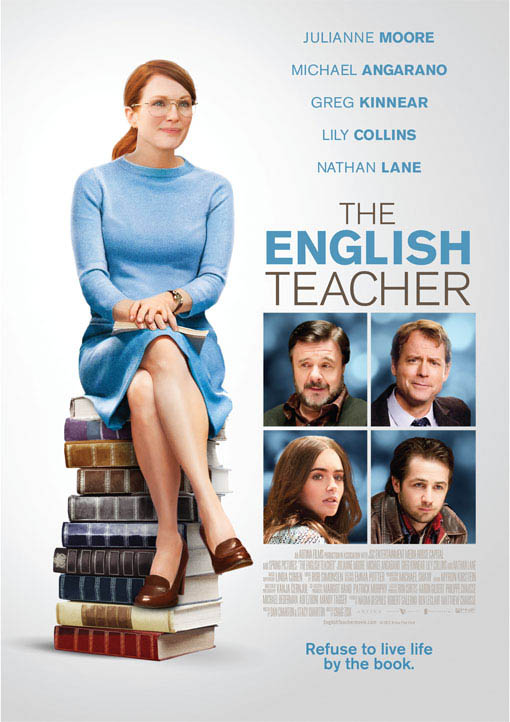
  • Finally there is this, a thing existing on the Internet, a movie poster for something called The English Teacher, which apparently earned Julianne Moore a paycheck to spend on a new villa in Monaco. The movie looks lame and forgettable. Further, it is childish to get riled up over a movie. Nonetheless, for some reason the expression on Greg Kinnear’s face makes me want to throw a TV through a wall. He looks like he’s doing a George-Bush-during-press-conferences face. I am going to venture out onto a metaphorical limb here and guess that this film is a nominally literate cornball dipshit’s idea (to use the proper academic terminology) of what teaching consists in. The English Teacher (TET) loves leatherbound books so much that she sits on them. No time for chairs! She’s got students to inspire. And you know she’s smart, because she’s wearing glasses.

Weekend Beats: I’ll Streak His Blood Across My Beak

I’ve been thinking a lot lately about something in Joan Didion’s essay “On Keeping a Notebook.” She writes:

I think we are well advised to keep on nodding terms with the people we used to be, whether we find them attractive company or not. Otherwise they turn up unannounced and surprise us, come hammering on the mind’s door at 4 a.m. of a bad night and demand to know who deserted them, who betrayed them, who is going to make amends. We forget all too soon the things we thought we could never forget. We forget the loves and the betrayals alike, forget what we whispered and what we screamed, forget who we were. I have already lost touch with a couple of people I used to be; one of them, a seventeen-year-old, presents little threat, although it would be of some interest to me to know again what it feels like to sit on a river levee drinking vodka-and-orange-juice and listening to Les Paul and Mary Ford and their echoes sing “How High the Moon” on the car radio. (You see I still have the scenes, but I no longer perceive myself among those present, no longer could even improvise the dialogue.) The other one, a twenty-three-year-old, bothers me more. She was always a good deal of trouble, and I suspect she will reappear when I least want to see her, skirts too long, shy to the point of aggravation, always the injured party, full of recriminations and little hurts and stories I do not want to hear again, at once saddening me and angering me with her vulnerability and ignorance, an apparition all the more insistent for being so long banished.

This quote is one of the many reasons Didion is, in my opinion, the greatest essayist I’ve ever read. Feel free to think I’m nuts, or that I’m discounting James Baldwin, Christopher Hitchens, DFW, Maxine Hong Kingston, or some other writer you favor; they’re all great. But Didion’s my kind of Californian, and I spent a lot time reading her when I was living alone in Santa Cruz, a year that it dumped down rain and was gray from about October to March. It was awesome, and that person I used to be is actually someone I sometimes wish I was in touch with more than I am. I’ll spare you a nauseating explanation of why I miss him and why we don’t talk much, but I can say that he would have loved this Songs: Ohia tune, had it been imagined and released when he was me and I was him. It wasn’t, and sadly the guy who wrote the song won’t write any more. But maybe next time that person I used to be comes round again, I’ll play this one for him.


Insurance-Ad News: Halloween Edition

Advertisements for a cut-rate auto-insurance company, The General, have been floating around California television (especially sports programming) for at least a half-decade. The similarity between their name/web address combo and our name/web address combo is problematic, given that by all appearances The General is a scam run by a Malaysian crime syndicate with contacts in the shitty-animation world, or perhaps a time capsule from the 1990s, or a student film shot on a repurposed porn set. What it actually seems to be, going by their website, is a regional insurance company that only has offices in Louisiana despite being chartered in Nashville, and which for some reason puts their creepy, cheap commercials on South Coast television.

Why the penguin? Why does he serve the little brother of George Patton and Yosemite Sam with such purpose? He’s almost as bad as this guy.

Bonus Beats: Lou Reed Lives On

As you are no doubt aware, Lou Reed died yesterday at the age of 71. I won’t bore you with a “Lou Reed was super important to me when I was in college” story. He was, especially when I moved to Santa Cruz and didn’t really know anyone. But Lou Reed and the Velvet Underground were super important to a lot of people, at least most of the people I know, and I’m hardly a VU fanatic. They were simply a great, really influential band. So here’s a little something sweet for your Monday.