To twist a Ben Franklin quote that isn’t actually a Ben Franklin quote, sometimes the Web’s archaeological capabilities are a sign that God loves and wants us to be happy. Bill Murray drinking a can with Harry Caray on a hot night in the late 80s. Enjoy.
On a certain level, this is the beautiful inverse of Koyaanisqatsi. And there must be some economic potential in turning shoes and tampons into crumbly stuff. You could dominate the lucrative Pacific Rim crumb markets.
Stressed out by our posts on the sea of troubles in which American higher education is flailing? Relax. That’s one of the main things gardens have been for since there have been gardens (besides the whole growing-food aspect).
● Although binge-spending on campus amenities is problematic in a lot of infuriating and scary ways, it does mean that many American schools (at least those that end up on the dumb ranking lists barfed out by Forbes and US News and other magazines every year) have remained passable facsimiles of Arcardia. Yes, I’m being aesthetically charitable, but schools with competitive admission profiles spend major funds on landscaping for a reason: an environment distinguished by transplanted ornamental trees, machine-shorn lawns, stone fountains, ivy wired to buildings, and other postmodern-bucolic stuff is meant to evoke the repose necessary for deep thought and complex scholarship. That’s why Plato taught in an olive grove. Also, it entices prospective students with all sorts of green nooks for smoking weed in.
● Read all about the above, and more, in Robert Pogue Harrison’s magisterial Gardens: An Essay on the Human Condition. It’s actually more of a book than an essay. If the untamed side of things is more your style, he also wrote a book called Forests: The Shadow of Civilization. It is also good.
● Maybe grab a couple other garden tomes? None of us read enough anyway. These would be the Oxford Companion to the Garden (wonderful even though the British origin makes you put up with lots of colour and vigour and missing commas) and Michael Pollan’s Second Nature: A Gardener’s Education. Contra the ad pitch on Pollan’s website, it is not “a modern Walden,” because it doesn’t have any boring stretches where you want to die or go read Emerson instead. Built upon an autobiographical foundation (there is great stuff about lawn care on suburban Long Island after World War II), the text is ultimately a hybrid of cultural history, botanical inquiry (the stuff about weeds is rhapsodic and sensible at the same time), gardening advice, and ethical meditation. Pollan’s central claim is that gardening, unlike (say) American wilderness worship or a vague feeling for the poor Amazon, reminds us, over and over, that human experience takes place within a life-world that we must simultaneously exploit, care for, and love deeply.
● Staying with the literary angle, refresh yourself with Andrew Marvell’s “The Garden.” Over the years critics have gone at it with all kinds of ideological crowbars, but you shouldn’t forget Philip Larkin’s remark that the poem might be best understood as “a good description of the mind of someone half-asleep under the summer trees in a garden” (“The Changing Face of Andrew Marvell,” collected in his Required Writing).
● Rich people usually have nice land around their homes. Often that land bears complicated gardens. And if rich people go broke and then go crazy, they sometimes do it in high style, as Grey Gardens reminds us. I’ve seen this documentary three or four times, and it never ceases to be demonically compelling. Don’t call it a “cult classic.” It’s just a classic. Man, WASPs have some weird genes.
● Merely eccentric wealthy people tend to be a lot more functional, and one of them, Madame Ganna Walska, left behind the coolest, most variegated, enchanting garden I have ever been to, Lotusland in Montecito, California. If you are ever in the Santa Barbara area and have a few hours, go. It is absolutely worth the steep admission fee ($35). They sometimes do free-tour days, but those are tough to get.
● I have a little kitchen garden, and bugs and weeds get in it all the time, which MAKES ME SO ANGRY. These people can help: the University of California Integrated Pest Management Program. Caution: this site’s mesmerizing level of visual and written detail, along with its intense dedication to helping you do the practical stuff that keeps a garden functional, will take up lots of your free time, if you garden.
● Aesthetics aside, we also need more working gardens in urban neighborhoods that lack decent grocery stores. Gardens are nice to walk through and look at, but they can also help bring down America’s catastrophic rates of obesity and diabetes, scourges that are concentrated in the places where poor people live. From the LA Times, here is a touching story about how kids in a scruffy part of Los Angeles are maintaining local garden clubs.
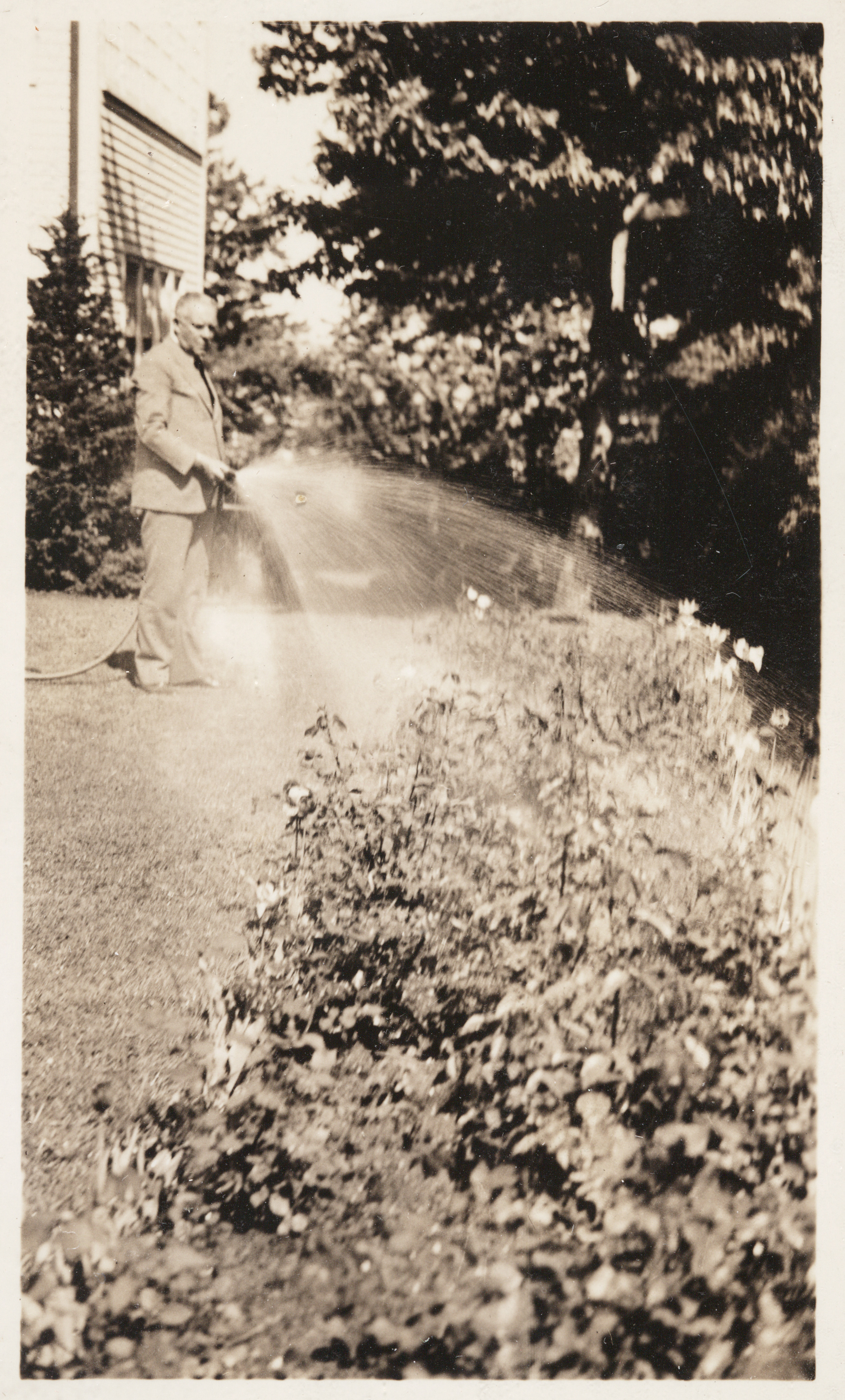
● Here is a snapshot of Wallace Stevens watering his rose garden in West Hartford, Connecticut sometime in the 1930s. Note that he is wearing a suit. The image is housed in the archives of The Huntington Library in Pasadena, which also happens to maintain some astonishing gardens; the photographer is unknown.
● And here is that scene from Disney’s version of Alice in Wonderland that has inspired thousands of budding artists and similar weirdos, and subtly terrified millions of children more.
● We’ll leave you with some more music. Have a listen to the Stone Temple Pilots’ corny but energizing “Wicked Garden” (the garden seems to be a metaphor for something). Kind of fun to mute the Alice clip above and play this:
● . . . or maybe you should just stick with Beethoven’s 6th, the “Pastoral” symphony:
I’m not going to pretend that I’m some OG Noah Baumbach fan. The first time someone told me about Kicking and Screaming, I assumed she was talking about the youth soccer movie starring Will Farrell. I believe I even spent the next day thinking that said youth soccer film was some secret gem that I needed to see ASAP. I am glad the internet was able to clear that up for me. So no, I don’t have anything particularly deep to say about how Baumbach’s latest film, Frances Ha, represents an organic outgrowth of his previous work. I’ve liked the three of his films that I’ve seen, but none as much as Frances Ha.
It’s hard for me to describe why this movie is so good. It’s not, as many first-year composition students would say, “really relatable” (cue sound of me crying). I’ve never lived in Brooklyn or Manhattan, and have never been close enough with folks who do to go out and have a typical alt experience. I went to New York once for a wedding during a hurricane, and that’s it. And while I know what it’s like to be broke as hell at 27 while chasing some ultimately pointless dream (Frances wants to be a touring dancer, perhaps the only thing more unlikely than becoming an English professor), I didn’t see much of myself in Frances.
And maybe that’s just it. Baumbach and Greta Gerwig (his co-writer, lover, and the star of the film) have produced a character study of someone who reminds me of bits and pieces of folks I’ve met in my life without her being reduced to a “type.” Frances feels very much like her own complete person, which is rare in both the film and real worlds. I certainly am not the first person to say this, but Gerwig’s Frances works for the same reasons Diane Keaton’s Annie Hall and Jason Schwartzman’s Max Fischer do: she reads as authentic, so you find yourself interested in what happens to her, even if it isn’t much. I suppose that’s another way of saying that I’d watch Frances do just about anything, and since the film gives us a chance to do just that, I loved it.
There are many other reasons to see the film beyond the central character. It’s one of the funniest movies I’ve seen in a long time. It’s shot well. There are a couple great musiccues (but not too many). The film’s secondary characters all serve purposes realized by the actors’ performances. And it’s weirdly about what the financial crisis has done to people of my generation (cogent film analysis from the National Review?!?!).
But finally it all comes back to Frances, who Greta Gerwig just nails. I suppose the best praise I can give this movie is that I plan on buying a physical copy of it when it becomes available because I want re-watch it a lot. I can’t remember the last movie I said that about.
What Gatsby indeed, Carey Mulligan. As you could probably tell from my post about Fitzgerald’s ledger, I am a little bit nutty for the bard of the Jazz Age. Perhaps because I live in LA, or just because I feel prematurely old, I identify with the washed-up Hollywood Scott more the cocky young playboy of the early 1920’s, but it goes without saying that the work Fitzgerald produced from 1920 to 1934 was a whole hell of a lot better than what he wrote once he relocated to the west coast. Fitzgerald’s best work came out during a stretch when Americans were churning out poetry and fiction that changed literature forever. Here’s a partial list:
Edith Wharton’s The Age of Innocence (192o)
T.S. Eliot’s The Waste Land (1921-1922)
Jean Toomer’s Cane (1923)
Ernest Hemingway’s In Our Time (1925)
Willa Cather’s The Professor’s House (1925)
Hemingway’s The Sun Also Rises (1926)
Hart Crane’s The Bridge (1926)
Cather’s Death Comes for the Archbishop (1927)
William Faulkner’s The Sound and the Fury (1929)
Hemingway’s To Have and Have Not (1929)
Faulkner’s As I Lay Dying (1930)
Faulkner’s Sanctuary (1931)
Faulkner’s Light in August (1932)
There was a bunch of other amazing stuff written by Americans during this period, and obviously my own prejudices inform the above list (I’ll cut a man who tries to tell me Faulkner didn’t pwn 1929-1936). But missing from this list is the best novel ever written by an American: The Great Gatsby. Smart people disagree with me about this, and that’s fine. If you want to say Absalom, Absalom! is the tops, I won’t argue. If you try to tell me Moby Dick is, I’ll take you seriously. But come on. The Great Gatsby does more in 200 pages than most writers accomplish in entire careers. Just read this:
For Daisy was young and her artificial world was redolent of orchids and pleasant, cheerful snobbery and orchestras which set the rhythm of the year, summing up the sadness and suggestiveness of life in new tunes. All night the saxophones wailed the hopeless comment of the Beale Street Blues while a hundred pairs of golden and silver slippers shuffled the shining dust. At the gray tea hour there were always rooms that throbbed incessantly with this low, sweet fever, while fresh faces drifted here and there like rose petals blown by the sad horns around the floor.
Through this twilight universe Daisy began to move again with the season; suddenly she was again keeping half a dozen dates a day with half a dozen men, and drowsing asleep at dawn with the beads and chiffon of an evening dress tangled among dying orchids on the floor beside her bed. And all the time something within her was crying for a decision. She wanted her life shaped now, immediately — and the decision must be made by some force — of love, of money, of unquestionable practicality — that was close at hand.
That force took shape in the middle of spring with the arrival of Tom Buchanan. There was a wholesome bulkiness about his person and his position, and Daisy was flattered. Doubtless there was a certain struggle and a certain relief. The letter reached Gatsby while he was still at Oxford.
I have probably taught The Great Gatsby more than any other novel in my teaching career, and every time I try to impress upon my students just how little the novel has to do with love. It’s a story about horny, ambitious young people who use other people like drugs. For Gatsby, Daisy is merely a necessary part of the dream of himself he made up as he rowed out to Dan Cody’s yacht. For Tom, she’s a necessary part of the maintenance of his position in the Social Darwinist order. And for Daisy, Gatsby, Tom, and the other half dozen men are just ways to feel desired, secure, and valuable. The image of the “beads and chiffon of an evening dress tangled among dying orchids” on Daisy’s floor captures it all, and I think that image might be my favorite in all of American literature.
The less that can be said of Baz Luhrmann’s new adaptation, the better. Others have already panned it, so I will simply add this: while Luhrmann’s Gatsby predictably features some nice party scenes, it doesn’t think enough of its viewers to let them figure out what the “beads and chiffon of an evening dress tangled among dying orchids” mean. The film is like Sparknotes come to life, as the characters mouth awful bits of invented dialogue that tell us what we should be taking away from each scene. And don’t get me started on Nick. In Luhrmann and Tobey Maguire’s incapable hands, Nick Carraway is transformed from one of the great mysteries of American literature into a simpering, sycophantic pud. Read or reread the book instead of seeing this triviality.
I am wary of Tumblrs and photographers, and the title is sorta lame, but this is a fun, clever site. I was surprised by how durable the film settings have been so far.
The video is a bit grainy, and there is some distracting superimposed text, but this is still pretty great. Wearing a suit so on-point that it could have destroyed televisions across America, Baldwin ventures into the conservative bastion of 1960s Miami and talks about the “Negro Problem” in the passionate yet measured, cerebral tones you may recognize from essays like “Notes of a Native Son” and books like The Fire Next Time. Remember when writers could be well-regarded public figures? Remember that? Me neither. Oh well. Enjoy.
Among other subjects, this iteration of The General Reader will have a decent deal to say about lyric poetry. (That basically means short poems.) One could interpret this Sunset Corp YouTube nugget as a cynically sentimental depiction of the genre.


 The General Reader
