Fragments of Pascal’s Fragments: On the “Pensées”

In one of his letters, Wallace Stevens claims, “I have never studied systematic philosophy and should be bored to death at the mere thought of doing so” (1).  He admits dipping into a “little philosophy” sometimes—no “serious contact . . . because I have not the memory”—”in the spirit” of a friend who had renounced studied, interpretive reading in favor of “read[ing] it as a substitute for fiction,” as though Locke and Nietzsche were vagrant storytellers (2).

That is probably a useful way for poets to approach any discourse that systematizes, abstracts, or otherwise tries to theorize the mess of lived experience into some conceptual framework. Poets are into a different kind of human record-keeping. Whatever philosophizing they do is only one part of a congeries of effects: sound, syntax, image, rhythm, form, metaphor, allusion, association, narrative, intuition, characterization. Philosophy is salt in the soup, too much and it tastes wretched. “I am sorry that a poem . . . has to contain any ideas at all,” Stevens apologized elsewhere, “because its sole purpose is to fill the mind with the images & sounds it contains. A mind that examines such a poem for its prose contents gets absolutely nothing from it” (3).

Most philosophy bores the shit out of me. Or rather, while the practice of philosophy is great, I dislike most of the texts I encountered in classrooms. This is shameful and lazy, I know. I tried my best in college, taking seminars on Eighteenth-Century Empiricism, and again during graduate school, where I pretended to care about the philosophers and theorists I was then reading. I still enjoy Plato (from what I recall) on matters of the soul; Nietzsche can be funny, and J.S. Mill is tidy; cribbing from George Scialabba’s essays is a pleasure; and I can definitely get behind indeterminate weirdos like Gaston Bachelard. Oh, and Blaise Pascal. Love Pascal.

The Pensées were not published during Pascal’s life (1623-1662). He didn’t even leave a title, because there was no book yet, only a mass of lapidary fragments, some comprising a few paragraphs, many just a sentence or two. Some are probably close to the form they would have been published in. Many are rougher. But Pascal was a fine prose stylist and a mensch, so they’re all engaging. After his death, friends and family assembled the material into what is essentially the text we have today. I use the Oxford paperback translation, the introduction to which will tell you more than I can (4).

I like fragmentary texts (5). The preference probably has something to do with my disorganized poet brain (6). More importantly though, such works seem true to what life is actually like. This resonance becomes even stronger when a text is literally unfinished, fragmentary because of some event in the writer’s life (usually his death). Walter Benjamin’s Arcades Project, meant to be a unified theory of modern life but scuttled when the Nazis drove him to suicide, is an example. You could throw in some classical Greek or Roman poets if you want to talk lost texts.

Texts can also be fragmented—or at least rhetorically, aesthetically, and philosophically jumbled—by design or genre convention. Think of shaggy dogs like Tristram Shandy, Gothic encyclopedias in the vein of Moby-Dick, total jumbos like Bleak House, a book about paper and bureaucracy. Writers’ journals are great, too: Pepys, Kafka, Woolf, Boswell (an Enlightenment satyr with radar for strong drink), Cheever, Plath (more stuff about cookbooks and good housekeeping than you’d imagine). Jules Renard: man, that guy is awesome. Many letter collections rock, particularly the letters of poets—get Lord Byron’s when you can. Then there is table talk and other types of recorded conversation, such as Faulkner in the University. Plus epigrams like Martial’s.

Samuel Coleridge wins the fragment gold medal. Not only did he leave behind unfinished poems, unfinished lectures, unfinished letters, an unfinished critical behemoth (the Biographia Literaria), and sterling table talk (“Examine nature accurately, but write from recollection; and trust more to your imagination than to your memory” [7]), he also kept a notebook of midnight hashings: “What a swarm of thoughts and feelings, endlessly minute fragments, and, as it were, representations of all preceding and embryos of all future thought, lie compact in any one moment! . . . and yet the whole a means to nothing—ends everywhere, and yet an end nowhere” (8).

Anyway, where was I. The Pensées. It is/they are fantastic. You can wander for hours in this thing. You might set it aside for months, only to open it at random when the urge strikes, and it probably will. Reading a bit of Pascal leads to more Pascal. He intended this material to be a religious treatise, but its humanism is of such breadth and warmth that you can set the Christian apparatus aside, or at least make it share space with other approaches (9).
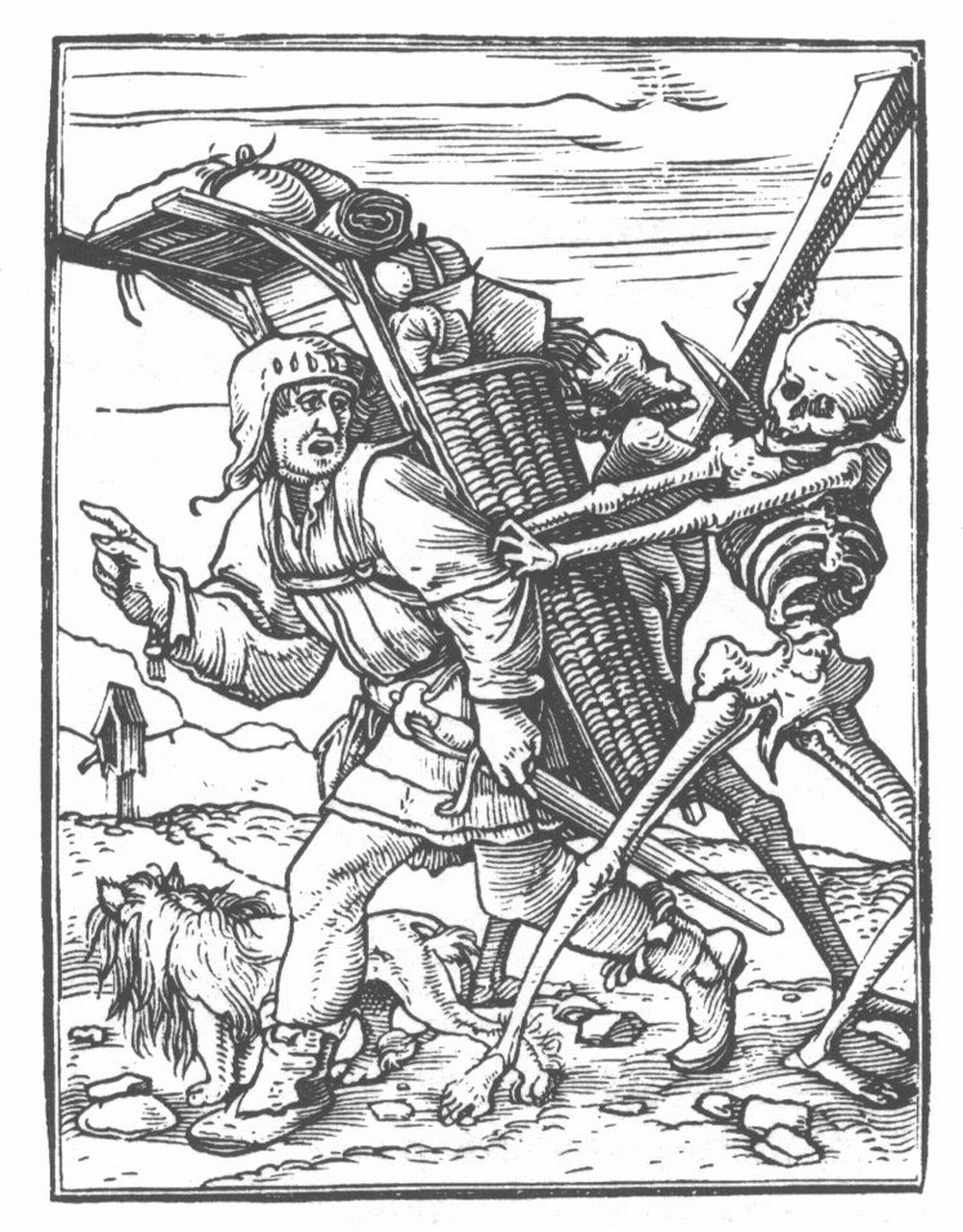
Hans Holbein, woodcut from the "Dance of Death" series (1549)

Hans Holbein, woodcut from the “Dance of Death” series (1549)

Within it all, one question: How do we spend our time before we don’t have any more time? That’s Death above, jumping out on a medieval bro.

In Pascal’s writing this often leads to the problem of boredom. We get bored easily. This anxiety bubbles inside his ruminations on classical authors, political power, Scripture, paganism, wine drinking (the gist: moderation), aesthetics, labor, sports, Montaigne, social ritual, spiritual hierarchies, and other human pastimes. Why would any of us be bored? For him, only the contemplation of God’s love would scratch the itch; for many of you general readers, I suspect, such faith is no longer something to grasp, even though we’ve still got all the itching—in forms like boredom—to which Christianity is one response.

Here are some choice bits arranged at random, in the spirit of the Pensées. Like a true #failedintellectual, I’ve cited them by page and fragment number in the Oxford English translation; slashes indicate paragraph-ish breaks within the fragments. You’ll find it all downright modern. Pascal would have understood iPhones and Twitter.

Man’s condition: Inconstancy, boredom, anxiety (10, his italics).

I have often said that man’s unhappiness springs from one thing alone, his incapacity to stay quietly in one room. [. . .] That is why we like noise and activity so much. That is why imprisonment is such a horrific punishment. That is why the pleasure of being alone is incomprehensible. That is, in fact, the main joy of the condition of kingship, because people are constantly trying to amuse kings and provide them with all sorts of distraction.—The king is surrounded by people whose only thought is to entertain him and prevent him from thinking about himself. King though he may be, he is unhappy if he thinks about it (11).

The feeling of the inauthenticity of present pleasures and our ignorance of the emptiness of absent pleasures causes inconstancy (12).

The whole of life goes on like this. We seek repose by battling against difficulties, and once they are overcome, repose becomes unbearable because of the boredom it engenders. We have to get away from it, and beg for commotion. We think about either our present afflictions or our future ones. Even when we think we are protected on every side, boredom with its own authority does not shrink from appearing from the heart’s depths, where it has its roots, to poison the mind (13).

It is not good to be too free. / It is not good to have everything necessary (14).

We are so unhappy that we can only take pleasure in something on condition that we should be allowed to become angry if it goes wrong (15).

It is unfair that anyone should be devoted to me, although it can happen with pleasure, and freely. I should mislead those in whom I quickened this feeling, because I am no one’s ultimate end, and cannot satisfy them. Am I not near death? So the object of their attachment will die (16).

When we read too quickly or too slowly we understand nothing (17).

Descartes useless and uncertain (18).

Anybody who does not see the vanity of the world is very vain himself. / And so who does not see it, apart from the young who are preoccupied with bustle, distractions, and plans for the future? / But take away their distractions and you will see them wither from boredom. / Then they feel their hollowness without understanding it, because it is indeed depressing to be in a state of unbearable sadness as soon as you are reduced to contemplating yourself, and without distraction from doing so (19).

Man’s greatness lies in his capacity to recognize his wretchedness. A tree does not recognize its own wretchedness. So it is wretched to know one is wretched, but there is greatness in the knowledge of one’s wretchedness (20).

The parrot’s beak, which it wipes even though it is clean (21).

Paul Valéry thought that most texts are never finished, only abandoned. Since you can extend this to the unwritten work of most lives, I’m with Pascal: “I blame equally those who decide to praise man, those who blame him, and those who want to be diverted. I can only approve those who search in anguish” (22). This life thing does bewilder you sometimes, provoking all sorts of bootless cries. “Who put me here? On whose orders and on whose decision have this place and this time been allotted to me?” (23).

Notes
1. Letters of Wallace Stevens, ed. Holly Stevens (Berkeley: University of California Press, 1966), p. 636.
2. For what it’s worth, your critic considers much of Stevens’s corpus a lyric parody of philosophical discourse, one meant to tantalize readers of a certain bent with the notion that a poem contains a quantum of Meaning that can be deracinated and subjected to interpretation.
3. Letters of Wallace Stevens, 251.
4. Blaise Pascal, Pensées and Other Writings, ed. Anthony Levi, trans. Honor Levi (Oxford and New York: Oxford UP, 1995, 2008).
5. That is, if it’s good fragmentary stuff. Not something like Rev. Casaubon’s “Key to All Mythologies” project in Middlemarch. Everyone hated Casaubon.
6. As Robert Frost claims in “The Figure a Poem Makes,” scholars and poets both “work from knowledge,” but whereas “scholars get theirs with conscientious thoroughness along projected lines of logic,” poets “stick to nothing deliberately, but let what will stick to them like burrs where they walk in the fields.” Excellent point. See “The Figure a Poem Makes” (1939), in Selected Prose of Robert Frost, eds. Hyde Cox and Edward Connery Lathem (New York: Collier, 1968), 20.
7. Coleridge: Selected Poetry and Prose, ed. Elisabeth Schneider (New York: Holt, Rinehart and Winston, 1951), 464. It’s true, my home library’s Coleridge is a paperback from 1951. What? You gotta economize.
8. Ibid., 476-477.
9. One can do the same with George Herbert’s poetry and Graham Greene’s novels.
10. Pensées, pp. 36-37, fragment 146. Pascal’s italics.
11. pp. 44-45, frag. 168.
12. p. 107, frag. 107.
13. p. 46, frag. 168.
14. p. 22, frag. 90.
15. p. 22, frag. 89.
16.  p. 7, frag. 15.
17. p. 16, frag. 75.
18. p. 105, frag. 445.
19. p. 16, frag. 70.
20. pp. 36-37, frag. 146.
21. p. 35, frag. 139.
22. p. 8, frag. 24.
23. p. 26, frag. 102.

What You Write When You Teach Writing

Within my institution’s* hierarchy, I’m a Lecturer, which means that I’m a full-time faculty member who just teaches. (Teaches writing, in my case.) This is expressed in my material surroundings (e.g., I always share an office with at least one another PhD), just as it is existentially codified within most academic disciplines, including English, which I used to call home and now avoid for reasons I’d be happy to tell anyone about over a drink or five. That is, if you manage to get onto the tenure track, your teaching performance has little to no bearing on whether or not you advance from Assistant Professor to tenured Associate Professor, or from Associate to the magic Full, or earn raises after that. In fact, “too much” focus on undergraduates will often hurt one’s tenure case. And if you’re trying to get into the TT hunger games in the first place, it is a disadvantage to have spent most of your professional time on instruction as an adjunct, teaching fellow, Visiting Assistant Professor, one-year appointment (that’s me), instructor, or whatever name your employer bestows upon various types of contingent brain labor, because that means you had less time to spend doing Very Important Scholarship. Search committees frown quietly upon PhDs who aren’t “focused on” or “serious about” their research profiles.

As a rhetorical motif, “publish or perish” is beyond stale (and nobody reads most scholarship anyway), but it remains the law of the Titanic’s deck.

In the years before the post-employment economy I might have hung around to make Professor, but now I go by “Dr. Boyd” when I’m on campus hangin’ with the kids, since I would rather students not call me “Professor,” because their tuition isn’t being spent on many professors, just stadiums and bougainvillea. Besides, schools aren’t paying the actual tenure-stream profs much either. And the situation is much worse for adjuncts who must jerry-build a financial existence out of abusive part-time contracts. At least my job includes health insurance.

There are three problems with that “just teaches” paradigm. First, it is not a good idea to implicitly or explicitly wedge “just” in front of anything about teaching. A sizable portion of humanity’s next half-century is sitting in a classroom somewhere right now. Second, the professional life of every lecturer I know includes heavy labor outside of the classroom. We’re all writers—some scholarly, others nonacademic, others doing a mix. Third, teaching is intellectually and emotionally exhausting work, especially if you teach classes that involve lots of writing, and especially if, like many contingent faculty, you teach introductory/freshman/first-year/lower-division/[pick your adjective] Writing. No “just” about that noise.

If you are a competent teacher in my field, you make students write a great deal in class and out. You force them to plan their work, produce rough drafts, explore multi-tiered revision strategies, then submit the polished versions of their work. Repeat as necessary.

This means that an instructor produces a Pleistocene flood of words, too. There is no other way to form productive, sustained connections with students. Conferences and office-hours chats are helpful, but writing instruction ultimately consists of multiple exchanges of written text.

Exhausting work for anyone who tries it, but particularly enervating for writers. I am not kidding when I estimate that 75-90% of my potential daily writing energy goes into work for my classes, most but hardly all of it spent in providing detailed feedback on my students’ writing. At the university where I work, lecturers teach eight courses—most of them fully enrolled at 25 students or very close to that—over the school year, which is divided into three ten-week terms. (Every lecturer gets two terms that each comprise 3 classes, or about 65-75 students total, and another “light” term that usually works out to 45-50 young scholars.) If you take on summer courses, which most of the lecturers I know do, because the Department of Education wants loan payments every month, you work with 25-50 more students during even slimmer academic time frames.

Think about the slog of reading this entails. Writers are heavy readers: without a routine intake of colorful language, of other writers’s work, one’s skills decline. Your ear gets out of practice.

Teaching entails a laborious form of reading. You are working with apprentices, many of them bright and eager. But they tend to do what apprentices do: Mess up while they’re developing. A teacher encounters much prose that is peppered with, and sometimes wholly devoted to, muddy phrasing, clichés, solecisms, unexamined opinions, and harried appeals to such repositories of knowledge as About.com and Wikipedia, even when the writer is ultimately working towards something smart and engaging. This doesn’t mean that students are dumb, it means they are apprentices. That’s how education works. With her limited time, a comp teacher does what she can to introduce them to complex, effective rhetorical practices and revision habits.

And when you’ve hauled your parched, scratched brain through twenty or thirty or sixty papers by writers who are mostly in their late teens or early twenties, then composed thoughtful responses (because that is your job), you aren’t much in the mood to read Roberto Bolaño or Harper’s. Ironically, the skills that make an effective writing teacher are depleted by teaching writing effectively.

This is one reason that schools need to commit to smaller classes and humane courseloads for faculty. Burnout happens too quickly otherwise. This in turn degrades the quality of instruction that undergraduates receive, no matter how dedicated an individual teacher is. Would you rather have your root canal done by a dentist who has worked on four patients already that day, or a dozen?

I do not mean to suggest that faculty from other disciplines don’t work as hard as writing teachers. Check out this depressing time-use study from Boise State if you want to see how much labor the academic life entails. Further, this is part of a bigger trend in the United States: American workers are expending more energy for less money in order to help their employers become more profitable, because, hey, the free market figures things out. I just happen to know my field and its demands best. Academics or not, most of us owe our souls to the company store, as the man says.

So I’ve got this list here. I’ve tried to catalog every type of teaching-oriented writing I could think of. The list does not include “service” work (the quasi-administrative duties of faculty) or anything having to do with a teacher’s writing life outside of class.

  • Paper feedback. The big gorilla. For example, part of my current courseload includes two sections of introductory writing, or a total of 48 students. Rather than marking heavily on a text itself, I prefer to respond to student work with typed end comments in the form of a brief letter. On a five-page assignment in an intro class, I typically write 250-300 words of feedback. So, thinking conservatively, that’s 250 words x 48 papers, or 12,000 words. In the ten-week structure of the course, I do this three or four times. That’s at least 36,000 words for part of my job. In an upper-division seminar (I also have one of those every term), my end-comments consist on average of 400-600 words on at least two major assignments, sometimes three. Oh, and all of this had better be grammatical, readable prose.
  • Every message written to keep the class as a whole updated about whatever.
  • Every e-mail written in response to various queries from individual students. Profs, you know how abundant those are, especially when an assignment is coming due. Content aside, these e-mail responses serve as models of professional, clear prose.
  • Like all of the lecturers in my program, I draft my own curricular materials: all the syllabi, assignment prompts (which can run multiple pages for complicated assignments), peer-review worksheets, reading-question guides, rubrics, and a plethora of other documents on everything from comma splices to strategies for writing a conclusion. One typically revises these materials every time one teaches; sometimes you end up completely overhauling them, because that’s part of one’s professional growth. You learn from what worked, or didn’t work, in previous iterations of a course.
  • All messages and posts to the course website. All descriptions and copyright information for visual materials posted to the site (e.g., a YouTube interview with an author or a series of photos from a magazine).
  • Recommendation letters. So many! Especially in the spring, when everybody is scrambling for jobs, internships, grad-school apps, and what not. It takes hours to draft a helpful recommendation letter.
  • Run into any plagiarism? Get ready to spend hours documenting and writing up the case before you pass it on to the relevant authorities.
  • Various e-mails to associated instructors and staff, such as the wonderful librarians who introduce my students to the library’s research tools and archives.
  • Any bibliographic information for the photocopies assembled into a course reader. (I don’t use textbooks.) The Table of Contents for each reader.
  • Students will often ask for advice about things like personal statements for scholarship applications. I try to help if the student has been a committed member of whatever class they took with me. So I write some more comments.
  • Compiling and maintaining Excel spreadsheets for grades. These often include notes-to-self about particular assignment grades.
  • Request forms (often surprisingly detailed) for computer-lab space, library orientations, guest speakers, reader printings from the copy shop, book orders if you do those. For upper-div seminars, I might include some books along with the reader.
  • Notes on assigned readings. You have to read or re-read whatever you make the students dig through.
  • Class plans. I write mine by hand on a legal pad.
  • Texts, e-mails, and Tweets to other teachers, complaining about work. Blog posts about work.

Hey, writing teachers. Hey, you chalkboard vets. What did I miss? Let me know and I will add it to the catalog of toil.

*Note: At the time I wrote this, I was working at the University of California, Santa Barbara.

Big Weekend Beats: Tom Waits is “Big in Japan”

Big things poppin’ over the weekend, y’all, but for now here is a song, “Big in Japan,” from one of my favorite Tom Waits albums, Mule Variations (1999). Just an awesome basket of songs. I’ve become a bigger fan of Waits’s albums from the 1980s, but this one introduced me to his music in high school. Thanks, 120 Minutes.

Perhaps the title nods to Bach’s Goldberg Variations, or Glenn Gould’s version of those. Probably, right?  Dunno. I’m not going to Google it. I’m going to pretend that these are still the pristine pre-Internet years, the years when print ruled, and just send you over to YouTube:

I love me a text with rhetorical patterns, even obsessive ones. Have a good weekend.

Weekend Links: Stocks, Bonds, America on Loan

The weekend just pulled into your driveway. Let’s eeease the seat back, as the man says. Here are some links to help you be as intelligent and dynamic as you can be, however chill things might get between now and Sunday. Call us whenever you want.

  • When he wasn’t curating his open-necked-shirt game, economist Thomas Piketty was writing what sounds like a mind-bending study of wealth stratification in the West since the late 1700s. You should buy Capital in the Twenty-First Century book right now, dear reader, as these two reviews (John Cassidy in the New Yorker and Paul Krugman for the NY Review of Books) advise; but don’t try to use Amazon, because it is sold out there. Harvard UP’s Belknap label is scrambling to print more. Let’s hope their scrappy operation can pull through! In the meantime, ruminate on the fact that a work of academic scholarship that is still in hardcover sold this much this fast (it was released only five weeks ago). You can also download the homie’s Technical Appendix for free if you want to wade into some Excel spreadsheets, wizard-math modeling, deep-cover historical footnotes, and other academic flora.
  • America, meet yourself. Sarah Kendzior has written a cool-eyed but harrowing narrative (“The Minimum Wage Worker Strikes Back”) on the efforts of Midwestern fast-food employees to organize for a living wage. Built almost lyrically around the accounts of individual witnesses, this ethnography of labor will remind you that economic collapses are usually also moral catastrophes. Millionaire stockholders and billionaire capital managers exist thanks to workers who, thanks to millionaires and billionaires, don’t make enough to buy a bus pass. If the United States really were an Enlightenment democracy, if the twenty-first century hadn’t become a grim rewind of the late 1800s, Kendzior wouldn’t have needed to write anything. Her work here is so bracing, I don’t mind that the title’s phrasal adjective is missing a hyphen. (Should be “Minimum-Wage,” unless it’s a very subtle pun. I know, I’m a pedant.) Read SK’s work wherever you can—Al Jazeera America publishes a lot of it—because she’s fantastic. Her Twitter feed is also lively. Oh, and she has a PhD in anthropology. Amazing how those useless degrees turn out to be useful.
  • Welfare for humans, bad! Welfare for corporations, very good! (But keep it quiet.) WalMart is on food stamps, y’all, and the company is just about the only food-stamp recipient who deserves your scorn. Add this to your purple-rage-inducing knowledge that ExxonMobil gets federal subsidies and Apple stashes money in Irish shell companies and et fucking cetera.
  • Science is finally catching up with literature: Research published last October in Science indicates that “literary” reading (basically, immersion in fictional narratives that compel aesthetic and philosophical attention while also entertaining the reader) makes you better at recognizing that other people are autonomous subjects, not merely actors in your personal movie. Humanists have been making this argument for centuries. In a recent essay titled “Why Fiction Does It Better,” Lisa Zunshine (whose scholarship draws on narrative art as well as neuroscience) updates the case. No doubt President Obama will mention this in his UC Irvine commencement address.
  • Working within the Population Dynamics Research Group at USC, Dowell Myers and Joel Pitkin have assembled a fascinating report with a deeply academic title, “The Generational Future of Los Angeles: Projections to 2030 and Comparisons to Recent Decades.” Partial preview: The city’s population is not growing quickly, far fewer immigrants are arriving anymore (contra paleocons like Pat “CULTURE WAR MEXIFORNIA” Buchanan), and we need to spend smarter on our educational infrastructure immediately. Angelenos, I promise the report is quite readable, so read it.
  • More on John Keats, language wonder, in the coming weeks; for now, here is a poom by Emily Dickinson—for my money, the purest practitioner of lyric in English not named Shakespeare. The odd punctuation, syntax, and capitalization is all hers. Snakes in a backyard!

A narrow Fellow in the Grass
Occasionally rides –
You may have met him? Did you not
His notice instant is –

The Grass divides as with a Comb –
A spotted Shaft is seen,
And then it closes at your Feet
And opens further on –

He likes a Boggy Acre –
A Floor too cool for Corn –
But when a Boy and Barefoot
I more than once at Noon

Have passed I thought a Whip Lash
Unbraiding in the Sun
When stooping to secure it
It wrinkled And was gone –

Several of Nature’s People
I know and they know me
I feel for them a transport
Of Cordiality

But never met this Fellow
Attended or alone
Without a tighter Breathing
And Zero at the Bone.

James Tate, Bourgeois Surrealist (A Decent Thing to Be)

Poetry based on neo-surrealist free association, homespun absurdities, televisual appetites, and a twitchy sense of humor (much of it written in a voice that, on a rhetorical level, describes impossible scenes with great clarity) isn’t for every reader—just the ones with good taste.

Hey everyone, allow me to introduce James Tate, if you haven’t already made his acquaintance. Tate published his first book of poems in 1967, when the slightly older John Ashbery was developing his own eccentric vocabulary, and with plausible reason the two poets are often compared. Tate’s poems are leaner than Ashbery’s, however. This is a compliment. Whereas even in his best years (before the late 80s) Ashbery dabbled in torturous syntax and ironic maunderings with no payoff (not even nihilistic humor), Tate is handy with short lines, stand-up-comic weirdness, and a narrative (kinda) sensibility based on image-to-image jumps. Sometimes the stanzas can be downright spindly, in a Kay Ryan or Donald Justice sort of way.

An aesthetic like this can easily degenerate into rote, tedious auto-Dada. (You put a thing beside another thing it doesn’t usually go beside, then brandished an unexpected cognitive reaction. Human minds are weird, modernity is cheap, got it. And no need to conclude!) Tate has written some bad poems; but as Auden pointed out when the Paris Review interviewed him, so has every poet.

Tate isn’t a collage artist, but he does love junk and abundance. You might call it Bricolage Wave. His strongest work exploits the material vocabulary of the mid-century United States, dicing up its cynical romanticism and physical paraphernalia (motorcycles, eyeliner, confetti, cigarettes, motels, telephones, advertising puns, litter, bureaucracies). The poems are salads. Many are comic with an edge of menace. For texts that generally disdain rhythmic regularity, their forms often exhibit a fine grasp of written music. They challenge one’s attempts at interpretation while still drawing upon a reservoir of culture literacy and demanding that the reader be familiar with this.

This is all to say, Tate is worth reading. If you like Seinfeld and Tom Waits (or Action Bronson), you will enjoy him. Here is “On the Subject of Doctors,” part of the collection Viper Jazz (1976), which sounds like a Steely Dan album. The final seven lines in particular show Tate’s talent for low-key rhythms and half-humor. Keep it uneasy, yeah?

I like to see doctors cough.
What kind of human being
would grab all your money
just when you’re down?
I’m not saying they enjoy this:
“Sorry, Mr. Rodriguez, that’s it,
no hope! You might as well
hand over your wallet.” Hell no,
they’d rather be playing golf
and swapping jokes about our feet.

Some of them smoke marijuana
and are alcoholics, and their moral
turpitude is famous: who gets to see
most sex organs in the world? Not
poets. With the hours they keep
they need drugs more than anyone.
Germ city, there’s no hope
looking down those fire-engine throats.
They’re bound to get sick themselves
sometime; and I happen to be there
myself in a high fever
taking my plastic medicine seriously
with the doctors, who are dying.

Monday Beats: Straight Outta Gainesville

Tom Petty is a man. A man who draws deep water on this website. A man from Florida who made an album. An album that came out 25 years ago, when Tom Petty himself was a robust 39.* An album called Full Moon Fever. An album that you would almost certainly enjoy, general readers.

Having been a teenager during the mid- to late-1990s stage of Petty’s fame, when MTV and M2 (long since renamed MTV2) were still actually curating videos by famous and sub-famous musicians alike, I got a heavy dose of the strange, intermittently brilliant visual complements to the Petty singles that were all over the radio, and kind of still are, if you limit your definition of “radio” to classic-rock stations in large American cities.

This video, for example, is fantastic. It gives you plenty of smirking, lowbrow meta-textuality, and besides Petty doing his stoned-Mad-Hatter thing at the front and back ends, you get the elaborate hair of Jeff Lynne and George Harrison, complex shirts all around, and Ringo Starr looking like a blind Muppet (I’ve been told this final association only makes sense to me). The camera goes all sorts of places, y’all. Fun. As a visual text it befits “I Won’t Back Down,” my favorite of the album’s ten songs (when my favorite isn’t “The Apartment Song” or “Yer So Bad”), all of which are near-perfect articulations of transatlantic (but still distinctly American) garage-pop.

Tom Petty with his flimsy hair and that dry suggestion of a twang, what a mensch. A man without a home country, having adopted LA after escaping north Florida, his audience is getting older. That’s a shame. Many people in their teens and 20s would dig Full Moon Fever. I bumped it in my Camry when I was seventeen; my dad and I both liked it. In aesthetic terms, its cover is pure bedroom-poster material. Young people, you need not relinquish your skateboards and body sprays to embrace Tom Petty!

The opening riff of “I Won’t Back Down” slices and lingers, establishing a basic sadness that persists beneath the song’s general catchiness and collaborative ethos. The lyrics, rigged as urgent couplets and more spacious choruses, mirror this tension. Like Petty’s incomparable voice they seem resigned to being optimistic.

NOTES
* The 3/31 “Hollywood Prospectus” podcast on Grantland drew the date to my attention. I am indifferent to large swaths of the pop-culture landscape that Andy Greenwald and Chris Ryan have taken as their bailiwick, but they are thoughtful dudes, and they spend the last twenty minutes of this episode talking about why Tom Petty’s music is amazing.


Weekend Beats: Five Years from Now

As various histories of hip-hop are written over the next few decades, Mike Jones (whose Wikipedia page is worth preserving mainly because it is so badly written) may not go down as a gimmick, but he will be a minor figure. The Houston MC’s goofy, monotonous flow is forgettable, and his fondness for rapping about pre-wealth difficulties with women and blurting his actual phone number into tracks doesn’t make him seem very cool either. The best work he ever did was carried along by Slim Thug’s grumbling presence and got even better when Diplo (whose work was surfacing nationally in 2004/2005) took hold of it for a remix to which, unfortunately, I can’t legally construct a link.

But like Mike Jones would say, MIKE JONES! MIKE JONES! Dude left me with several songs I keep on the iPod for exercise, including this 2005 single, “5 Years From Now,” which features a vanished background singer named Lil’ Bran. Affable and earnest, Jones’s flow on the track tip-toes a simple beat with tidy couplets; my favorite part starts around 2:50, when the keyboards disappear, the beat seems to hitch, and MJ contemplates fatherhood, prison, mortality, and fame.

I don’t mean “favorite” ironically. Even if Jones is a mid-2000s half-paragraph, this track is fun, kind-hearted, and urgent, which aren’t the worst qualities in the world.

The Commencement Speech Obama Should Give, But Probably Won’t

In a rearguard action titled Not for Profit: Why Democracy Needs the Humanities, Martha Nussbaum contends that a humanist education helps one learn to “judge political leaders critically, but with an informed and realistic sense of the possibilities available to them” (26). This critical radar isn’t the province of history and philosophy alone, either. One can develop the capacity for simultaneous skepticism and empathy by reading literature, and I don’t just mean texts like Julius Caesar or All the King’s Men, whose plots entail overtly political entanglements. Witnessing the psychological, sexual, and then legal bind that Dmitri Karamazov gets himself into will also give you a vivid sense of how “making the Right Choice” is sometimes impossible.

Last week, UC Irvine announced that Barack Obama would give this June’s commencement speech. UCI estimates that the logistical complexity of a presidential visit will add around $1 million to the event’s costs; and if you live in northern Orange County, have fun with your weekend driving! That said, I admit that it is pretty cool to get the President for your graduation ceremony instead of some actor or a retired senator.

But if you have spent much time on the General Reader, you know that the editors do not support Mr. Obama’s education policies, particularly his administration’s daft conception of how higher learning (i.e. College) works in theory or in American historical practice. You can read some of our grumblings here and here and here and here.

To be fair, President Obama inherited an education system that, from the pre-K level up to graduate programs, has been terribly damaged by the same forces that are eating away at our whole democracy. His administration didn’t create the preference of state legislatures for spending more on prisons than schools and food stamps; or the metastasis of a sumptuously compensated managerial class that isn’t very good at managing; or the cynical neoliberal reliance on part-time contract labor; or the strange popular faith that a form of magic called Technology will solve all forms of human suffering and lack; or the indifference of citizens who would rather be babysat by their screens than read anything about how their nation operates, because, hey, Candy Crush; or the shifting of financial risks and burdens onto individuals (like the students who acquire debt that will accrue interest at more than twice the Fed prime rate); or the creepy, spreading belief—nourished by a scum-tide of corporate money—that since radically defunded public institutions have a hard time functioning, then we must privatize them and trust that the market will take care of us.

Further, Mr. Obama has had to confront the hysterical wreckage of the Republican Party, an “opposition” that is little more than a proudly irrational mob with an awesome media team. When your opponents’ reaction to literally everything you say or do is UMMDURRRR NAW NO WAY BADMAN, it is difficult to accomplish much. In many respects all the President can do is talk intelligently and patiently.

Luckily, commencements are all about talking. Most speakers go in for pious abstractions about The Value of an Education/Hard Work/Economic Competitiveness. Is it too much to ask that Obama, a man lauded for his eloquence, reject the standard rhetorical fare? After all, most of the the students he is addressing voted for him.

A President’s capacity to persuade the public is limited; if the bully pulpit were still bully, then the Affordable Care Act would have a 90% approval rating and we’d be taxing carbon. But were Mr. Obama to start speaking honestly and in concrete terms about why American higher ed is such a mess, surely the debate over what to do will grow at least slightly more intelligent. His rhetorical support alone would make more room for education reformers who are actually teachers and students, not standardized-testing corporations, textbook publishers, Silicon Valley tech pimps, cornball privateers, or New York Times columnists.

With that in mind, here are some notes to help the President draft his speech. Mr. Obama, if you need more advice, hit me up on Twitter.

  • Since you are speaking at a branch of the greatest public-university system ever built, tell us about the people and ideologies threatening to destroy it. Instead of merely scolding colleges and universities for their tuition rates, you could call out the state legislatures that have spent forty years abdicating their commitment to citizens and thereby driving up those rates. The UC’s present woes did not result from geological forces that nobody could resist; they are the result of actual decisions made by actual people under the influence of a privatization fetish that remains ascendant in the United States. As such these decisions and people can be countered by other decisions and other people who aren’t so dim. Treating “fiscal crises” and “budget cuts” like tectonic shift does nothing but disguise existing problems and create new ones. Just be honest.
  • Many of the students you are addressing have taken on tens of thousands of dollars in debt to pay for their education. The people in the audience who just finished their PhDs? Oh, they have debt, too. This is a great time to demonstrate that you have the stones to support Elizabeth Warren’s proposition that we cut student-loan interest rates in half. And if you really want to show us some Change we can Believe in, announce that you would like to see all student loans become interest-free. People who earned BAs and graduate degrees want to pay off their debts, but artificially elevated interest rates make it hard to do so, especially for those of us who did what you are always asking young people to do, and went into public service. Just be honest.
  • Explain how a return to robust public funding of state universities would ensure that any student able to handle college-level brain work can get an education as good as the ones you and the First Lady received at Columbia, Princeton, and Harvard. It is fine that you attended private school, but you should commit to ensuring that the public/private distinction has nothing to do with baseline educational quality. Just be honest.
  • Smaller classes, smaller classes, smaller classes. Also, smaller classes. This is what works. You know that, having been educated in small classes at excellent schools. You will send your daughters to colleges that prize small classes. Schools that do not rely primarily on courses with fewer than 25 students should be ranked low on whatever national ratings scale ends up emerging from your recent proposal. No exceptions. Just be honest.
  • You are speaking to an audience from a university that, like almost all American universities, relies heavily on teachers who have little job security. This is bad for the teachers (duh) and their students. Even intimate seminars cannot accomplish much if they are not taught by people who have advanced degrees in their subjects and the material security to develop their pedagogical skills. For the millionth damn time: We cannot depend on adjuncts. America cannot educate its children using temps, no matter how good the temps are; and we are very good. Schools that do not primarily employ full-time, tenure-track teachers should be ranked low on whatever national ratings scale ends up emerging from your recent proposal.  (As with the bullet point above, a model based on this commitment has already been formulated by Robert Samuels, who teaches in the UC and leads its biggest faculty union. You could totally call him up.) No exceptions. Just be honest.
  • Point out that American schools spend too much money on amenities like sports programs (especially basketball and football programs) and elegant dorms. These financial habits are killing them. Yeah, I had fun filling out my NCAA bracket, too. But if colleges are cheating and stupefying their students by offering them new fitness centers so they won’t care too much about taking classes in overcrowded, crumbling rooms, then fuck our brackets. Just be honest.
  • Remind the administrators in attendance that “retention” targets and quantitative enrollment goals can never be more important than maintaining (or re-establishing) academic rigor. If college classes are not demanding, if they do not ask their participants to read, think, and write a great deal, then GPAs swell up while intellects languish. This hobbles a democracy. Just be honest.
  • You should praise UC upper-management for recently (finally) signing a humane labor deal with the union that represents the system’s poorest employees, and emphasize that income inequality, which you have declared “the defining challenge of our time,” will only lessen if we encourage new unionization and support existing labor groups. For fuck’s sake, don’t crow about trade deals, stock markets, or mortgage-based tax breaks that mainly help rich people. Just be honest.
  • Don’t say anything about T/technology. Everyone knows T/technology, whatever it is, is great. Half the audience is texting right now. T/technology can go an hour without being petted. Just be honest.
  • You don’t need to tell the audience about how education helps people get jobs. They know. Since kindergarten most of the graduating seniors have heard about little besides the instrumental value of a degree. In fact, by now too many of them see the past four or five years as job training that involved parties but had damn well better to lead to a healthy bank balance, end of story. Why don’t you take the time to broach other topics, like the Jeffersonian business about education preparing the entire self to be a reflective citizen? Not too much, mind you, because you must avoid windy abstractions, especially when a sizable chunk of your audience is hungover, but if you keep it short, reminding your listeners that college does more than equip a person to earn money couldn’t hurt. History classes, pianos, poetry readings, overheated front-stoop squabbles over politics, and art museums really aren’t that bad. Just be honest.
  • OK, so maybe you leave the granular, street-by-street humanities-defending to people like Martha Nussbaum. (I know you dislike art history, until you don’t dislike it because disliking it makes people dislike you.) Perhaps you could talk about a larger cognitive practice, one that facilitates individual growth as well as aggregate material expansion in a post-industrial economy where organizations must be able to articulate, exchange, and evaluate complex ideas. I don’t mean science and math, which, like most politicians, you frequently commend. (As you should, because science and math are beautiful.) I mean that other support-beam of civilization: writing. Mr. President, your facility with language is the basis of your success. Were it not for that keynote address you gave at the 2004 Democratic Convention, you aren’t President in 2014; if the English language, a glory when handled with love and concentration, did not suffuse your entire being, you wouldn’t have been able to write that speech in the first place. Science, math, and writing (and its twin, reading) are meaningless without one another. But rarely does a public figure speak up for writing. Maybe you could. Tell the people how you got here. Just be honest.

Mr. Obama, you are one of the most articulate, cerebral men who has ever held the White House. Your presidency provides some evidence that mass democracy doesn’t always reward scoundrels and grifters. So come June, walk onto the stage in Anaheim and tell the people some concrete, grown-up truths.

Just be honest. A democratic nation that gives up on its public schools is no longer a democracy, or even a nation.