Topical Verse: Doing Justice

One of the ironic benefits of a lengthy education in a language’s literature (English in this blog’s two editorial cases) and its attendant scholarship is that you become skeptical of narratives and theories that purport to comprehensively explain any of that literature’s constituent parts, let alone the whole thing. Your bullshit radar gets good at spotting what Kingsley Amis calls “Victorian system building.”

If you ever took an English-lit survey in college, you probably encountered the magisterial Norton anthologies. I don’t use that adjective ironically: those books really are the best undergraduate-level anthologies ever assembled. You can carry a decent chunk of civilization’s accomplishments under your arm. Sorry, Longman, Heath, and other anthologies, but it’s true. (Although the Heath texts did help demonstrate what the supposedly conservative Norton has long since embraced, which is the idea that texts by “minority” writers are often not minor).

Problem is, an anthology has to simplify things a lot, because it is hard to cover all the ins and outs of English in a single volume. For example, according to your author’s much-thumbed and -beloved household Norton Anthology of Modern Poetry, American poetry has two founding magicians, Walt Whitman and Emily Dickinson. This is true, to an extent. Nobody in America had written anything that sounded remotely like Leaves of Grass before New York’s original bohemian perv showed up, and there is still nothing like Dickinson’s extraterrestrial hymns.

But things get more complicated from there. Despite the attempts of some critics to map Whitman onto William Carlos Williams (the vernacular, Jacksonian, quotidian voice); or to draw a line from Dickinson to Wallace Stevens (the aristocratic, post-symbolist, bizarro-metaphysical lyric tone); or to demonstrate that Dickinson is to Elizabeth Bishop as Whitman is to Allen Ginsberg, what Philip Larkin says about painters is true. (Grad students planning to write a dissertation which systematizes everything so brilliantly that a school hurls a tenure-track job at you, take note, then quit grad school immediately.) For Larkin, “each painter represents an exhaustion of a particular way of seeing things.” If visual art constitutes “heightened seeing,” he contends in this 1947 letter, then “Poetry = heightened talking.”

This doesn’t mean that the Romantic myth of the genius who has nothing to learn from anyone is true. Only creeps like Percy Shelley and Kanye West believe that. Rather, great artists are singularities, but within patterns, within contexts, within historical communities. They are both radical and traditionalist. Their language of experience is an intensified mutation of some other rather large group’s or groups’ language of experience.

Here I come to one of my favorite poets, Donald Justice. Homie often gets pegged as one of Stevens’s heirs, because his poems frequently read like dream-logic parodies of symbolist puzzles, but his work is also plainspoken. His voice might remind you of Raymond Carver, the Spoon River Anthology, and Whitman. Justice’s best poetry is situationally intelligible: in other words, you can generally tell what the basic set-up is (“OK, guy is looking at some flowers and remembering childhood”), which makes it easier to enjoy yourself. Much love to T.S. Eliot, but it doesn’t always have to be difficult. His heightened talking still sounds like regular talking. His poems could be scenes from novels.

Anyway, here is “The Telephone Number of the Muse” (1973):

Sleepily, the muse to me: “Let us be friends.
Good friends, but only friends. You understand.”
And yawned. And kissed, for the last time, my ear.
Who earlier, weeping at my touch, had whispered:
“I loved you once.” And: “No, I don’t love him.
Not after everything he did.” Later,
Rebuttoning her nightgown with my help:
“Sorry, I just have no desire, it seems.”
Sighing: “For you, I mean.” Long silence. Then:
“You always were so serious.” At which
I smiled, darkly. And that was how I came
To sleep beside, not with her; without dreams.

I call her up sometimes, long distance now.
And she still knows my voice, but I can hear,
Beyond the music of her phonograph,
The laughter of the young men with their keys.

I have the number written down somewhere.

Tales From the Industrial University

Adam Weinstein posted a gripping essay on Deadspin today. The title is sort of clunky (“Jameis Winston Isn’t [t]he Only Problem Here: An FSU Teacher’s Lament”), but it does encapsulate Weinstein’s main idea, which is that upper-echelon “college” football, as institutionally structured in the contemporary United States, does terrible things to colleges, especially to student-athletes and the people who teach them.

We love football, and we really love winning, and while we might be pseudo-intellectuals who idolize tweedy, critical theory-spouting professors, we hate it when they denigrate the game’s presence on campus. We want to do right by these players. One of mine was from a sugarfield shantytown best known as the AIDS capital of the state. I hope he never goes back. “You’re like, ‘Fucking A, man, this is awesome,'” my co-worker Derek says of teaching big-name players. “You’re part mentor and part fanboy.” (The names of the FSU instructors in this story have been changed to protect their identities and the identities of their students.)

But we’re increasingly flummoxed by the football culture surrounding Tallahassee, one that’s grown malignant with the wins and the scrutiny, like a traditional Islamic country turned radical and defensive, its craziest pilgrims whirling around Doak Campbell Stadium, the black cube at the center of their Mecca. It’s a culture that tells these adolescents that their highest calling is to sacrifice their bodies in the grassy shrine, that all else is distraction. It’s the same culture that’s now undergoing paroxysms of wild paranoia to spin Benghazi- and Trayvon-style conspiracy theories that might explain these obviously baseless allegations against Jameis Winston, the teenager whose prophetic power can reduce old white men to joyful sobbing.

As a football fan who teaches college, I found Weinstein’s narrative chilling, though not very surprising.

I should note that my experience teaching NCAA athletes has been much different, although granted I teach at a school that doesn’t have a football program and isn’t particularly sports-crazy despite being generally obsessed with fitness. The athletes whom I’ve taught have displayed the same wide range of talent, civility, interests, and work ethic as the overall student population; often I don’t even realize who plays sports. That is probably a good thing.

OOPS, Sorry!

Having proselytized aggressively and lucratively for privatized online education (as it were), California supergenius and headset aficionado Sebastian Thrun is now engaged in a quietly massive rhetorical walking-back of those efforts. In one respect, good on him: It would be gratifying to see Wall Street execs do the same now that the Great Recession is limping off into the distance. On the other hand, the way bigger hand, Thrun’s maneuver is infuriatingly meek and selfish. As Rebecca Schuman, fan-object of this blog, points out on Slate, his position boils down to: My shitty product was shitty mainly because its potential consumers were shitty, not because it was a shambling, pointless, greedy waste of human capital. Seriously now, just look at the photo atop the Fast Company story. As many a person on many a bar stool would say, Fuckin’ guy . . . .

Still, if nothing else, the hyperlink wormhole which ensued after I read Schuman’s piece led me to Tech In Translation, which turns out to be the witty, sane work of Amanda Krauss, whom you might know from her former blog-incarnation as Worst Professor Ever, which she wrote after telling the Classics department at Vanderbilt, where she was on the tenure track, to go fuck itself.

Anyway, back to waiting to see how Dr. Thrun gets that horse back into the barn.

Saturday Links

Ayo, readers. Here are some weekend texts to keep you cozy during each November day’s 26 hours of darkness. (Or, if you live in the Southern Hemisphere, to give you something to read on your phone so you don’t have to interact with other people.)

  • From The Economist, a brief piece on America’s repulsive penchant for mandatory minimums and life-without-parole for nonviolent offenders. Being TE, the bosom publication of neoliberal trans-Atlantic “moderates,” they have to screw it up by pasting “none too bright” onto “typically poor” when describing inmate demographics, and by pivoting (in fewer than ten words) from acknowledging that the best available estimates indicate that two-thirds of nonviolent lifers are black (ninety-one percent in Louisiana!) to assuring readers that “the problem with the system is not racial bias; applying such draconian, hope-crushing sentences to non-violent offenders of any race is cruel and pointless.” This is like saying that the problem with Stalin wasn’t so much that he butchered and enslaved millions of Soviet subjects, but that killing/enslaving anyone is evil. The fact that the second part is true doesn’t somehow invalidate the first, dear editors of major publication.
  • The branch of the UAW that represents UC graduate students recently released a report titled “Towards Mediocrity: Administrative Mismanagement and the Decline of UC Education.” Read ‘er here. It points out plenty of things this blog has underscored in its own little way: that holding impersonal classes in decaying buildings is bad for the UC; that not investing in teachers and researchers (especially younger ones) is bad for the UC; that going whole-hog for privatized online classes which are demonstrably expensive and shitty is bad for the UC; that reducing the amount of intellectual and material support for low-income students is bad for the UC (and the US); that well-compensated administrators, like UC Irvine’s chief medical officer, do not need quiet little (massive) bonuses, like said CMO’s $73,000 moving-expenses stipend. (Was dude moving to Argentina?) No doubt this report will do nothing to change the situation that inspired it. But hey, the President gave a speech.
  • Labor conditions got you down? Lucky for us, many episodes of The Muppet Show (1976-1981) are on YouTube. Here is the episode where Johnny Cash was the guest. Fair warning, though, if you don’t have a sense of humor or grasp of irony: At one point JC performs with a Confederate flag in the background while Gonzo rides a bronco in the fore.
  • This early half-gem of David Foster Wallace’s is being sold at Urban Outfitters now. Seems like an odd marketing move, considering that among the 200 or so undergraduates whom I have forced to read essays of his, precisely threeas a DFW fanboy I remember the numberhad even heard of the man, let alone read anything he wrote. I am actually hoping that UO knows their target demo and is onto something wonderful. Like, maybe copies of Infinite Jest will be piled next to deep-Vs and cheap boat shoes. Could happen.
  • Now in the Grantland stable, Wesley Morris is my favorite film critic. Like DFW, Morris wields a sophisticated, erudite critical vocabulary when talking about American culture, including some of its trashier prongs, without being self-conscious about the performance. Read some stuff here (at his first home, the Boston Globe), here, or here. A sample sentence, from a review of Spring Breakers: “What [director Harmony] Korine does with the beer-soaked skin, face-devouring makeouts, and piles and piles of barely dressed people is intensify the college-party atmosphere in a way that feels simultaneously orgasmic and repulsive.” He hyphenated the phrasal adjectives! Even though I’m straight, I’m swooning.
  • I live in California, and these short days will only shorten for the next few months. Winter’s coming. So here is Karl Shapiro’s “California Winter,” a wonderful elongated lyric. Don’t worry if you don’t live in California, unless you believe that only English people should read Dickens.

Long-Weekend Beats

History first: Chrissie Hynde is publicly OK with Rush Limbaugh featuring this Veterans Day weekend’s amazing song prominently (and for years!) on his hate-talk show. She went through some real casuistry to get there, but she still got there. That is gross, because the republic has enough problems without a xenophobic cyst like Rush, and good music is always in relatively short supply. (Fact: as a nerdy and eager pre-teen, I purchased and [twice] read RL’s seminal release See, I Told You So, thanks to lobbying from older relatives, but I have since made peace with that.)

Yet as a snob like me has to constantly remind himself, art doesn’t belong to anyone. That is why the Romantics could so intentionally misread Paradise Lost and decide that Lucifer was a hero and good guy after all; that is why the twentieth century’s most important poem, T.S. Eliot’s “The Waste Land,” so carefully appropriates and distorts the West’s detritus; that is how chains of theft can clear pasture for genius (cf. the Stones & Zeppelin/the blues, The Ramones/British punk, Greek sculpture/Apple’s matte products); and unfortunately that is how somebody like the aforementioned demagogue can share tastes with you, me, and all manner of progressives who like “vinyl,” coffee made in French presses, and Lou Reed.

But whatever. Just listen, maybe comment, then click back out into the Internet.

Seriously, isn’t this track fantastic? Are you not moving a hip or two? That bassline is in the empyrean with cuts like “Another One Bites the Dust” and “Hypnotize.” It is a thick existential burden, a rich man’s text. Go forth and prosper, y’all.

Monday Links

  • Your humble editors were lucky to have some good teachers in graduate school. One of them, Stephanie LeMenager, is about to publish her second book, Living Oil: Petroleum Culture in the American Century. If you’d like to see an example of weight and erudition merged with readability, consider it. I am looking your way, university libraries.
  • Britain’s perfectly OK version (I kid, I kid) of the New York Times, the Guardian, recently posted a good 15-minute interview with David Simon, who created The Wire. It complements his role in a 2012 documentary on the drug war, The House I Live In.
  • Thomas Frank has a poignant, righteous essay in The Baffler. It is about US higher education. It is reality-centric. It anticipates what will become a significant literary posture over the next decade: melancholy shame at how we all, but especially the Baby Boomers, constitute one big benumbed “generation that stood by gawking while a handful of parasites and billionaires smashed it for their own benefit,” “it” being the incredible public-university system America put together in the mid-twentieth century with the goal of sustaining a vibrant middle class. Which the system did. For a while. A vibrant middle class being the basis of political and cultural modernity. Then billionaires.
  • Big Ghost is one of the web’s best music critics. I hope his gritty urban slang and frequent aversion to commas don’t upset my progressive white friends. (Hi, almost every reader!) Here is BG’s viciously profane, incisive reading of a Drake album.
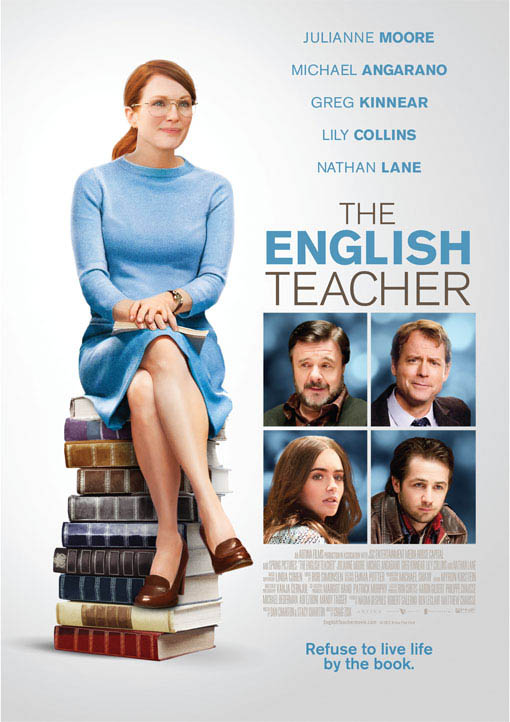
  • Finally there is this, a thing existing on the Internet, a movie poster for something called The English Teacher, which apparently earned Julianne Moore a paycheck to spend on a new villa in Monaco. The movie looks lame and forgettable. Further, it is childish to get riled up over a movie. Nonetheless, for some reason the expression on Greg Kinnear’s face makes me want to throw a TV through a wall. He looks like he’s doing a George-Bush-during-press-conferences face. I am going to venture out onto a metaphorical limb here and guess that this film is a nominally literate cornball dipshit’s idea (to use the proper academic terminology) of what teaching consists in. The English Teacher (TET) loves leatherbound books so much that she sits on them. No time for chairs! She’s got students to inspire. And you know she’s smart, because she’s wearing glasses.

Insurance-Ad News: Halloween Edition

Advertisements for a cut-rate auto-insurance company, The General, have been floating around California television (especially sports programming) for at least a half-decade. The similarity between their name/web address combo and our name/web address combo is problematic, given that by all appearances The General is a scam run by a Malaysian crime syndicate with contacts in the shitty-animation world, or perhaps a time capsule from the 1990s, or a student film shot on a repurposed porn set. What it actually seems to be, going by their website, is a regional insurance company that only has offices in Louisiana despite being chartered in Nashville, and which for some reason puts their creepy, cheap commercials on South Coast television.

Why the penguin? Why does he serve the little brother of George Patton and Yosemite Sam with such purpose? He’s almost as bad as this guy.