Topical Verse: Memorial Day

I didn’t advertise the last bit of verse I put up because I didn’t want to appear to be capitalizing on events in Isla Vista which, as we gather details about the killer and his plans, become all the more horrific. I invite you to go back and read the Bukowski poem though, as I think it has something important to tell us about how our culture teaches us to think about being alone, loneliness (which is different), and self-worth.

Today’s small bit of verse I will advertise though, as I think its message is one we should spend time thinking about on this particular Memorial Day. Published sixteen years before Eisenhower’s famous and totally prescient warning about the “military-industrial complex,” Randall Jarrell’s “The Death of the Ball Turret Gunner” is often one of the shortest poems in anthologies of American verse, but it is surely one of the most accurate descriptions of how the state can instrumentalize people in order to maintain its power (both over the people themselves, and over other states).

“The Death of the Ball Turret Gunner” 

From my mother’s sleep I fell into the State, 
And I hunched in its belly till my wet fur froze. 
Six miles from earth, loosed from its dream of life, 
I woke to black flak and the nightmare fighters. 
When I died they washed me out of the turret with a hose.

That’s the whole poem. Its lines aren’t symmetrical, yet it has balance: the awakening from the dream is preceded by two lines about a person, and is followed by two lines about the hard fact that, in the eyes of the “State,” this person isn’t an individual, but rather canon fodder, a substance to be cleaned up, like the foam leftover from a used up fire extinguisher, when it has served its purpose. We get an entire life-cycle in five lines. The key is Jarrell’s implication that the State sees it as its prerogative to wake us, its weapons of war, from the “dream of life” so that we may fulfill our purpose: dying for the State. If you can read this poem and not think about the current VA scandal, you probably haven’t heard of the current VA scandal.

Like many people, my late grandfather served during World War II. He was captured by the Nazis at the Battle of the Bulge, and was sent to a prison camp. He stayed alive until the camp was liberated, but even then he had to make his way back across hostile territory largely on his own. He rarely talked about the war, but often had nightmares that I can’t even begin to imagine. In the last weeks of his life, when he was dying of cancer, the VA treated him with dignity and great care. As it should have. Jarrell’s poem isn’t a condemnation of those who fight in wars, nor is it even a blanket condemnation of war itself. Sometimes it is necessary. But if the state is going to send people off to die, sometimes in the name of folly and hubris, the least it can do is treat those who come home, battered inside and out, as something more than inconveniences. It should treat them all the way it treated my grandfather. If it can’t do that, then something really is rotten in the state of Denmark.

Isla Vista

I’m sure both Ryan and I will have more to say about the act of cowardly terrorism committed in Isla Vista last night. UCSB is where both of us got our PhDs, learned how to teach, got to work with many wonderful students, and established our (nascent) professional careers after finishing our dissertations. It’s also where I met many inspiring mentors and colleagues, Ryan foremost among them. And it’s why I’m engaged to a woman from a little town in the south of England. UCSB was my twenties. So instead of just spewing all the anger and sadness I have right now, I’ll sit on it for a little while, at least until I have something (if anything) more rational to say. Instead, I’d like to offer up a poem that’s been on my mind all day. Charles Bukowski’s “Oh Yes” is the last footnote in my dissertation about American bachelors, and it’s one all young people need to read, but probably don’t have the experience to understand. And I guess that’s the point, but damn…

“Oh Yes”

there are worse things than
being alone
but it often takes decades
to realize this
and most often
when you do
it’s too late
and there’s nothing worse
than
too late.

-Charles Bukowski

Early Summer Reading

My grades have been in for a little over two weeks now. I’ve yet to get a complaint from a student about said grades, so I think it might be safe to call it: summer is here. Now, I realize that for everyone not working in education, summer is just a hotter version of the rest of the year. Maybe there are more weekend cookouts. Maybe more white wine is uncorked. Maybe there’s a pilgrimage to some family homestead. But, dammit, even if you don’t get a real summer (and the truth is that most people working in education don’t really have that much time off either, what with summer teaching, course prep, and assorted kinds of career development), there’s a chance that on a warm summer afternoon, you might find yourself with a little time to read. The following are some suggestions for how to fill that time, though we will have more throughout the summer.

  • Let’s just get this one out of the way first. If you’ve yet to read Ta-Nehisi Coates’ massive Atlantic article “The Case for Reparations,” you should carve out about an hour and do so. Coates is acknowledged, even by many of his conservative critics, as a great writer. His blog posts and articles about the Civil War, his trip to France, and being a black man in America are always worth reading. Like many writers, his blog posts can be messy, but they’re always lucid, and his longform, and I’d assume more stringently edited pieces, are good examples of what I wish more academics would produce. That is to say, I wish academics, many of whom allegedly study narrative and rhetoric, would spend less time theorizing, and more time time telling compelling stories about the world as it was, is, and could be. When it comes down to it, glossing Foucault doesn’t do what Coates does in the passage below. The tenure system’s perverse relationship with academic publishing is part of what will eventually be the undoing of many colleges and universities. The places that survive will do so because they understand that teaching and public scholarship, like Coates’ work and that of Yunte Huang (notice that he lists “writer” first), are more important than impenetrable “studies” that no one reads.

When Clyde Ross was still a child, Mississippi authorities claimed his father owed $3,000 in back taxes. The elder Ross could not read. He did not have a lawyer. He did not know anyone at the local courthouse. He could not expect the police to be impartial. Effectively, the Ross family had no way to contest the claim and no protection under the law. The authorities seized the land. They seized the buggy. They took the cows, hogs, and mules. And so for the upkeep of separate but equal, the entire Ross family was reduced to sharecropping.

This was hardly unusual. In 2001, the Associated Press published a three-part investigation into the theft of black-owned land stretching back to the antebellum period. The series documented some 406 victims and 24,000 acres of land valued at tens of millions of dollars. The land was taken through means ranging from legal chicanery to terrorism. “Some of the land taken from black families has become a country club in Virginia,” the AP reported, as well as “oil fields in Mississippi” and “a baseball spring training facility in Florida.”

  • If you’re in the mood for something a little shorter, Dennis Romero at the LA Weekly just nails why people in Los Angeles should sneer at the culture in San Francisco (and not the other way around). Having grown up in the Bay Area, it’s pretty appalling to see what’s happened to the place. Silicon Valley has become synonymous with a utopian mindset that makes me glad it was people like Axl Rose taking buses out to LA instead of people like Eric Schmidt. When people in San Francisco are done “disrupting” the world, they should consider the following, per Romero:

It’s the Bay that has become a parody of smug white privilege… The preachiness of a McMansion-dwelling Westsider telling you to conserve energy will never be as annoying as some Silicon Valley trust-funder telling you he’s going to change the world when you know all he really wants to do is change his wallet. One is trying. One is lying. 

  • The New York Review of Books is always on its game, but I especially love when it produces a little gem of an article about something I previously knew almost nothing about. It does this all the time, mostly because, like most people I really don’t know all that much. So you shouldn’t be surprised to hear that my familiarity with the life of John Quincy Adams, our sixth president and the grandfather of one of America’s weirdest intellectuals, was, uh, lacking. Thanks to Susan Dunn, I now know that JQ Adams had a frustrating marriage, hated slavery, was addicted to politics, knew both Washington and Lincoln, was mocked for lobbying for better education and scientific research, and was a total dick to his children. As Ryan and I like to say, “In America!”
  • Finally, this isn’t strictly a reading recommendation, but a film about a voracious reader and writer seems like an appropriate substitute (famous last words…) Plimpton!, the latest American Masters biopic is  about, wait for it, George Plimpton, the longtime editor of The Paris Review and “participatory journalist” who famously tried his hand at many different glamorous professions, mostly within the sporting world. He turned these experiences into big pieces for Sports Illustrated, and sometimes later into books. He also wrote light novels, showed up in movies, and had his own falconry video game for ColecoVision (yes, this was a real thing). But I think Plimpton was most important as a curator of an American literary culture that took itself seriously, but also knew how to have a good time. One that wasn’t so political, whiny, and boring. One that didn’t give two shits about MFA programs or “critical theory.” One that would have laughed at “trigger warnings” (thanks, UCSB) and “splaining.” Oh, I know, he was a rich kid who basically just didn’t screw up his life, but I really don’t care. The guy loved writers and writing in a way that most people (including many writers) don’t, so that earns him a lot of points in my book.


Put Me In, Coach, or I’ll Hire Another Coach

In the cover story from last month’s Harper’s, Genevieve Smith tries to make sense of the recent American craze for “life coaches” and other personal-brand/-fulfillment/-identity consultants. Like most everything in Harper’s, it is crisply written. It is also fair. Smith acknowledges that it is easy to mock the idea of a Life Coach (hence coaches now tend to omit the “life”), and she is deeply skeptical of the industry’s premise, viewing it as creepy neoliberal monetization of the acts and values that constitute friendship (empathy, trust, candor, patience). She encounters people who rhapsodize about “producing transformation” and are not kidding.

But Smith admits that life-coaching underscores a reality worth remembering: “our problems are mostly the same,” though they materialize in different forms in different lives and communities.

We are unhappy at work, or if we’re happy at work, we’re working too much and missing exercise or our hobbies or time with our kids. Our parents are sick or dying, or not sick but their minds are going, or at least they’re driving us crazy. Or if not our parents, then our spouses, our friends, our children. We feel disconnected from the ones we love. We feel listless and uninspired. We never followed our passions. We know we’d be happier if we ate right, if we meditated, if we called our mothers, but we don’t. We never do.

Of course, anybody who reads literature, watches films, or listens to music could have told you that. And theoretically at least, the world’s major religions are responses to that shared suffering. Leave it to Americans to look for solace in a transaction that is mainly intended to transform a rudderless client into a more efficient, effective free-agent knowledge worker in a market where secure employment is getting scarce.

Coaches are sort of like teachers (experienced teachers could do this motivational shit in their sleep), and their clients are somewhat comparable to students, in the sense that they are studying something, even if the content is usually delivered as cloudy bromides about Improvement, Actualization, and Motivation, and given physical form in corny group exercises where participants act out their hidden powers or whatever. In one scene, actual grown-ups pretend to inhabit roles like Egyptian queens, surfer-dude Rebels, and fireworks (?). An MBA bro even does a cartwheel.

But the coaching-oriented strain of education entails—indeed centers upon—a monetary transaction. I pay you to coach me, and if I dislike how you coach, you are fired. And that’s fine! That is how capitalism works.

Things can quickly get parlous for the coaches. Many of them work for large consulting companies. In one chilling passage, a group becomes disillusioned with their leader’s techniques. This particular self-bolstering activity that I don’t really get—something Moby-Dickish about embracing the Inner Captain—irritates the clients, so they begin “organizing” their complaints against the instructor, first via e-mail, then personal confrontation. The coach fails to placate them by emphasizing that this is how his program works and that they should be patient. Next time the group meets, they have a new instructor. No more stuff about boats and captains. Like the previous coach, the replacement coach works for the Coaches Training Institute, the final word in whose name is presumably intended to make the firm sound like some kind of not-for-profit, quasi-humanitarian venture.

Again, what happened to the first coach is OK as long as we are talking about an enterprise where a good or service is being exchanged for money. If I dislike your restaurant’s burritos, I’m free to never buy them, or to bitch on Yelp about how the guacamole sucks.

Trouble is, the USA has spent the past few decades clumsily applying this consumer model to most of our colleges and universities. Students and their parents are encouraged to see education as a private good purchased to make a person more employable, and once a student stops conceiving of education as an opportunity to work diligently under the challenging guidance of well-trained experts in multiple disciplines and instead treats it like a commodity transaction, the purchase of a credential bearing a school’s name, fundamentally the same as buying a burrito or a Honda, then the entire project collapses. If getting a bachelor’s degree is like ordering at Chipotle, then it is difficult to convince the tuition-payer (or more likely, student-loan debtor) that handing over money is just the first step, that now the buyer gets to write a lot, read widely, study gobs of difficult math and science, and be evaluated according to rigorous standards developed by people with PhDs. That the degree itself is not the point—the liberal education for which it stands is. It may be exasperating for professors, and a misunderstanding of how institutional accounting works, but the “I pay your salary, so hand me that A” narrative is understandable. I need an A on my burrito.

Now that the majority of American professors have scant job security— like that suddenly unpopular life coach, adjuncts can easily be let go by their employers for the feeblest of reasons—it is difficult to contest this narrative. While this is not the case at every school in the country, it is true of the majority, particularly those that rely heavily on part-time labor. Too often, college teachers have little expectation that their bosses will back them during, say, a dispute over an “unfair” grade, so they inflate gradesreduce writing and reading requirements or soften exams, overlook plagiarism, and try to turn instruction into entertainment. This has been a disaster for higher ed. As Richard Arum and Josipa Roksa demonstrate at depressing length in their magnificent Academically Adrift (2011), which someone needs to nail to the US Department of Education’s front door, too many schools are graduating too many students with etiolated critical-thinking skills and communication abilities, which, in a terrible irony, leaves those new graduates unprepared for the global economy to which, they were promised, a college diploma is the golden key.

Education is not a burrito and teachers are not hired coaches. But many Americans, most of whom would publicly declare their respect for education and teachers, no longer understand this, or never did. Our market society, to which universities were once a partial exception, is happy to oblige them. It will not be surprising when the University of Phoenix starts allowing students to collectively fire their teachers or at least purchase alternative ones. I can see this policy catching on elsewhere, too.

Lazy Sunday Beats and Links

Oh, hey. General Reader here. These are some texts we liked reading that you would probably also like to read. There are things to listen to as well. Enjoy them on this lovely Mother’s Day.

  • For many pundits, Barack Obama’s refusal to ignore the electorate and get the USA involved in reputation-killing trillion-dollar military disasters is a sign of weakness. As John Cassidy observes at the New Yorker, this line of criticism ignores the arrogance and waste of the Bush regime: Obama is only a foreign-policy bungler if you think that the Iraq War went well and that things will work out in Afghanistan somehow. Otherwise the President is a realist who operates according to historical precedent and geopolitical fact, not foolish proclamations about shocking and awing our way around the world. Obama has, remarks Cassidy, remembered his Machiavelli—it is strength, not weakness, to avoid fights that can, at best, end in Pyrrhic victories (and at worst, end in Iraq).
  • We all need Shakespeare. I know that he often suffers the Gatsby fate: assigned so much in English courses that people end up thinking he’s perfunctory and boring, “classic” mainly through cultural inertia or pedagogical convention. “Yeah, yeah, Hamlet is great, got it”—most educated individuals acknowledge that he’s Very Important and thus, ironically, end up not reading him beyond school. Which is a shame, because as with The Great Gatsby, most of Shakespeare’s work (not Coriolanus, oh god not Coriolanus) is shockingly beautiful and repays multiple readings. Go ahead. Open up Hamlet or Macbeth or the Sonnets or A Midsummer Night’s Dream, flip to a random page, and experience one of those “Holy shit, how did a human being think to say it that way?” moments Shakespeare provokes. You’ll never get to the end of his wonders. With that in mind, here is one of my favorite sonnets, #29:

When in disgrace with fortune and men’s eyes,
I all alone beweep my outcast state,
And trouble deaf heaven with my bootless cries,
And look upon myself and curse my fate,
Wishing me like to one more rich in hope,
Featured like him, like him with friends possessed,
Desiring this man’s art and that man’s scope,
With what I most enjoy contented least;
Yet in these thoughts myself almost despising,
Haply I think on thee, and then my state,
Like to the lark at break of day arising
From sullen earth, sings hymns at heaven’s gate;
For thy sweet love remembered such wealth brings
That then I scorn to change my state with kings.

  • Hey, parents and students, here is the narrative that will bond you with contingent faculty in the fight to save higher education: The adjunct system exploits teachers and wastes your money, because your tuition dollars end up going mostly to redundant deans and resplendent landscaping, not undergraduate education. Susan McNamara, a professor in Boston, has written a bang-up explanation of this for the Globe. (Plus the professor in the article image is wearing jeans and a navy blazer, which I can totally get behind.) Read it now.
  • Some tenured and tenure-track professors have long been part of the effort to improve the working conditions of adjuncts (and thus the learning conditions of students), and many more have recently climbed aboard. Some of the staunchest labor allies I’ve met are tenured full professors in the University of California. But in the UK and the US, too many TT faculty have been complicit in the forty-year ascension of a managerial class that now controls most colleges and universities despite having little experience or interest in education. Some faculty saw a way to profit, in terms of money and/or prestige, from neoliberal “reforms” that weakened the professoriate as a whole; too many others stood idle while this happened. Like I said, if they haven’t already, most TT profs are coming around to a more enlightened, pro-labor view of things, but Tarak Barkawi (himself a tenured scholar) implores us to remember our institutional past in order to salvage the future. Power has many ways to recruit relatively powerless enablers. Barkawi’s editorial focuses on the UK, but its lesson is transatlantic.
  • My friend Jarret, who has introduced me to probably 60-65% of the music I love, played Arthur Russell for me about ten years ago while we were chillin’ in a post-college basement, and I’ve been a fan since. Russell was a classically trained cellist, and during his largely unremunerative career as a musician and producer in New York, he worked with Philip Glass, Allen Ginsberg, and David Byrne, among others. An enormous influence on fellow artists, he died broke, of AIDS, in 1992, leaving behind a lot of fragmentary or uncollected work. One of my favorite pieces, “A Little Lost,” is a spacey, droned-out, heartbreaking composition where Russell’s voice and lyrics blend with the shuffling strings, forming a sonic component of the track as much as a rhetorical accompaniment. It’s about love. Also death, I think. Songs usually are. Enjoy.
  • When you stare into the douche abyss, the abyss stares back. When it comes to cultural matters this pressing, yes, I will link to Buzzfeed. Just don’t look directly into Billy Ray Cyrus.
  • Allen Iverson was so cool. If I had a time machine, I’d zip back to 2001, kidnap dude, bring him back to 2014, and turn him loose on the NBA. Reminding us that sports are not just about the games, Jay Caspian Kang examines the continuing role of AI’s famous arm sleeve in his overall cultural cachet.

Fragments of Pascal’s Fragments: On the “Pensées”

In one of his letters, Wallace Stevens claims, “I have never studied systematic philosophy and should be bored to death at the mere thought of doing so” (1).  He admits dipping into a “little philosophy” sometimes—no “serious contact . . . because I have not the memory”—”in the spirit” of a friend who had renounced studied, interpretive reading in favor of “read[ing] it as a substitute for fiction,” as though Locke and Nietzsche were vagrant storytellers (2).

That is probably a useful way for poets to approach any discourse that systematizes, abstracts, or otherwise tries to theorize the mess of lived experience into some conceptual framework. Poets are into a different kind of human record-keeping. Whatever philosophizing they do is only one part of a congeries of effects: sound, syntax, image, rhythm, form, metaphor, allusion, association, narrative, intuition, characterization. Philosophy is salt in the soup, too much and it tastes wretched. “I am sorry that a poem . . . has to contain any ideas at all,” Stevens apologized elsewhere, “because its sole purpose is to fill the mind with the images & sounds it contains. A mind that examines such a poem for its prose contents gets absolutely nothing from it” (3).

Most philosophy bores the shit out of me. Or rather, while the practice of philosophy is great, I dislike most of the texts I encountered in classrooms. This is shameful and lazy, I know. I tried my best in college, taking seminars on Eighteenth-Century Empiricism, and again during graduate school, where I pretended to care about the philosophers and theorists I was then reading. I still enjoy Plato (from what I recall) on matters of the soul; Nietzsche can be funny, and J.S. Mill is tidy; cribbing from George Scialabba’s essays is a pleasure; and I can definitely get behind indeterminate weirdos like Gaston Bachelard. Oh, and Blaise Pascal. Love Pascal.

The Pensées were not published during Pascal’s life (1623-1662). He didn’t even leave a title, because there was no book yet, only a mass of lapidary fragments, some comprising a few paragraphs, many just a sentence or two. Some are probably close to the form they would have been published in. Many are rougher. But Pascal was a fine prose stylist and a mensch, so they’re all engaging. After his death, friends and family assembled the material into what is essentially the text we have today. I use the Oxford paperback translation, the introduction to which will tell you more than I can (4).

I like fragmentary texts (5). The preference probably has something to do with my disorganized poet brain (6). More importantly though, such works seem true to what life is actually like. This resonance becomes even stronger when a text is literally unfinished, fragmentary because of some event in the writer’s life (usually his death). Walter Benjamin’s Arcades Project, meant to be a unified theory of modern life but scuttled when the Nazis drove him to suicide, is an example. You could throw in some classical Greek or Roman poets if you want to talk lost texts.

Texts can also be fragmented—or at least rhetorically, aesthetically, and philosophically jumbled—by design or genre convention. Think of shaggy dogs like Tristram Shandy, Gothic encyclopedias in the vein of Moby-Dick, total jumbos like Bleak House, a book about paper and bureaucracy. Writers’ journals are great, too: Pepys, Kafka, Woolf, Boswell (an Enlightenment satyr with radar for strong drink), Cheever, Plath (more stuff about cookbooks and good housekeeping than you’d imagine). Jules Renard: man, that guy is awesome. Many letter collections rock, particularly the letters of poets—get Lord Byron’s when you can. Then there is table talk and other types of recorded conversation, such as Faulkner in the University. Plus epigrams like Martial’s.

Samuel Coleridge wins the fragment gold medal. Not only did he leave behind unfinished poems, unfinished lectures, unfinished letters, an unfinished critical behemoth (the Biographia Literaria), and sterling table talk (“Examine nature accurately, but write from recollection; and trust more to your imagination than to your memory” [7]), he also kept a notebook of midnight hashings: “What a swarm of thoughts and feelings, endlessly minute fragments, and, as it were, representations of all preceding and embryos of all future thought, lie compact in any one moment! . . . and yet the whole a means to nothing—ends everywhere, and yet an end nowhere” (8).

Anyway, where was I. The Pensées. It is/they are fantastic. You can wander for hours in this thing. You might set it aside for months, only to open it at random when the urge strikes, and it probably will. Reading a bit of Pascal leads to more Pascal. He intended this material to be a religious treatise, but its humanism is of such breadth and warmth that you can set the Christian apparatus aside, or at least make it share space with other approaches (9).

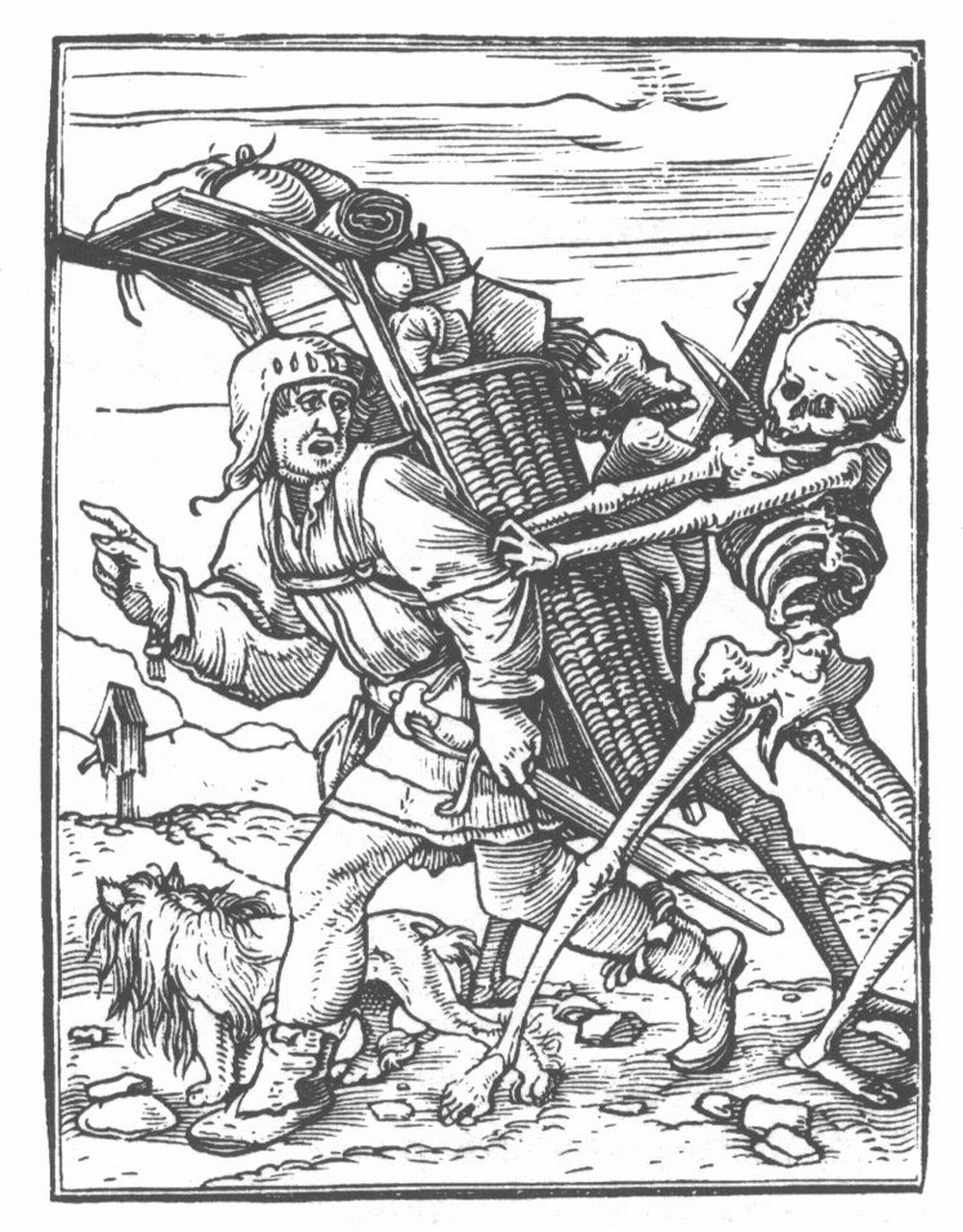
Hans Holbein, woodcut from the "Dance of Death" series (1549)

Hans Holbein, woodcut from the “Dance of Death” series (1549)

Within it all, one question: How do we spend our time before we don’t have any more time? That’s Death above, jumping out on a medieval bro.

In Pascal’s writing this often leads to the problem of boredom. We get bored easily. This anxiety bubbles inside his ruminations on classical authors, political power, Scripture, paganism, wine drinking (the gist: moderation), aesthetics, labor, sports, Montaigne, social ritual, spiritual hierarchies, and other human pastimes. Why would any of us be bored? For him, only the contemplation of God’s love would scratch the itch; for many of you general readers, I suspect, such faith is no longer something to grasp, even though we’ve still got all the itching—in forms like boredom—to which Christianity is one response.

Here are some choice bits arranged at random, in the spirit of the Pensées. Like a true #failedintellectual, I’ve cited them by page and fragment number in the Oxford English translation; slashes indicate paragraph-ish breaks within the fragments. You’ll find it all downright modern. Pascal would have understood iPhones and Twitter.

Man’s condition: Inconstancy, boredom, anxiety (10, his italics).

I have often said that man’s unhappiness springs from one thing alone, his incapacity to stay quietly in one room. [. . .] That is why we like noise and activity so much. That is why imprisonment is such a horrific punishment. That is why the pleasure of being alone is incomprehensible. That is, in fact, the main joy of the condition of kingship, because people are constantly trying to amuse kings and provide them with all sorts of distraction.—The king is surrounded by people whose only thought is to entertain him and prevent him from thinking about himself. King though he may be, he is unhappy if he thinks about it (11).

The feeling of the inauthenticity of present pleasures and our ignorance of the emptiness of absent pleasures causes inconstancy (12).

The whole of life goes on like this. We seek repose by battling against difficulties, and once they are overcome, repose becomes unbearable because of the boredom it engenders. We have to get away from it, and beg for commotion. We think about either our present afflictions or our future ones. Even when we think we are protected on every side, boredom with its own authority does not shrink from appearing from the heart’s depths, where it has its roots, to poison the mind (13).

It is not good to be too free. / It is not good to have everything necessary (14).

We are so unhappy that we can only take pleasure in something on condition that we should be allowed to become angry if it goes wrong (15).

It is unfair that anyone should be devoted to me, although it can happen with pleasure, and freely. I should mislead those in whom I quickened this feeling, because I am no one’s ultimate end, and cannot satisfy them. Am I not near death? So the object of their attachment will die (16).

When we read too quickly or too slowly we understand nothing (17).

Descartes useless and uncertain (18).

Anybody who does not see the vanity of the world is very vain himself. / And so who does not see it, apart from the young who are preoccupied with bustle, distractions, and plans for the future? / But take away their distractions and you will see them wither from boredom. / Then they feel their hollowness without understanding it, because it is indeed depressing to be in a state of unbearable sadness as soon as you are reduced to contemplating yourself, and without distraction from doing so (19).

Man’s greatness lies in his capacity to recognize his wretchedness. A tree does not recognize its own wretchedness. So it is wretched to know one is wretched, but there is greatness in the knowledge of one’s wretchedness (20).

The parrot’s beak, which it wipes even though it is clean (21).

Paul Valéry thought that most texts are never finished, only abandoned. Since you can extend this to the unwritten work of most lives, I’m with Pascal: “I blame equally those who decide to praise man, those who blame him, and those who want to be diverted. I can only approve those who search in anguish” (22). This life thing does bewilder you sometimes, provoking all sorts of bootless cries. “Who put me here? On whose orders and on whose decision have this place and this time been allotted to me?” (23).

Notes
1. Letters of Wallace Stevens, ed. Holly Stevens (Berkeley: University of California Press, 1966), p. 636.
2. For what it’s worth, your critic considers much of Stevens’s corpus a lyric parody of philosophical discourse, one meant to tantalize readers of a certain bent with the notion that a poem contains a quantum of Meaning that can be deracinated and subjected to interpretation.
3. Letters of Wallace Stevens, 251.
4. Blaise Pascal, Pensées and Other Writings, ed. Anthony Levi, trans. Honor Levi (Oxford and New York: Oxford UP, 1995, 2008).
5. That is, if it’s good fragmentary stuff. Not something like Rev. Casaubon’s “Key to All Mythologies” project in Middlemarch. Everyone hated Casaubon.
6. As Robert Frost claims in “The Figure a Poem Makes,” scholars and poets both “work from knowledge,” but whereas “scholars get theirs with conscientious thoroughness along projected lines of logic,” poets “stick to nothing deliberately, but let what will stick to them like burrs where they walk in the fields.” Excellent point. See “The Figure a Poem Makes” (1939), in Selected Prose of Robert Frost, eds. Hyde Cox and Edward Connery Lathem (New York: Collier, 1968), 20.
7. Coleridge: Selected Poetry and Prose, ed. Elisabeth Schneider (New York: Holt, Rinehart and Winston, 1951), 464. It’s true, my home library’s Coleridge is a paperback from 1951. What? You gotta economize.
8. Ibid., 476-477.
9. One can do the same with George Herbert’s poetry and Graham Greene’s novels.
10. Pensées, pp. 36-37, fragment 146. Pascal’s italics.
11. pp. 44-45, frag. 168.
12. p. 107, frag. 107.
13. p. 46, frag. 168.
14. p. 22, frag. 90.
15. p. 22, frag. 89.
16.  p. 7, frag. 15.
17. p. 16, frag. 75.
18. p. 105, frag. 445.
19. p. 16, frag. 70.
20. pp. 36-37, frag. 146.
21. p. 35, frag. 139.
22. p. 8, frag. 24.
23. p. 26, frag. 102.
What You Write When You Teach Writing

Within my institution’s* hierarchy, I’m a Lecturer, which means that I’m a full-time faculty member who just teaches. (Teaches writing, in my case.) This is expressed in my material surroundings (e.g., I always share an office with at least one another PhD), just as it is existentially codified within most academic disciplines, including English, which I used to call home and now avoid for reasons I’d be happy to tell anyone about over a drink or five. That is, if you manage to get onto the tenure track, your teaching performance has little to no bearing on whether or not you advance from Assistant Professor to tenured Associate Professor, or from Associate to the magic Full, or earn raises after that. In fact, “too much” focus on undergraduates will often hurt one’s tenure case. And if you’re trying to get into the TT hunger games in the first place, it is a disadvantage to have spent most of your professional time on instruction as an adjunct, teaching fellow, Visiting Assistant Professor, one-year appointment (that’s me), instructor, or whatever name your employer bestows upon various types of contingent brain labor, because that means you had less time to spend doing Very Important Scholarship. Search committees frown quietly upon PhDs who aren’t “focused on” or “serious about” their research profiles.

As a rhetorical motif, “publish or perish” is beyond stale (and nobody reads most scholarship anyway), but it remains the law of the Titanic’s deck.

In the years before the post-employment economy I might have hung around to make Professor, but now I go by “Dr. Boyd” when I’m on campus hangin’ with the kids, since I would rather students not call me “Professor,” because their tuition isn’t being spent on many professors, just stadiums and bougainvillea. Besides, schools aren’t paying the actual tenure-stream profs much either. And the situation is much worse for adjuncts who must jerry-build a financial existence out of abusive part-time contracts. At least my job includes health insurance.

There are three problems with that “just teaches” paradigm. First, it is not a good idea to implicitly or explicitly wedge “just” in front of anything about teaching. A sizable portion of humanity’s next half-century is sitting in a classroom somewhere right now. Second, the professional life of every lecturer I know includes heavy labor outside of the classroom. We’re all writers—some scholarly, others nonacademic, others doing a mix. Third, teaching is intellectually and emotionally exhausting work, especially if you teach classes that involve lots of writing, and especially if, like many contingent faculty, you teach introductory/freshman/first-year/lower-division/[pick your adjective] Writing. No “just” about that noise.

If you are a competent teacher in my field, you make students write a great deal in class and out. You force them to plan their work, produce rough drafts, explore multi-tiered revision strategies, then submit the polished versions of their work. Repeat as necessary.

This means that an instructor produces a Pleistocene flood of words, too. There is no other way to form productive, sustained connections with students. Conferences and office-hours chats are helpful, but writing instruction ultimately consists of multiple exchanges of written text.

Exhausting work for anyone who tries it, but particularly enervating for writers. I am not kidding when I estimate that 75-90% of my potential daily writing energy goes into work for my classes, most but hardly all of it spent in providing detailed feedback on my students’ writing. At the university where I work, lecturers teach eight courses—most of them fully enrolled at 25 students or very close to that—over the school year, which is divided into three ten-week terms. (Every lecturer gets two terms that each comprise 3 classes, or about 65-75 students total, and another “light” term that usually works out to 45-50 young scholars.) If you take on summer courses, which most of the lecturers I know do, because the Department of Education wants loan payments every month, you work with 25-50 more students during even slimmer academic time frames.

Think about the slog of reading this entails. Writers are heavy readers: without a routine intake of colorful language, of other writers’s work, one’s skills decline. Your ear gets out of practice.

Teaching entails a laborious form of reading. You are working with apprentices, many of them bright and eager. But they tend to do what apprentices do: Mess up while they’re developing. A teacher encounters much prose that is peppered with, and sometimes wholly devoted to, muddy phrasing, clichés, solecisms, unexamined opinions, and harried appeals to such repositories of knowledge as About.com and Wikipedia, even when the writer is ultimately working towards something smart and engaging. This doesn’t mean that students are dumb, it means they are apprentices. That’s how education works. With her limited time, a comp teacher does what she can to introduce them to complex, effective rhetorical practices and revision habits.

And when you’ve hauled your parched, scratched brain through twenty or thirty or sixty papers by writers who are mostly in their late teens or early twenties, then composed thoughtful responses (because that is your job), you aren’t much in the mood to read Roberto Bolaño or Harper’s. Ironically, the skills that make an effective writing teacher are depleted by teaching writing effectively.

This is one reason that schools need to commit to smaller classes and humane courseloads for faculty. Burnout happens too quickly otherwise. This in turn degrades the quality of instruction that undergraduates receive, no matter how dedicated an individual teacher is. Would you rather have your root canal done by a dentist who has worked on four patients already that day, or a dozen?

I do not mean to suggest that faculty from other disciplines don’t work as hard as writing teachers. Check out this depressing time-use study from Boise State if you want to see how much labor the academic life entails. Further, this is part of a bigger trend in the United States: American workers are expending more energy for less money in order to help their employers become more profitable, because, hey, the free market figures things out. I just happen to know my field and its demands best. Academics or not, most of us owe our souls to the company store, as the man says.

So I’ve got this list here. I’ve tried to catalog every type of teaching-oriented writing I could think of. The list does not include “service” work (the quasi-administrative duties of faculty) or anything having to do with a teacher’s writing life outside of class.

  • Paper feedback. The big gorilla. For example, part of my current courseload includes two sections of introductory writing, or a total of 48 students. Rather than marking heavily on a text itself, I prefer to respond to student work with typed end comments in the form of a brief letter. On a five-page assignment in an intro class, I typically write 250-300 words of feedback. So, thinking conservatively, that’s 250 words x 48 papers, or 12,000 words. In the ten-week structure of the course, I do this three or four times. That’s at least 36,000 words for part of my job. In an upper-division seminar (I also have one of those every term), my end-comments consist on average of 400-600 words on at least two major assignments, sometimes three. Oh, and all of this had better be grammatical, readable prose.
  • Every message written to keep the class as a whole updated about whatever.
  • Every e-mail written in response to various queries from individual students. Profs, you know how abundant those are, especially when an assignment is coming due. Content aside, these e-mail responses serve as models of professional, clear prose.
  • Like all of the lecturers in my program, I draft my own curricular materials: all the syllabi, assignment prompts (which can run multiple pages for complicated assignments), peer-review worksheets, reading-question guides, rubrics, and a plethora of other documents on everything from comma splices to strategies for writing a conclusion. One typically revises these materials every time one teaches; sometimes you end up completely overhauling them, because that’s part of one’s professional growth. You learn from what worked, or didn’t work, in previous iterations of a course.
  • All messages and posts to the course website. All descriptions and copyright information for visual materials posted to the site (e.g., a YouTube interview with an author or a series of photos from a magazine).
  • Recommendation letters. So many! Especially in the spring, when everybody is scrambling for jobs, internships, grad-school apps, and what not. It takes hours to draft a helpful recommendation letter.
  • Run into any plagiarism? Get ready to spend hours documenting and writing up the case before you pass it on to the relevant authorities.
  • Various e-mails to associated instructors and staff, such as the wonderful librarians who introduce my students to the library’s research tools and archives.
  • Any bibliographic information for the photocopies assembled into a course reader. (I don’t use textbooks.) The Table of Contents for each reader.
  • Students will often ask for advice about things like personal statements for scholarship applications. I try to help if the student has been a committed member of whatever class they took with me. So I write some more comments.
  • Compiling and maintaining Excel spreadsheets for grades. These often include notes-to-self about particular assignment grades.
  • Request forms (often surprisingly detailed) for computer-lab space, library orientations, guest speakers, reader printings from the copy shop, book orders if you do those. For upper-div seminars, I might include some books along with the reader.
  • Notes on assigned readings. You have to read or re-read whatever you make the students dig through.
  • Class plans. I write mine by hand on a legal pad.
  • Texts, e-mails, and Tweets to other teachers, complaining about work. Blog posts about work.

Hey, writing teachers. Hey, you chalkboard vets. What did I miss? Let me know and I will add it to the catalog of toil.

*Note: At the time I wrote this, I was working at the University of California, Santa Barbara.

What’s Old Is New

A few summers back, I taught a course on representations of the “American Dream” in novels after 1980. As is the case with most summer classes taught by grad students, the syllabus was a slapdash affair dreamed up while I was finishing my dissertation and stressing about what would happen when the school cut off my funding and health insurance in a few months. So yeah, I readily concede that my reading list (Don DeLillo’s White Noise, John Rechy’s The Miraculous Day of Amalia Gomez, Chuck Palahniuk’s Survivor, and Jennifer Egan’s A Visit from the Goon Squad) wasn’t some comprehensive journey through Reaganomics, Clinton’s sexual neoliberalism, and the Bushes’, well, Bushness. It wasn’t meant to be. Mostly, I was just hoping to get some kids living exclusively in their swimsuits in Isla Vista for the summer to read a few books and to think about how we’ve all been set up in this country to have massive expectations that rarely match up with the lives we lead. I wanted them to think about how disappointment, denial, selling out, addiction, and making do are inherent in the American Dream, so that they might, to borrow a bit from Faulkner’s grandest drunk, Father Compson, “forget it now and then for a moment and not spend all of [their] breath trying to conquer it.” If literature really is, as Kenneth Burke claims, “equipment for living,” I was trying to give them some matches to burn down the houses they’ll never be able to afford anyway.

But then many of them didn’t bother to read a damn word of any of the books. So much for productive arson. There were, of course, a few kids who kept up with the reading, and I remember a couple even coming to my office hours every now and then to talk about what whether Rechy is a racist and/or a sexist (no), if they are allowed to laugh at Survivor (of course), and what DeLillo was trying to say (figure it out for yourself). I was already long past the point where I took students not reading personally. I mean, how can postmodern American literature possibly compete with this?

In the second-to-last week of the class, I had to leave town for a couple days to attend a wedding in New York. I had planned to show a movie, Richard Linklater’s Slacker, during the periods I would miss, and since it’s a little long, I anticipated being back in time to watch the end with them. The wedding was great, and my trip to New York turned out to be a memorable one when Hurricane Irene decided to strafe Manhattan and turn the place into a weird party ghost town. It was some serious I Am Legend shit walking through the deserted canyons of the city the morning after the storm. Lingering gusts would pick up the occasional chair and throw it across the street, but that seemed like a reasonable price to pay for a New York minute most would never experience. One problem: my flight back to California was cancelled. This meant that I would miss the end of the film, and given how packed the rest of the summer session would be, I figured I wouldn’t get a chance to talk to the students about how Slacker fit into the story our course syllabus was trying to tell.

Much to my surprise, my students forced the issue and demanded that we talk about the movie. Some hated it and wanted to vent. Others, though, were furious at these kids, and explained why it not only fit into the course, but was a really important movie. One girl who hadn’t said anything throughout the semester was particularly moved by the film, and said that it made her feel awful about all the time she’d wasted not trying to make art. This is exactly the kind of thing I’d hoped the novels in the course would inspire someone to say, but I wasn’t expecting that a plotless 20-year-old film about stoners, nerds, and other assorted weirdos in Austin, TX would speak to them. I put it on the syllabus because it was a movie I loved, and because I needed to show a film.

I now realize that I should have seen this coming. Students (yes, even English majors) routinely tell me that they “don’t have time to read,” and we live in an increasingly visual culture. Hell, even the respected business reporter Felix Salmon recently declared himself “post-text.” He writes:

Text has had an amazing run, online, not least because it’s easy and cheap to produce. When it comes to digital storytelling, however, the possibilities — at least if you have the kind of resources that Fusion has — are much, much greater. I want to do immersive digital stuff, I want to make animations, I want to use video, I want to experiment with new ways of communicating in a new medium. I can do all of that at Fusion.

My summer class was a few years back, but this kind of thing was already shaping my students’ minds. Text is just so boring and, well, textual. Still, I was stunned that a film as loose as Slacker made some of them think about anything other than what they might need to remember to pass my reading quizzes, which one student called “the bain (sic) of my existence” in a course evaluation. I am particularly proud of that one.

*

About a year ago, I wrote that Steven Soderbergh may go down as the most important mainstream filmmaker of his generation. I stand by this statement, but I wouldn’t be surprised if the Coens or Wes Anderson are in the conversation too. And after watching the trailer for Richard Linklater’s new film, Boyhood, I kind of wish I’d mentioned Linklater in the same breath as Soderbergh. I can’t help thinking of one and not the other. Like Soderbergh, the diversity of Linklater’s projects sets him apart from other directors. While Anderson’s films have a stylistic consistency, there isn’t a “Richard Linklater look” (other than the fact that the guy himself is in his 50s, but looks about 35). He’s made rotoscoped movies, slick Hollywood comedies, a real-time dramatic adaptation, a gonzo travel show, and, for my money, one of the best and most consistent (from film to film) trilogies ever shot. And this list doesn’t include Dazed and Confused, the best movie about high school and salmon-colored pants ever made.

Linklater’s latest film is perhaps his most experimental. Boyhood tells a simple story about a kid between the ages of six and eighteen, but it has taken twelve years to finish shooting. This isn’t due to some power struggle with a studio, as was the case with Kenneth Lonergan’s excellent movie, Margaret. No, this was by design, as the film uses the same child actor, Ellar Coltrane, throughout. Filmed for a few weeks each summer, Boyhood features Linklater’s frequent collaborator, Ethan Hawke, and Patricia Arquette as Coltrane’s divorced parents. Hawke’s role in the movie is particularly interesting, as it means he was involved in two long-term projects with Linklater, including two installments of the Before Trilogy (Before Sunset and Before Midnight) over the course of shooting Boyhood.

As the world becomes more “post-text,” Linklater may be the mainstream filmmaker best positioned to bring the virtues of the novel into film. Hollywood movies have been eschewing long takes in favor of MTV-style quick cuts (Soderbergh is the master of this) for decades now, but Linklater’s process, and his products like Waking Life and the Before Trilogy (which may get even more installments in the future) reveal a commitment to the idea that the fullness of time is integral to understanding relationships between people and ideas. Tweets and shorts are great, but the bildungsroman has been the most durable narrative form because we’re all fascinated by the idea that moments within the thousands of days we’ve lived have determined where we are, and that unknown moments will determine where we will go. The moments need context in order to resonate, and context is what Linklater depicts through dialogue, visual metaphor, and implied scope better than any director today. Watch the trailer for Boyhood to see what I mean.