Your Sunday Rage

Decaying middle-class incomesFewer and fewer jobs that pay a decent wage for hard work? Higher and higher health-insurance premiums? (Or maybe your job just disappeared altogether, along with that great HMO coverage.) Sure does suck to be you, American worker, even if you toil in a sector that is supposedly run by good-hearted Prius owners.

But hey, at least you can admire the gated communities going up on the edge of town, browse Stanford’s website (they’ll even let you take an online course), maybe cruise the Whole Foods parking lot and try to guess which shoppers buy what percentage of their grocery list there, knowing that at least a few of your betters are doing just dandy.

Here comes the LA Times to cheer you up some more. From a Sunday feature story with a somewhat euphemistic title, “The Tougher Workplace”:

Employers once wanted long-term relationships with their workers. At many companies, that’s no longer the case. Businesses are asking employees to work harder without providing the kinds of rewards, financial and psychological, that were once routine. Employers figure that if some people quit, there are plenty of others looking for jobs. […]

The workplace is even tougher for the millions of Americans who have lost the security of a steady paycheck, as companies rely more on temporary staffing agencies. Temp jobs used to be a gateway to permanent employment. Increasingly, they have become a way of life. About 25% of the workforce is temporary, according to research firm Aberdeen Group, up from 17% in 2009.

Woah, slow down, Upton Sinclair! You could take the glass-half-full angle, and see this as an economic environment where workers are given the opportunity to explore creative employment pathways they didn’t even know existed. One man’s untreated chronic illness is another man’s steroidal profits.

For more on the brave new neo-liberal paradise we’re slouching toward, check out this great new documentary.

Saturday Links

Here’s a weekend reading/viewing list for your edification and pleasure:

“Things We Do Not Say”

One of the things I’ve noticed about my writing students, especially the first- and second-years, is that most of them aren’t very good at detecting irony (e.g., recognizing that Joan Didion isn’t sentimentally extolling the virtues of the Central Valley in “Notes from a Native Daughter”) or spotting clichés. With respect to the latter solecism, they are quite good at noticing and fixing the crud in a sample paragraph that I give them after saying, “This excerpt has clichés in it that you should try to address.” But when it comes to their own writing, in-the-nick-of-times and unforgettable moments and in-today’s-societys start to slip in. This is a problem even for most of my brightest students, and many of the students I teach are very bright.

No doubt this has a lot to do with the fact that freshmen and sophomores are freshmen and sophomores. A few months ago I was digging through some old college papers that I’d stashed in my parents’ basement after I’d graduated, and most of those that I glanced over were awful. Just lame, pompous, hasty, Olympian nonsense that I tossed in the garbage. I used a lot of damn clichés–often high-minded ones, but still clichés that probably made my professors wince or laugh. (“Garcia Marquez’s political eco-narratives are truly moving works of art.” No, really, I wrote that and showed it to another adult.) When you are 19, you are an idiot, even if you do think of yourself as a Reader.

But most of my students don’t read much, just like most Americans don’t read much, just like many other cultures don’t read much. Now, I am skeptical of anybody who claims that there was some  golden age of mass reading (have a look at the literacy rates in Russia when Dostoevsky was alive, in Britain when Tennyson was humming, in the U.S. when James Joyce got onto the cover of Time). In any era, you can find intellectuals bemoaning the state of the public readership. However, you will have a hard time finding a high-school or college teacher who thinks that many of hir students are reading serious texts on the reg. (I’m willing to bet that stands even if you venture into Yale or Amherst or Reed or wherever. I went to a snooty school and it was true there.)

Effective writers read a lot. By getting what Martin Amis calls their daily diet of words, they continually develop an intuitive familiarity with the rhythms of the language they work in. There is no way to write well without reading voraciously. A brilliant charlatan who can’t be bothered to read other people might be able to present a surface gloss that is appealing in small doses (Helloooooo, Vice staffers), but non-readers don’t produce work that is worth reading a second time. Sorry. They don’t. You do not have to read Literature alone. But you have to read something besides status updates and threads on Reddit. You have to read stuff that has gone through the hands of editors and proofreaders. You have to know what pro text looks like.

So the plague of not-reading means that a lot of students are helpless when it comes to grasping and enjoying the textures of a good piece of writing that isn’t selling a product or a tidy idea or mere sensation. It means that many of them flail around in shallow, platitudinous thickets when they draft their own stuff.

But so many genuinely want to become better readers and writers. As a start, or one form of a start, I find that it helps to give them concrete lists of common flubs, misconceptions, and banalities, the kind that appear in any reputable style and usage guide. Students appreciate that level of editorial specificity, as well they should, because these are the kinds of crib sheets that actual writers and editors use every day.

So, from the Washington Post, there is this list of phrases and words that are verboten because they have become disgustingly bland through overuse. I know that some educational theorists think it is useless to give students a roster like this, but in the real world, the place where professional writers operate, this is one of the ways things get helped along. No, you can’t turn a whole writing class into a carnival of Helpful Lists, because perusing a list does not a writer make, but it does help to imitate the professionals who know how to remain on guard against blemishes like “tightly knit community” and “hot-button issue” and “lifestyle.” Enjoy.

A Moment of Heresy

If the point of a positive book review is to get the audience to want to read the book under discussion, then Robert Dean Lurie’s brief piece in The American Conservative about the new Selected Letters of William Styron  does its job admirably. As much as I find myself disagreeing with many of the political points that get made in TAC (Pat Buchanan is the king saying something totally sensible about why we should avoid war, only to follow it up with an appalling xenophobic or anti-gay screed), I appreciate that it still bothers to publish aesthetic criticism. Given that the magazine’s brand of conservatism is more Eliot and Burke than Romney and Ryan, this makes sense. Still, it says something about the state of our political discourse that one is shocked to find a website or magazine that discusses public policy also talking about Darkness Visible (one of the best books of any kind ever written) and the puffed-up preening of Styron and Mailer.

But The American Conservative has recently gotten something much more important right as well. Tom Pauken, the former chair of the Texas Republican Party, wrote a piece in January denouncing “No Child Left Behind” and the culture of standardized testing it has spawned. We are all familiar with these mind-numbing, bogus tests that create perverse incentives all up and down the academic food chain. Right now 35 teachers in Atlanta are under indictment for fudging their students’ results because the higher the students score, the more teachers (both good and bad) keep their jobs or make more money. As bad as the War in Iraq and the financial meltdown have been, No Child Left Behind might be the most damaging legacy of the Bush years.

But the Obama administration doesn’t seem to understand what is really wrong here either. It’s not testing per se that’s the problem, but that we have educational tunnel-vision. Whenever I hear Barack Obama talk about how we need to send more kids to college because people with college degrees earn more money, I cringe. If it is this simple, why don’t we just mandate that all colleges simply let in anyone who applies? A college degree is supposed to signal to employers that you have done something hard and are therefore a good candidate to complete difficult tasks in the future. But what if everyone has college degrees? What then?

What is needed is real reform at the K-12 level, something everyone seems to acknowledge, but never actually happens. Too many people have said too many things they can’t take back without losing face or money or power, and so kids keep going through this ringer of irrelevance, racking up accomplishments or failures that ultimately tell us very little about who they are and what they could be. Tom Pauken’s solution might strike some as retrograde, but it’s actually similar to the approaches in many other western democracies whose education systems outperform ours by most objective and subjective measures. He writes:

We need to allow for multiple pathways to a high school degree. One academic pathway would emphasize math and science. Another, the humanities and fine arts. A third would focus on career and technical education. All students would get the basics, but there would be greater flexibility than under the “one size fits all” existing system which pushes everyone towards a university degree.

This is a common sense approach to preparing young Texans to be college-ready or career-ready. It is time to end this “teaching to the test” system that isn’t working for either the kids interested in going on to a university or for those more oriented towards learning a skilled trade. Let’s replace it with one that focuses on real learning and opportunities for all.

In the past, when public frustration hit the boiling point, the testing establishment would simply roll out a new test with a new acronym and promise that the new test will fix everything. That is why, from 1991 to the present, the acronym of the Texas standardized test has gone from TAAS to TAKS and, now STAAR.

It’s that last sentence that really gets me. Education today is a sick combination of the worst kinds of conservative and progressive ideologies. It’s the same shit in a new box, sold to us by people who stand to lose a lot if anything actually happens.  And so nothing changes.

I imagine that Tom Pauken and I would agree on very little.  Again, he was the head of TEXAS Republican Party, for Christ’s sake.  Still, humanists of all stripes need to come together and wrench education in this country away from the technocrats, especially when they are doing everything in their power to make education a business devoid of human subtlety and emotion. Standardized multiple-choice testing has been around for years. Computerized writing analysis is knocking on the door. If we do nothing, those of us who actually care about educating complicated and whole human beings will find ourselves begging for change outside of the house we used to own.

InVincible

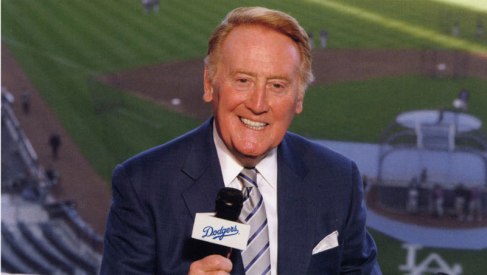
I long ago quit arguing with people who think that watching/playing/knowing anything about professional sports is dumb, just like I long ago quit arguing with people who think that professional sports are more important than books, film, painting, politics, and all the other stuff that gets repped on Arts & Letters Daily. If I did still argue with the former group of boring dweebs, I would just repeat, “Vin Scully Vin Scully Vin Scully Vin Scully.” I would keep telling my interrogator to go listen to that man call five minutes of an LA Dodgers game. To not even look at the TV if they couldn’t stand it. To just keep the volume on low. To use a radio if they want to feel good about not buying into high-def capitalist bread-and-circuses. To just listen.

Here is Vin Scully in 1964, looking like he’s ready for Don Draper to polish his shoes (because VS is a real person who exists in the actual world):

Image

Now it’s 2013 and we have Twitter and wi-fi and stuff, and he is still going way more than strong. When he started calling Dodgers games, the team played in Brooklyn and Harry Truman was president; at 85 years old, he still calls games by himself: no second or third commentator in the booth, as is the case with almost every professional sports broadcast on earth. Just hours and hours of a fundamentally slow-paced game, with one guy working to keep you interested, and game after game, year after year, he remains the most compelling, mellifluous, learned, humane, quietly swaggy voice in American sports.

See, his astonishing longevity aside (85!), Scully’s style (it is hard not to write “Vin’s,” because that is what any baseball fan would say when talking about him) of broadcasting is what makes him an honest-to-God cultural treasure. Most sports talking heads are idiots. Anyone who has ever suffered through Tim McCarver (baseball), Jon Gruden (football), or–ugh–Reggie Miller, the congested, brittle ex-jock who stinks up TNT broadcasts (basketball), can attest to that. But even if the sports commentariat weren’t clogged with the mental equivalent of Applebees franchises, the  intensely tan, blow-dried Scully would still reign.

This has a lot to do with the pace of baseball, which you might call a tense languor punctuated by moments of fierce geometric action. Someone who can tell compact stories and make perceptive observations but who also knows when to shut up is priceless for a baseball fan with a functional brain.

First of all, he expertly handles the basic structural aspects of a baseball telecast. That is, he continually provides contextual information a viewer might enjoy or need (like where on the field a player’s hits tend to land, or how double plays work) and crucial narrative guidance: the man’s between-innings spiels are often pithy masterpieces, and he can even make an ad for Sprint sound dignified.

More broadly, his rhetorical style and range of knowledge are informed by a kind of open-minded, good-hearted humanist curiosity about the world that is increasingly rare in narcissistic, smartphone-addled America. Scully might relay an anecdote about Arnold Palmer’s favorite clubs, eulogize some knuckleballer from the 1930s, paraphrase Keats, make a weird comparison between hitting a baseball in cold weather and punching a wall, or wax philosophic about tattoos (using puns), but his style is also structured with silent pauses and genuine exclamations of joy. He comes across as a beguiling older neighbor–even if you’re fifty–without mocking, bemoaning, or expressing bitter confusion about contemporary baseball culture. 300-pound Dominican guys with heavy ink don’t spook him: the worst the young bucks incur is a “Whatever gets you through the night” and the trademark chuckle that is hokey but sweet. At the same time, he does not go in for the canned, bombastic masculinity that ruins most broadcasts. (MIKE, THAT’S HOW YOU HIT IN THE N-F-L!)

He links midcentury coastal America with 2013 Los Angeles, for fuck’s sake. Samuel Johnson says that the worst thing a writer can do to hir audience is bore them. If you are a baseball sophisticate, Scully does not ever bore you, and he usually teaches you something new about the game and its history; if you’re a newbie, he won’t lose you. He sounds like baseball.
Image

This can’t go on forever. It probably won’t go on for much longer. I’m not even a Dodgers fan. I root against the Dodgers much of the time. When Vin goes–whether he retires before dying or not–I will cry some. Not kidding.

Speaking of Narcissism

Just a quick dispatch from the higher ed front-

The other day I was talking to my upper-division social science writing students about how humanities and social science departments feel pressured to justify their places on university campuses. What this has led to is both fields trying to be more like the hard sciences.  This has been disastrous for the humanities, as “theory” and identity politics have supplanted reading and writing as the discipline’s core. As for the social sciences, by demanding to be taken as seriously as the big bully on campus, they’ve only made their own efforts look like cheap imitations of the real thing.

I’ll have more to say about how humanities departments have destroyed themselves in due time, but that’s not what I want to do now.  What interested me was my students’ reactions when I used the term “navel-gazing.” Most of them laughed. When I asked why they were laughing, a young man (who seems bright and serious) in the front of the class said that he had never heard that phrase before, and that seemed to hold true for most of his classmates. This shocked me, as it is a phrase that I feel like I run into quite often in book reviews, political discussions, and take-downs of particularly out of touch cultural figures. I’ll spare you a sermon about what this incident says about what college students are and are not reading. Instead, I will paste some of the entries from the OED on this and related phrases below, as I find them fascinating. I particularly like the reference to Los Angeles. Feel free to accuse me of navel-gazing.

navel-gazing n. = navel contemplation

-1959   Canad. Jrnl. Econ. & Polit. Sci. 25 242   Contemporary Americans are inclined to regard such activities as navel-gazing, and to be more interested in the practical utility of models and specific operational techniques.
-1972   Publishers Weekly 10 July 27/2   David Obst has no monopoly on national navel-gazing.
-1990   Independent 27 July 19/6   Navel-gazing has taught these men and women to accept that there has to be someone in authority for the firm to work.

navel-contemplation n. meditation or contemplation, esp. of a self-absorbed, complacent, or profitless kind

-1921   D. H. Lawrence Let. 2 May (1962) II. 650   Your Nirvana is too much a one-man show: leads inevitably to navel-contemplation.
-1974   Times 27 June 18/3   To fight off the navel-contemplation mood induced by our move of office.
-1986   Q Oct. 76/1   Writing with these musicians has forced Simon to look up from navel-contemplation towards the open sky of entertainment.

navel-contemplator n. = omphalopsychite n. at omphalo- comb. form ; (also more widely) a person who indulges in navel-contemplation.

-1856   R. A. Vaughan Hours with Mystics I. vi. vii. 300   They call these devotees Navel-contemplators.
-1986   Financial Times (Nexis) 11 Apr. i. 19   We are in Los Angeles where the sun shines, the night life sparkles, and navel-contemplators of the world unite.

omphaloskepsis n. (also omphaloscepsis)  [ < omphalo- comb. form + ancient Greekσκέψις inquiry (see scepsis n.)] = omphaloscopy n.

-1925   A. Huxley Those Barren Leaves v. iv. 366   The flesh dies… And there’s an end of your omphaloskepsis.
-1952   H. Ingrams Hong Kong i. 22   The British saw London as the world’s capital. Omphaloscepsis has always been one of the world’s troubles.
-1983   Verbatim Summer 23/1   Presumably, one arrives at game theory through omphaloskepsis.

omphalomancy n.  [ < omphalo- comb. form + -mancy comb. form; compare French †omphalomantie (1752), omphalomancie (1868 in Littré)] divination by the navel, esp. the art or practice of divining the number of future children a woman is to have by counting the number of knots on the umbilical cord of a baby born to her (obs. rare); (in extended use) the art or skill of predicting or estimating numbers of people (rare).

-1652   J. Gaule Πυς-μαντια 165   Omphelomancy, [divining] by the navell.
-1892   New Sydenham Soc. Lexicon,   Omphalomancy, the prophesying of the number of future children a woman will have according to the number of knots on the navel-string of the child born.
-1987   Amer. Jrnl. Sociol. 93 210   The last chapter is a brief exercise in omphalomancy, an estimate of intellectual progeny in leading roles.

The Culture of Narcissism

So I am not a fan of Amanda Marcotte’s work, but as they say, even a broken clock is right twice a day. Or in this case, close. Once.  Recently, Slate‘s resident “everything can be reduced to sexism” pundit wrote a post about why we shouldn’t find the video of the doofus asking Kate Upton to his prom charming, but yet another example of how the patriarchy teaches young men to be whistling cartoon wolves in zoot suits bent on total female subjugation, if not death. For Marcotte, this is just another brick in the wall of “the overall culture of male entitlement.” Well, she’s right about this episode revealing entitlement, but it has little to do with gender. This entitlement is the logical result of social networking culture’s amplification of one our shittiest human tendencies: our sense that we have any right to dictate how others feel about us. Genitals shmenitals.

To make this story all about patriarchal ills, Marcotte does not mention that this video proposal/demand has been directed at male celebrities too. Justin Timberlake was asked via YouTube to attend a Marine Corps ball and, unlike Upton, he agreed to go with his fan(atic). Now, maybe he actually wanted to do this, but if he didn’t, he really had no choice. If Timberlake had said no, he would have gotten slammed as anti-military, out of touch, and probably sexist for rejecting a woman with the “courage” to subvert gender norms by asking him out. In this sense, the stakes were a lot lower for Upton. No one really likes teenage boys, except maybe their mothers.

But I actually give Kate Upton a lot more credit than most celebrities who get put in this position. By (too) nicely saying no she reminded us of something we seem to have forgotten about as a culture. Just because you have Facebook and Twitter and follow celebrity accounts maintained by PR flacks does not mean you are actually friends with the people you worship. And no, you aren’t as worthy of their attention as they are of yours. They don’t pay to see you do anything. They don’t Google sexy pictures of you. They owe you nothing. And yet we applaud when some kid puts another human being in a really awkward spot in order to feed his own ego. Honestly, his parents should be ashamed. But I am sure they aren’t.

This sense of feeling like the objects of our affection owe us reciprocation is neither gendered nor new. The Greek gods and goddesses were constantly raping or turning the people they loved into animals or plants in order deal with the burn of rejection. Carrie Underwood had a hit song about fucking up some dude’s car for possibly cheating on her (listen to it, it’s all about things he’s “probably” doing). Obviously, I think it’s better that people don’t cheat on one another, but even in a committed relationship there is a limit to what we can do to those who disappoint us. If he cheats on you, Carrie, leave him. But leave his truck alone, you psychotic loser.

I recently finished reading two novels, Jeffrey Eugenides’s great The Marriage Plot, and Graham Greene’s middling England Made Me. Though published about 80 years apart, they are both about how, whether we want to admit it or not, loving someone else can often be a very selfish act. All three of the main characters in Eugenides’s book use each other to not have to admit their own selfishness. They are bright, urbane, and enlightened (Ivy Leaguers, dammit!), but they are terrified of being alone because then they’d realize that they are basically sad assholes. They want to be wanted and need to be needed. Most of us do, really. Greene’s book focuses on fraternal twins, a man and a woman, who are so in love with themselves that they try to sabotage each other’s relationships in order to preserve the possibility that they might make Quentin Compson’s deranged incestuous fantasies come to life. It’s not as creepy as it sounds because the book just isn’t, aside from a few incredible passages, very good, but watching the twins interact is about as comfortable as biting down on tinfoil.

If Eugenides and Green are warning against the dangers of self-obsession, this Kate Upton story is an example of how our social networking culture just encourages it. Far from being called out by an adult world with a sense of decency, this kid who asked her out was cheered on in his self-aggrandizing debasement by millions. He was on the fucking Today Show. No wonder kids are leaving college barely any smarter than when they arrive. Why work hard and take yourself away from fun when there’s a whole world (wide web) out there just waiting to make you a celebrity? All your friends are there. There’s Jay-Z, and A-Rod, and Marco Rubio, and Amanda Marcotte, and Kate Upton, and that kid who asked out Kate Upton…

All Roads Lead to Blog

It seems only fitting that on Easter weekend this old blog has risen from the dead. Jesus would be proud, I think. Like the owner and proprietor of these here parts, I finished my PhD in English in 2011, capping it off with a riveting study on American bachelorhood in mid-20th-century US fiction. The trade papers, as you might imagine, went nuts with anticipation and desire. I too had a blog back in the day, and you can find the remnants of it here. Like Ryan, I really enjoyed writing about Kanye West and Glenn Beck (remember him?) and the like. It’s sad for me to read the last few entries where I assure the reader that my infrequent posting is only temporary. I hate lying, especially when I am the one doing it. But this new venture excites me, as I was always a big fan of The General Reader. We’re here to make some hot copy, folks. Bank on it.

For my first post, then, I am going to keep things fresh and local. To quote a song I don’t even like very much, “the city I live in, the city of angels” figures prominently in my dissertation, and I am even more interested in the place now that I have time to be. The story of Los Angeles is a compressed and at times inverted version of American history where the founding fathers aren’t depressive racist philosopher kings, but ambitious racist Alger characters who looked at the post-Civil War, post-gold rush American landscape and figured out that if you control an area’s media and natural resources, and cut deals with the railroads, well then, baby, you’ve got a stew going. In a moral vacuum, it’s a fascinating tale, one ably documented by Kevin Starr, Mike Davis, Norman Klein, and Carey McWilliams (especially Carey McWilliams). If you are looking for a good primer before jumping into a tome, or just a way to be informed enough without reading, PBS did an excellent documentary on LA’s  original ruling clan, the Chandlers (no relation to Raymond). You will find a link to it below. Now, if you’ll excuse me, I have to go draft a fantasy baseball team.

Inventing LA: The Chandlers and Their Times