Topical Verse: The Short Game

With the exception of Dorothy Parker, American poets have never been much for light verse. Ogden Nash doesn’t count, because his writing blows (File under: The Rhymes Usually Seem Forced, and also The Poems Are Not Funny). Things are different for English poets. This probably has something to do with their culture’s flair for irony, discomfort, and verbal wit, as well as its historical lack of an entrenched fundamentalist Protestantism. Think about it: even many of their Serious Poets are funny, like Shakespeare, Pope, Browning, Auden, Larkin, Louis MacNiece, Lord Byron, Donne (the dirty early stuff) and, well, you get the picture. Though not Milton. Oh god, not Milton.

Kingsley Amis is best known for novels like Lucky Jim, The Old Devils, and One Fat Englishman, all works that established him as one of the past century’s great comic novelists. But he was also a bang-up poet (seriously, he’s in the Norton anthologies) and a solid critic, so it isn’t surprising that his edition of The New Oxford Book of Light Verse (1987) is great. Here are two poems, both short, both always topical, neither serious.

“Limeraiku” (by Ted Pauker)

There’s a vile old man
Of Japan who roars at whores:
“Where’s your bloody fan?”

—————

“Miss Twye” (by Gavin Ewart)

Miss Twye was soaping her breasts in the bath
When she heard behind her a meaning laugh
And to her amazement she discovered
A wicked man in the bathroom cupboard.

Topical Verse: Back to School

The end of my summer is only a couple days away, so in honor of the return of the school year, I give you Tony Hoagland’s “America.” It describes a feeling all teachers have had: dismissing something a student says only to realize that you actually agree. All teaching is learning, but it’s easy to forget this on bad days when the class in front of you seems to exist only to make you feel ignored. You can’t let this diminish the respect you give your students’ ideas though, because you were once that precocious, jaded, vague, insecure, or pretentious student, and you’ve probably changed a lot less than you’d like to believe.

America

Then one of the students with blue hair and a tongue stud
Says that America is for him a maximum-security prison


Whose walls are made of RadioShacks and Burger Kings, and MTV episodes
Where you can’t tell the show from the commercials,


And as I consider how to express how full of shit I think he is,
He says that even when he’s driving to the mall in his Isuzu


Trooper with a gang of his friends, letting rap music pour over them
Like a boiling Jacuzzi full of ballpeen hammers, even then he feels


Buried alive, captured and suffocated in the folds
Of the thick satin quilt of America


And I wonder if this is a legitimate category of pain,
or whether he is just spin doctoring a better grade,


And then I remember that when I stabbed my father in the dream last night,
It was not blood but money


That gushed out of him, bright green hundred-dollar bills
Spilling from his wounds, and—this is the weird part—,


He gasped “Thank god—those Ben Franklins were
Clogging up my heart—


And so I perish happily,
Freed from that which kept me from my liberty”—


Which was when I knew it was a dream, since my dad
Would never speak in rhymed couplets,


And I look at the student with his acne and cell phone and phony ghetto clothes
And I think, “I am asleep in America too,


And I don’t know how to wake myself either,”
And I remember what Marx said near the end of his life:


“I was listening to the cries of the past,
When I should have been listening to the cries of the future.”


But how could he have imagined 100 channels of 24-hour cable
Or what kind of nightmare it might be


When each day you watch rivers of bright merchandise run past you
And you are floating in your pleasure boat upon this river


Even while others are drowning underneath you
And you see their faces twisting in the surface of the waters


And yet it seems to be your own hand
Which turns the volume higher?

Topical Verse: Summer

We’re officially in the dead of summer, and it feels like it here in southern California. Actually, it has felt more like summer in Louisiana here in L.A. for the past couple weeks. Just gross and humid. Still, I realize that most people in America have it much worse, so for today’s topical verse I’ve chosen a poem that celebrates both summer and place, William Blake’s “To Summer.” If you haven’t read much Blake, go to your local used bookstore and hunt around until you uncover an edition of his poems that also contains some of his etchings and drawings. Then, find your nearest pleasure garden, post up under a good shade tree, and read until you fall asleep nestled up against summer’s bosom. This is what this lazy weather is for, folks.

To Summer

O thou who passest thro’ our valleys in
Thy strength, curb thy fierce steeds, allay the heat
That flames from their large nostrils! thou, O Summer,
Oft pitchedst here thy golden tent, and oft
Beneath our oaks hast slept, while we beheld
With joy, thy ruddy limbs and flourishing hair.

Beneath our thickest shades we oft have heard
Thy voice, when noon upon his fervid car
Rode o’er the deep of heaven: beside our springs
Sit down, and in our mossy valleys, on
Some bank beside a river clear, throw thy
Silk draperies off, and rush into the stream:
Our valleys love the Summer in his pride.

Our bards are famed who strike the silver wire:
Our youth are bolder than the southern swains:
Our maidens fairer in the sprightly dance:
We lack not songs, nor instruments of joy,
Nor echoes sweet, nor waters clear as heaven,
Nor laurel wreaths against the sultry heat.

Topical Verse: Detroit

In honor of Detroit’s totally depressing and, according to Keith B. Richburg, entirely predictable bankruptcy (take heed, California), here is an offering by former U.S. Poet Laureate (and perpetual Detroit and Fresno Poet Laureate) Philip Levine. This selection comes from his later work, and if you haven’t read his more famous verses from the 1960s, especially “They Feed They Lion,” you should. Like Jim Daniels, Levine’s subjects are often working class, and his observations aren’t always politically correct. But his work is true and public, like the best rap music. We need more poetry like this right now.

What Work Is

We stand in the rain in a long line
waiting at Ford Highland Park. For work.
You know what work is—if you’re
old enough to read this you know what
work is, although you may not do it.
Forget you. This is about waiting,
shifting from one foot to another.
Feeling the light rain falling like mist
into your hair, blurring your vision
until you think you see your own brother
ahead of you, maybe ten places.
You rub your glasses with your fingers,
and of course it’s someone else’s brother,
narrower across the shoulders than
yours but with the same sad slouch, the grin
that does not hide the stubbornness,
the sad refusal to give in to
rain, to the hours of wasted waiting,
to the knowledge that somewhere ahead
a man is waiting who will say, “No,
we’re not hiring today,” for any
reason he wants. You love your brother,
now suddenly you can hardly stand
the love flooding you for your brother,
who’s not beside you or behind or
ahead because he’s home trying to
sleep off a miserable night shift
at Cadillac so he can get up
before noon to study his German.
Works eight hours a night so he can sing
Wagner, the opera you hate most,
the worst music ever invented.
How long has it been since you told him
you loved him, held his wide shoulders,
opened your eyes wide and said those words,
and maybe kissed his cheek? You’ve never
done something so simple, so obvious,
not because you’re too young or too dumb,
not because you’re jealous or even mean
or incapable of crying in
the presence of another man, no,
just because you don’t know what work is.

On Jim Daniels and Writing

Jim Daniels’s poetry was recommended to me about a decade ago, but I’ve only just now gotten around to reading it. This is one of the nasty side effects of getting an advanced degree in literature; you become not only one kind of writer, but one kind of reader. Or, rather, you become a reader reading to write academic criticism, not to produce (or really even enjoy) art. You’re told you must present at conferences and roundtables (some of the least useful exercises known to man) simply because you must. You’re also encouraged to publish tortured and genuflective articles no one will read in outlets no one has heard of. And be very, very careful about who you tell that you’d rather write poetry than play video games. Trust me.

But now I’m done with all of that, and I’m once again, to borrow a phrase from a future colleague, Mike Bunn, “reading like a writer.” Jim Daniels’s Show and Tell: New and Selected Poems (Univ. of Wisconsin Press, 2003) is the kind of book of poetry that 21-year-old me would have gone nuts over, and I can see why the person who recommended it then did so. Like a lot of creative writing students at a certain extremely crunchy Northern California university, I was obsessed with the working class narratives of Raymond Carver, Philip Levine, and Richard Hugo. The poems I was turning out under their influence weren’t metrical, didn’t rhyme, and told vague stories about love lost (I was in a happy relationship), hard work (I had worked shitty jobs, but not in factories), and bars (these I knew). The stuff I read was awesome, the stuff I wrote wasn’t. Jim Daniels’s work is in the tradition of the poets I admired then and continue to admire today, but reading his poetry ten years later makes me realize that the things that attract us to good writing at various stages in our lives (particularly in youth) aren’t necessarily what actually makes the writing good.

If you would have asked me then why Carver, Levine, and Hugo appealed to me, I probably would have said something about narrative and mood. And indeed, these are important elements of all poems I tend to enjoy. Poetry that lacks any sort of narrative arc bores the shit out of me, but then again I think that William Carlos Williams’s “The Red Wheelbarrow” is a dripping with narrative (the word “red” is the denouement). So, like a lot of things then, what constitutes a narrative is subjective. What reading Jim Daniels now reveals is that I was and am drawn to poetry that uses narrative in a distinct way: to work through but never resolve the frustration that comes from knowing that our interpretations of and reactions to joy and sorrow are both unique to the point of being painfully inexpressible (something Joan Didion calls “the burden of ‘home’”) and also really, really generic.

In one of the many portraits in Show and Tell, Daniels writes of “Crazy Eddy,” a “drunk/garbage man with a bad temper,”:

We didn’t know then
he picked up trash for a living
and drank twelve beers a night.
Maybe all he wanted was a green lawn
and a peaceful drunk.

The simplicity of both the phrasing and the sentiment here makes the critique all the more potent: we don’t know much about what others desire, what motivates them, and the assumptions we make usually lead us further from understanding. I can’t tell you how many times I have tried to express this idea in verse only to miss it, usually by a lot. Or take these couplets from “Shedding the Vestments”:

I was inside her for the first time
when her parents pulled up the driveway.

Her father’s brain was the size of a small stone
dug up by an idiot pig. He greeted me cordially.

This is one way to react to this event, and one particularly common to young men: smugness. However, there’s another reaction that’s equally plausible: pants-shitting panic. By giving us one possibility in such a dense couplet, the poem almost forces us to imagine its inverse as well, thus making the quality of the speaker’s youthful hubris even more stunning. As you might be able to imagine, this doesn’t bode well for the speaker, and when it all falls apart and the girl gets impregnated by someone else, the final line of the poem (“go to hell”) leaves us understanding how smugness and terror can both lead us to loneliness.

There are other great poems in Daniels’s collection, including “Time, Temperature,” which is about how the racial animus of a community can infect even people who consciously try to place themselves above it. Fittingly, this poem is dedicated to James Baldwin, and it is easily the most ambitious and cinematic in the collection. As with any book of poetry though, there are some duds in here. I am not a huge fan of the “[Insert Color] Jesus” poems, or the meandering “Niagra Falls,” as these start to veer into the realm of bad impressionistic art—all impressions, no firm connections or boundaries to give them even a loose shape. But duds aside, Show and Tell is well worth your time. Personally, I am happy to have more of that to devote to reading like a writer again.

The Weekend’s Difficult Men (Man #1): Richard Hugo

Even if he hadn’t written some of the better American poetry of the 1960s and 70s, Richard Hugo would be remembered by literary history for a number of reasons. Maybe only as a footnote, but still, a long one. He was one of Theodore Roethke’s students at the University of Washington. He co-founded Poetry Northwest. He taught at the famed Iowa MFA program. He was a friend and fellow-traveler of poets like William Stafford, Carolyn Kizer, James Wright, James Welch, and A.R. Ammons. And, perhaps most importantly, he taught creative writing for nearly two decades at the University of Montana, helping turn that MFA program into one of the finest in the country.

But luckily for readers of English, he happened to write a number of wonderful books of poetry, plus a crime thriller, a fine collection of autobiographical essays called The Real West Marginal Way, and a justifiably still-famous rumination on the art of poetry, The Triggering Town. His collected poems (titled Making Certain It Goes On) and Selected Poems are both available from the usual places, as are the prose books.
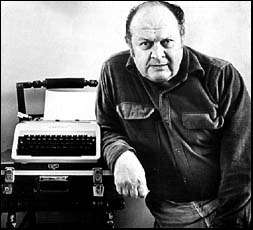
A word of caution, I guess: Richard Hugo is a very good poet, but he isn’t a great poet. He’s not in Whitman’s or Bishop’s league.  (It’s kind of like the difference between, say, Patrick Ewing and Michael Jordan.)  Mainly this is because Hugo has one fundamental tone, from which he departs only very rarely, and which adjectives like “depressed,” “bitter,” “despairing,” “morose,” and “elegiac” (that’s probably the best and most charitable one)  describe only half-adequately. You’ll see what I mean if you decide to read him; it comes across even if you only look at the half-dozen Norton Anthology pieces. It is most certainly NOT because he writes a lot about one loosely defined region of the United States, the Northwest (comprising both the Upper Plains and the Pacific region). You see, he still sometimes gets typecast as a “regionalist,” which in the lingo of American lit teachers tends to have lame, unfair connotations of “minor” or “fringe.”

Hugo’s major theme–as distinct from his emotional tone–is the impossibility of finding a stable, legitimately happy home in America. He was a white man from the improbably named White Center, at the time a gritty working-class suburb of Seattle; his father ran out on the family when Hugo was a kid; he had a terrible drinking problem; he suffered lifelong trauma (what would now be called PTSD) from his tour as a B-17 navigator in World War II; he constantly lamented his perceived failures with women*; he never really seemed to accept that by middle age he had become a respected American writer; in short, he always thought of himself as a schlemiel, and this fundamental theme gets articulated in a consistent pattern of settings. Wrecked or abandoned towns after the gold-mining industry failed. Cruddy villages in Italy. Failing small farms. Dive bars. Rivers near the Pacific. Fishing. More dive bars. Long car journeys from desolate hamlet to even worse (Hugo is the great American poet of the highway). The scenes of Indian massacres and humiliations, and the white liberal’s consequent, and justified, guilt. The austere natural environment of Montana and Washington.

*Regarding his sexual neurosis: this is where and why H. occasionally slips into adolescent self-pity, which in turn borders on misogyny and sometimes results in genuinely creepy passages about women who “wronged” him. You might want to steer clear of these poems, which are scattered throughout his corpus.

As for his style, Hugo is prosy, insofar as he mimes the voice of someone talking / confessing directly to you, but he also mixes in buried and half-rhymes, the occasional delicious stretch of iambic pentameter, and a lush profusion of image that most novelists don’t risk going after. His images are severe, though, and he rarely ventures into blowsy John Ashbery territory. It boils down to this: Hugo demonstrates the poetic utility of both free verse and metered verse–he reminds the reader that these things aren’t anathema to one another, that in fact they can be mixed in the same poem.

Hugo is essentially a confessional poet, writing with the same general attitude as Plath, Lowell, and Berryman. By this I mean he talks about himself and his small world a great deal. Personal memory is what fires him. He bares his heart, whether you want to hear it or not. But he is different from those poets in a crucial way, because unlike them he always connects the story of his existential despair (pardon that phrase) to wider and, from most people’s point of view, more important problems like environmental devastation, economic collapse, and the long, long history of Native American genocide. Hugo is a poet for American outcasts and underdogs; if you’re one, or were one, chances are you’ll empathize with him, and maybe even like his poetry, whether you came up in rural Nevada, the South, Harlem, East LA, or wherever.

What are you waiting for?  Start Googling him. Read what comes up. And consider buying a Norton Anthology of Modern Poetry.  If you want to keep your library light, this is a book you need.

-TGR

Sunday Poet: Louise Bogan

My blog production will go down markedly now that baseball season has started and the fascinating (Western Conference) NBA playoffs are on, too. But I would like to point you toward a poet you will probably like if you like to read poetry. Or if you aren’t sure, or don’t quite. Her name is Louise Bogan and she’s quite accessible. Bogan was the poetry editor of The New Yorker for almost 40 years (from the early 1930s until the ’60s, I think), which makes her one of the people who turned that magazine into perhaps the best English-language publication on earth. From what I understand she was an advocate of writers like Elizabeth Bishop, Robert Lowell, and Marianne Moore. More importantly, Bogan was a poet. Ecco Press publishes a slim retrospective collection of her stuff, The Blue Estuaries, available from the usual places.

Here is the best way I can describe her: Bogan is a weird, eerie, sometimes downright hallucinatory poet, but she is also formally conservative, preferring now to deviate much from the norms of English metrical verse. She rhymes and keeps a beat. In this sense you can see how she fits into a line of visionary weirdos that begins with poets such as Blake, Dickinson, and Yeats and continues on to people like Sylvia Plath, John Berryman, James Tate, Kay Ryan, John Ashbery, and Matthea Harvey. Formally speaking, Bogan is closer to the earlier visionaries; she is particularly good with tetrameter lines (i.e. lines that have 4 beats), using them for bleakly comedic and jerky, surrealist effect. Dickinson’s voice, again. A tetrameter line is short, so if you don’t want a series of them to take on this obnoxious, unintentionally funny bouncety-bouncety-bounce rhythm, you’ve got to be deft. Here is her 1937 poem “M., Singing” (copyright Louise Bogan, 1968):

Now, innocent, within the deep
Night of all things you turn the key,
Unloosing what we know in sleep.
In your fresh voice they cry aloud
Those beings without heart or name.

Those creatures both corrupt and proud,
Upon the melancholy words
And in the music’s subtlety,
Leave the long harvest which they reap
In the sunk land of dust and flame
And move to space beneath our sky.

How old-fashioned: Bogan capitalizes the first letter of the first word in each line!  Gives the fever-dream a certain dignity, yeah?

You can see what Plath and Roethke, for instance, learned from her—those clipped, sharp-rhymed little lines—and then modified for their own purposes (they both like to mix in free-verse, more image-rich phrases). Bogan is not a comforting poet, like Shakespeare is, and she’s not as funny as Auden or Louis MacNeice, the two European poets she most resembles. But she isn’t cold, not really. Rather her verse is just totally unsentimental. Some of this mood derives from her rhythmic practice, some of it from her refusal to let her poems become reducible to neat thematic summaries (“this poem is about. . .”), some of it from how sparse her images are, some of it from her skeptical view of things like love and calm. But a lot of beautiful poets—say, Frost—are pleasurable without being straightforwardly consoling. You admire how well they put it, and how  bravely, “it” usually having to do with disappointment or loneliness, but sometimes joy. The muted solace Bogan offers comes from the brevity, and the bizarre subconscious precision, of  her dream poems. Chances are you’ve been there.

Dig Carol Ann Duffy

My hunch is that American readers, even poetry aficionados, don’t read a lot of contemporary British poetry. The Irish lyricists get plenty of deserved attention, but their Anglo-Scottish counterparts–indeed, all the Commonwealth literatures (hear much about the great Australian Les Murray?)–are somewhat ignored, with the exception of Derek Walcott. Personally, I know almost nothing about newer stuff by Brits; my experience of their recent literature has mainly come through reading novels. But while studying for an exam a couple years ago, I did come across Carol Ann Duffy, Scottish resident of Manchester, born in the mid-1950s, publishing great short poems since the 80s.

She’s genuinely famous in the U.K. and was named Poet Laureate last year (the first woman to get the job), but Duffy isn’t taught much in American universities or written about in out literary mags. In lieu of me burping on about her anymore (she’s really good), I give you a BBC biography site and a link to a recent Guardian profile.

Google her. Read whatever comes up and also be advised that her Selected Poems (published as part of the very cool Penguin Poets line in 2004 and again in 2009, in a better-looking edition) is available on Amazon.com for as little as three bucks.

-TGR