Since a footnote doesn’t look sexy on the actual “About The General Reader” page, here is a footnote on where the phrase “self-facilitating media node” comes from: the promising, bleak, unfortunately short-lived BBC show Nathan Barley (February 2005-March 2005), which was created by Charlie Brooker and Chris Morris, whose pedigrees as satirists will be evident if you do some Googling. I should have explicitly posted on this sooner, because it is dumb and lazy to assume that just because nobody reads your blog, and just because the allusion is meant as a homage, you needn’t cite your sources. Consider this my apology, framed as a plug.
Nathan Barley is well worth a test-view on your part, and you can watch some of it on YouTube. “Self-facilitating media node” is how the astonishingly, (sort of) endearingly fuck-witted main character describes his website, trashbat.co.ck, which is, yes, registered in the Cook Islands. Cock Islands. No, no, Cook. At times the episodes falter, which is understandable given that the show only had six episodes to work things out, but the comic high points remain vicious. Nathan’s invented slang is especially good, or, as he’d say, “well weapon.” (Hoot your trap off, mate.) When you watch, keep in mind that this was made in 2004-2005, and be suitably unnerved by its anticipation of Vine, “selfies,” the Vice empire, web shows, iPhone commercials, Reddit, and a wealth of other slick brain damage.
2014 UPDATE: Our “About” page doesn’t use this language anymore. Go watch Black Mirror.
I know I bash on the late-1960s morality play that is the “XX” blog over at Slate a lot, but outside of this little pocket of cliched topic sentences in search of evidence, Slate really is a great site. Troy Patterson is a big reason why this is so. Aside from being Slate‘s resident man of taste and class, he also has real chops. He’s the only person at that site (maybe save David Weigel) who I trust to use a term like “Tory” in an intellectually honest way. So I can’t say I was surprised to see that Patterson’s a man who takes E.D. Hirsch’s work seriously.
For those unfamiliar with Hirsch, he’s the kind of academic who would never get a tenure-track job today, even though, as Patterson points out (with an assist from one of this blog’s patron saints, Christopher Hitchens), many states are coming around to the idea that kids actually need to learn content in order to acquire skills. The fact that Hirsch’s concept of “cultural literacy” was ever controversial is evidence of the sad decadence and arrogance of some influential English and “Education” departments since the 1970s, when “theory” came into fashion and substituted Orwellian jargon for intelligence. Now, let me be clear (thanks for that phrase, Obama), most English departments are filled with people who really don’t care about what Derrida wrote (or said, or uttered, or whatever stupid word he mandated that we use). But even many of these people have to pretend like Derrida (or Foucault, or Butler, and…) is responsible for more than like 3 useful pages of ideas. One day this will change, but by then English departments may have specialized and de-literatured themselves out of existence.
In any case, Hirsch was and is a real weirdo: a tenured English professor who cares about teaching more than anything else. And not only teaching, as most profs will defend to the death their right to teach graduate seminars, but teaching K-12. What kind of suicidal English professor cares about kids he’s not actually teaching at the moment? One who understands that he will have to teach them at some point. More importantly, Hirsch is the kind of guy who actually thinks about the world beyond the classroom. While his love of testing and data makes me uncomfortable, if I had to pick a side in the education debate, it wouldn’t take me long to choose his over Dewey’s disciples preaching confidence over competence. Competence breeds confidence in the long run, and Hirsch understood that the best way to help the poor is to give them an education that will allow them to converse with and challenge those in positions of power. This is something David Foster Wallace also understood, and if you haven’t read “Tense Present” recently, go do that right now.
Back to Patterson though. I would have loved to see him extend his discussion of how the internet has changed what should be on Hirsch’s famous list of 10,000 terms/ideas/people/events that all Americans should know to consider how it has changed attitudes toward the value of knowing anything at all. Patterson writes:
Is it too bold to suppose that one must now know 10,000 basic things? Obviously, a lot has happened to general knowledge since the book’s publication, not a little of it connected to what now appears to be a lacuna on Hirsch’s list—a gap that developed between International Monetary Fund and interrogative sentence. The Internet is a force of information inflation, and much of the stuff on the list remains relevant, give or take a few relics and some slang terms (pop the question, bite the dust) now fully embedded in mainstream vocabulary.
He’s gazing down on what’s important here, but perhaps it’s too mixed up and awful for him to really get into. I know that feeling. For the last few years I’ve had students sincerely question why they should have to remember (let alone memorize) anything, as the internet will always be there for them as a handy outboard brain. Thankfully, some of my students look horrified when they hear a classmate say this, but the fact that this scene keeps playing itself out is worrisome. I tell them that the internet is not going to be there for them when they’re having a conversation with some smart guy/gal who might be able to give them a job. If they don’t know (or have to look up cultural references on their iPhones) mid-conversation, s/he ain’t going to be impressed. This obviously isn’t the only reason why remembering stuff is important, but if the fact that a job in an increasingly awful and bifurcated economy might hinge on it won’t sway people, I don’t know what will.
And people accuse us humanists of being romantics…
Over at Deadspin they’re running a piece proclaiming 1978’s Superman vs. Muhammad Ali “the greatest” (get the joke, eh? Eh?) comic book ever. This woke up the little nerd who lives inside my gut, because it’s clear these people have never heard of Damage Control, a cluster of comics spread across two decades about a team of engineers using “engineering techniques that are much more advanced than the competition which enables them to perform their job in remarkably short periods of time.” That quote is from Marvel’s Wiki. I apologize for the ghastly phrasing. In any case, the Damage Controllers’ job is cleaning up the mess after superbeings destroy buildings and such. I was lucky (unlucky?) enough to own a copy of Damage Control Vol. 1, #1 when I was a kid (I think I traded a Frank Viola baseball card for it), and I remember feeling confused when I read it. It was basically about working in an office, something both my parents did. I imagine some guild of civil engineers put Marvel up to publishing it. Otherwise, I have no idea why this comic was made, let alone why there have been four limited series. I invite some poor grad student in need of a publication or conference appearance to dive into the wreck (er, stacks) and make a case for why Damage Control is some sort of protest against neoliberal values. Me, I’ll just bask in its bureaucratic glory and think of Frank Viola.
This list from BuzzFeed of the 65 books (why 65?) you should read in your 20s is a few months old at this point, but I thought it worth sharing. I have been out of my 20s for over a year now, and the end of that decade did coincide with some pretty big events in my life (finished grad school at 29, got engaged at 30), but I don’t think this had much to do with my 20s winding down. It’s just how it happened to play out. Being 31 doesn’t feel intrinsically different from being 28, so I’m not sure why this list is limited the way it is. Perhaps they actually mean that you should read these books in your early 20s, but even that is dubious. The point is that books change as we age, and this is why rereading is important. Not a radical idea, but maybe you only first realize this in your 20s because you’re finally starting to make decisions on your own. And all of this is predicated on being privileged enough to avoid having your adult life start at like 16 in a coal mine. The ennui of the college-educated is gross, but it’s something a lot of BuzzFeed readers (myself included) know well, so I guess that’s what this list is really about.
But for god’s sake, if you’re going to make of list of what post-college drifting 20-somethings should read, how can leave off the greatest post-college drifter novel of all time? I’ll simply give you a telling passage:
“You two start on home, Daisy,” said Tom. “In Mr. Gatsby’s car.”
She looked at Tom, alarmed now, but he insisted with magnanimous scorn.
“Go on. He won’t annoy you. I think he realizes that his presumptuous
little flirtation is over.”
They were gone, without a word, snapped out, made accidental, isolated,
like ghosts even from our pity.
After a moment Tom got up and began wrapping the unopened bottle of
whiskey in the towel.
“Want any of this stuff? Jordan? . . . Nick?”
I didn’t answer.
“Nick?” He asked again.
“What?”
“Want any?”
“No . . . I just remembered that today’s my birthday.”
I was thirty. Before me stretched the portentous menacing road of a
new decade.
This isn’t to say that there aren’t some great and surprising picks on this list. The Moviegoer by Walker Percy is incredible and wildly underread. If more people read it because of this listicle (such a gross term), I am fine with it.
So I guess I’ll throw out a question: What books do you think are missing from this BuzzFeed list?
Stressed out by our posts on the sea of troubles in which American higher education is flailing? Relax. That’s one of the main things gardens have been for since there have been gardens (besides the whole growing-food aspect).
● Although binge-spending on campus amenities is problematic in a lot of infuriating and scary ways, it does mean that many American schools (at least those that end up on the dumb ranking lists barfed out by Forbes and US News and other magazines every year) have remained passable facsimiles of Arcardia. Yes, I’m being aesthetically charitable, but schools with competitive admission profiles spend major funds on landscaping for a reason: an environment distinguished by transplanted ornamental trees, machine-shorn lawns, stone fountains, ivy wired to buildings, and other postmodern-bucolic stuff is meant to evoke the repose necessary for deep thought and complex scholarship. That’s why Plato taught in an olive grove. Also, it entices prospective students with all sorts of green nooks for smoking weed in.
● Read all about the above, and more, in Robert Pogue Harrison’s magisterial Gardens: An Essay on the Human Condition. It’s actually more of a book than an essay. If the untamed side of things is more your style, he also wrote a book called Forests: The Shadow of Civilization. It is also good.
● Maybe grab a couple other garden tomes? None of us read enough anyway. These would be the Oxford Companion to the Garden (wonderful even though the British origin makes you put up with lots of colour and vigour and missing commas) and Michael Pollan’s Second Nature: A Gardener’s Education. Contra the ad pitch on Pollan’s website, it is not “a modern Walden,” because it doesn’t have any boring stretches where you want to die or go read Emerson instead. Built upon an autobiographical foundation (there is great stuff about lawn care on suburban Long Island after World War II), the text is ultimately a hybrid of cultural history, botanical inquiry (the stuff about weeds is rhapsodic and sensible at the same time), gardening advice, and ethical meditation. Pollan’s central claim is that gardening, unlike (say) American wilderness worship or a vague feeling for the poor Amazon, reminds us, over and over, that human experience takes place within a life-world that we must simultaneously exploit, care for, and love deeply.
● Staying with the literary angle, refresh yourself with Andrew Marvell’s “The Garden.” Over the years critics have gone at it with all kinds of ideological crowbars, but you shouldn’t forget Philip Larkin’s remark that the poem might be best understood as “a good description of the mind of someone half-asleep under the summer trees in a garden” (“The Changing Face of Andrew Marvell,” collected in his Required Writing).
● Rich people usually have nice land around their homes. Often that land bears complicated gardens. And if rich people go broke and then go crazy, they sometimes do it in high style, as Grey Gardens reminds us. I’ve seen this documentary three or four times, and it never ceases to be demonically compelling. Don’t call it a “cult classic.” It’s just a classic. Man, WASPs have some weird genes.
● Merely eccentric wealthy people tend to be a lot more functional, and one of them, Madame Ganna Walska, left behind the coolest, most variegated, enchanting garden I have ever been to, Lotusland in Montecito, California. If you are ever in the Santa Barbara area and have a few hours, go. It is absolutely worth the steep admission fee ($35). They sometimes do free-tour days, but those are tough to get.
● I have a little kitchen garden, and bugs and weeds get in it all the time, which MAKES ME SO ANGRY. These people can help: the University of California Integrated Pest Management Program. Caution: this site’s mesmerizing level of visual and written detail, along with its intense dedication to helping you do the practical stuff that keeps a garden functional, will take up lots of your free time, if you garden.
● Aesthetics aside, we also need more working gardens in urban neighborhoods that lack decent grocery stores. Gardens are nice to walk through and look at, but they can also help bring down America’s catastrophic rates of obesity and diabetes, scourges that are concentrated in the places where poor people live. From the LA Times, here is a touching story about how kids in a scruffy part of Los Angeles are maintaining local garden clubs.
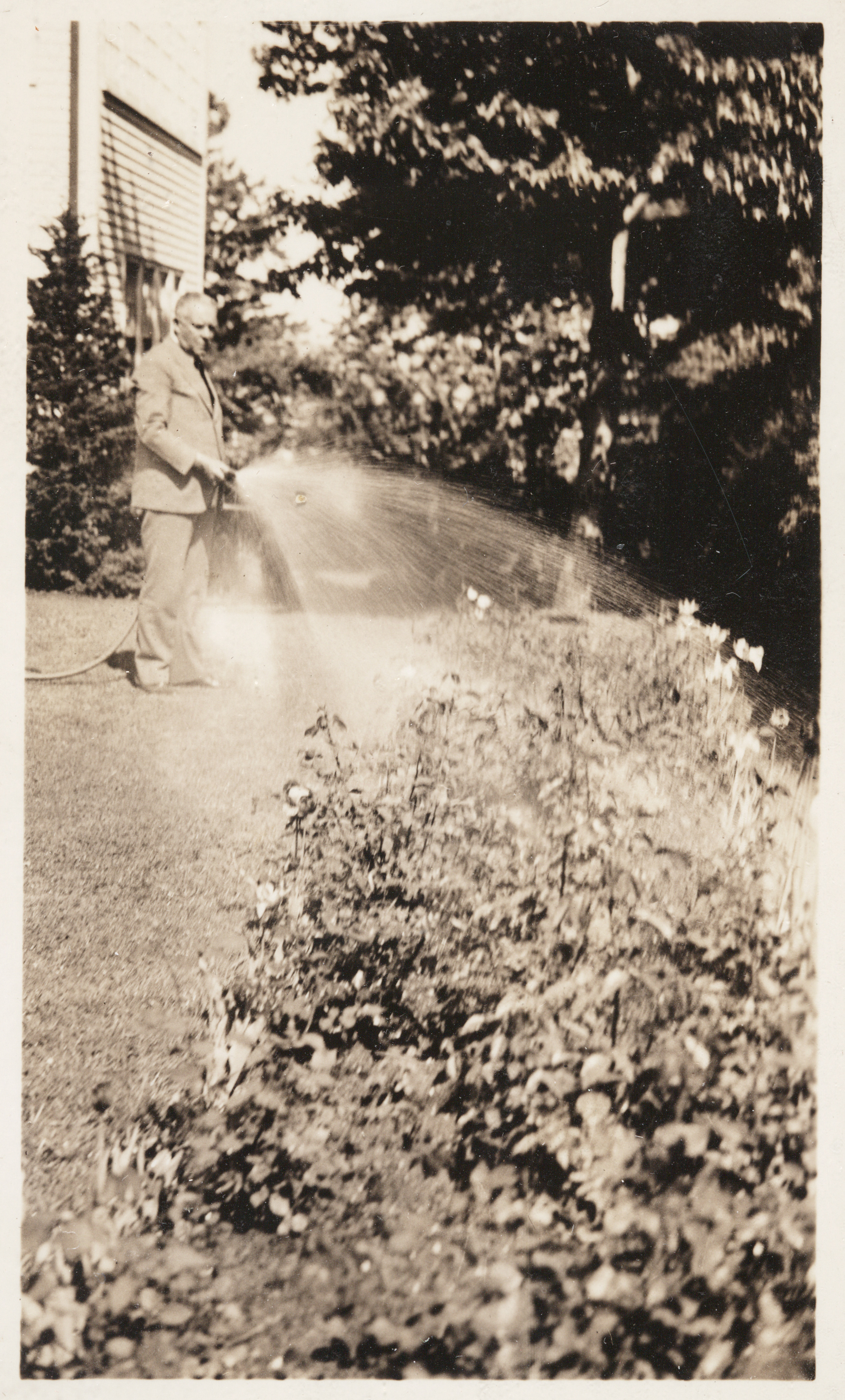
● Here is a snapshot of Wallace Stevens watering his rose garden in West Hartford, Connecticut sometime in the 1930s. Note that he is wearing a suit. The image is housed in the archives of The Huntington Library in Pasadena, which also happens to maintain some astonishing gardens; the photographer is unknown.
● And here is that scene from Disney’s version of Alice in Wonderland that has inspired thousands of budding artists and similar weirdos, and subtly terrified millions of children more.
● We’ll leave you with some more music. Have a listen to the Stone Temple Pilots’ corny but energizing “Wicked Garden” (the garden seems to be a metaphor for something). Kind of fun to mute the Alice clip above and play this:
● . . . or maybe you should just stick with Beethoven’s 6th, the “Pastoral” symphony:
More evidence that privatized online ed will be an expensive disaster (add the data to everything every decent teacher has told you when the subject comes up).
Evgeny Morozov has written a cool polemic, To Save Everything, Click Here; read some condensed versions of its claims here and here and here.
George Packer is one of America’s best nonfiction writers, and he just published The Unwinding: An Inner History of the New America. Spend your weekend reading up on the post-middle-class USA. Got my copy this week.
. . . and if you want to see an example of ad hominem burbling from a person who gets paid to review books but apparently hasn’t learned anything about writing from them, check out the New York Observer‘s wail. You probably won’t finish it, because in addition to being bad (bad because it is stupid, not because it rejects Packer’s theses), it is long.
This is just a quick one: Carl Wilson (no, not that Carl Wilson) has penned a wonderful (and at times wonderfully pretentious) essay about why it is okay to hate certain bands (insert any type of artist here) even when you know that they are pretty good and have a lot in common with other bands (or artists) you like. We all have these irrational hatreds. Wilson’s advice? Give in to the Dark Side…
I’m not going to pretend that I’m some OG Noah Baumbach fan. The first time someone told me about Kicking and Screaming, I assumed she was talking about the youth soccer movie starring Will Farrell. I believe I even spent the next day thinking that said youth soccer film was some secret gem that I needed to see ASAP. I am glad the internet was able to clear that up for me. So no, I don’t have anything particularly deep to say about how Baumbach’s latest film, Frances Ha, represents an organic outgrowth of his previous work. I’ve liked the three of his films that I’ve seen, but none as much as Frances Ha.
It’s hard for me to describe why this movie is so good. It’s not, as many first-year composition students would say, “really relatable” (cue sound of me crying). I’ve never lived in Brooklyn or Manhattan, and have never been close enough with folks who do to go out and have a typical alt experience. I went to New York once for a wedding during a hurricane, and that’s it. And while I know what it’s like to be broke as hell at 27 while chasing some ultimately pointless dream (Frances wants to be a touring dancer, perhaps the only thing more unlikely than becoming an English professor), I didn’t see much of myself in Frances.
And maybe that’s just it. Baumbach and Greta Gerwig (his co-writer, lover, and the star of the film) have produced a character study of someone who reminds me of bits and pieces of folks I’ve met in my life without her being reduced to a “type.” Frances feels very much like her own complete person, which is rare in both the film and real worlds. I certainly am not the first person to say this, but Gerwig’s Frances works for the same reasons Diane Keaton’s Annie Hall and Jason Schwartzman’s Max Fischer do: she reads as authentic, so you find yourself interested in what happens to her, even if it isn’t much. I suppose that’s another way of saying that I’d watch Frances do just about anything, and since the film gives us a chance to do just that, I loved it.
There are many other reasons to see the film beyond the central character. It’s one of the funniest movies I’ve seen in a long time. It’s shot well. There are a couple great musiccues (but not too many). The film’s secondary characters all serve purposes realized by the actors’ performances. And it’s weirdly about what the financial crisis has done to people of my generation (cogent film analysis from the National Review?!?!).
But finally it all comes back to Frances, who Greta Gerwig just nails. I suppose the best praise I can give this movie is that I plan on buying a physical copy of it when it becomes available because I want re-watch it a lot. I can’t remember the last movie I said that about.

 The General Reader