War Games

I watch a lot of sports, so I get to see many variations on three basic kinds of advertisements: car commercials, erectile-dysfunction medication commercials, and military propaganda.  This latter category breaks down into two sub-genres: recruitment ads explicitly financed by the U.S. military (“The few, the proud . . . “) and self-congratulatory spots by defense contractors like Boeing (“Helping protect America against . . . “).  The contractor ads are especially creepy; they look and sound like parodies out of Starship Troopers.

As a number of radical liberal theorists such as George Washington (in his 1796 Farewell Address) and General Dwight D. Eisenhower (in his Farewell Address, where he coins the term “military-industrial complex”) have argued, the establishment of giant standing armies runs directly, absolutely counter to the interests of a free republic.  A permanent military devours enormous amounts of money which could be spent elsewhere (say on silly stuff like schools and health care), concentrates power in the executive branch (and in America’s case, creates a fourth branch of government called the Department of Defense), and reinforces the idea that a nation’s identity is inseparable from its military culture and interests.  Consider that no person gets elected President of the United States without constantly praising the “integrity” and “sacrifices” and “nobility” of the armed forces; notice that for all his excellent left-of-center qualities, Barrack Obama will never, ever question the wisdom of spending more than half of the federal budget on the military.  $1.5 trillion last year.  Alone.  That’s trillion with a T.  Most of which is deficit-spending financed by China, Japan, and Saudi Arabia.  Even Obama’s newest Supreme-Court nominee, Elena Kagan, who is ostensibly a liberal, had to gush about how great the military is after conservatives attacked her for her opposition to military recruitment at Harvard.  Almost nobody in the American ruling class not named Kucinich will even mention the warnings of patriots like Washington and Eisenhower.

Now, I admire the individual bravery and professional dedication of soldiers.  (If you want a reason why, check out Frontline’s newest documentary, “The Wounded Platoon,” which airs this Tuesday on PBS.)  My grandfather, one of the kindest, most intelligent men I have ever known, was a two-star general in the National Guard.  But I do not think that soldiering is an inherently noble profession; in other words, I agree with General Washington.  The time when the American military existed to serve the Republic (instead of the other way around) is long past.  American political culture surrounds “our” troops with plenty of rhetoric about valor and sacrifice, but ultimately they exist to defend a narrow spectrum of imperialist and corporate interests, and they are generally treated as disposable goons, left to deal with their own physical and psychological agony once they’re discharged.

For decades, one of the most erudite, articulate critics of American militarism has been Chalmers Johnson.  Educated at Berkeley, Johnson’s academic specialty is geopolitical studies, with an emphasis on the Pacific Rim; he spent decades teaching at Berkeley and UC San Diego before his retirement (he’s now a UCSD Emeritus).  In addition to his astonishing knowledge of American military and political history, Johnson has two more great attributes: he isn’t a self-righteous twit who views the U.S. as entirely, invariably evil (like Noam Chomsky appears to), and he has a military background—he served in the Korean War and worked for the CIA in the 60s and 70s.  Johnson was a serious Cold Warrior.  But he was horrified by how the collapse of the Soviet Union did nothing to slow the growth of the U.S. defense budget, and he has since produced some of the best general-interest works on American neo-imperialism: among these are Blowback and The Sorrows of Empire.   The philosophical thread which connects all of his writings is that while modern democracies need adequate armies and must stand against psychotic anti-modern forces like Islamic fanaticism, it is absolutely insane that the U.S. has hundreds of military bases around the world (most of them left over from the Cold War), and that we spend so much money on, and devote so much political devotion to, the military.  We are still building new submarines and nuclear weapons (for instance).  Last time I checked, Osama Bin Laden didn’t have a navy, and even military analysts don’t think that ICBMs will do much to deter terrorists from seeking to build a rogue bomb.

Anyway, watch the above interview.  It’s about an hour long and will give you a clearer and more detailed summary of Johnson’s views than I am capable of writing.

-TGR
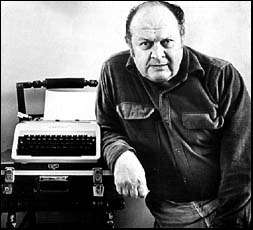
The Weekend’s Difficult Men (Man #1): Richard Hugo

Even if he hadn’t written some of the better American poetry of the 1960s and 70s, Richard Hugo would be remembered by literary history for a number of reasons. Maybe only as a footnote, but still, a long one. He was one of Theodore Roethke’s students at the University of Washington. He co-founded Poetry Northwest. He taught at the famed Iowa MFA program. He was a friend and fellow-traveler of poets like William Stafford, Carolyn Kizer, James Wright, James Welch, and A.R. Ammons. And, perhaps most importantly, he taught creative writing for nearly two decades at the University of Montana, helping turn that MFA program into one of the finest in the country.

But luckily for readers of English, he happened to write a number of wonderful books of poetry, plus a crime thriller, a fine collection of autobiographical essays called The Real West Marginal Way, and a justifiably still-famous rumination on the art of poetry, The Triggering Town. His collected poems (titled Making Certain It Goes On) and Selected Poems are both available from the usual places, as are the prose books.

A word of caution, I guess: Richard Hugo is a very good poet, but he isn’t a great poet. He’s not in Whitman’s or Bishop’s league.  (It’s kind of like the difference between, say, Patrick Ewing and Michael Jordan.)  Mainly this is because Hugo has one fundamental tone, from which he departs only very rarely, and which adjectives like “depressed,” “bitter,” “despairing,” “morose,” and “elegiac” (that’s probably the best and most charitable one)  describe only half-adequately. You’ll see what I mean if you decide to read him; it comes across even if you only look at the half-dozen Norton Anthology pieces. It is most certainly NOT because he writes a lot about one loosely defined region of the United States, the Northwest (comprising both the Upper Plains and the Pacific region). You see, he still sometimes gets typecast as a “regionalist,” which in the lingo of American lit teachers tends to have lame, unfair connotations of “minor” or “fringe.”

Hugo’s major theme–as distinct from his emotional tone–is the impossibility of finding a stable, legitimately happy home in America. He was a white man from the improbably named White Center, at the time a gritty working-class suburb of Seattle; his father ran out on the family when Hugo was a kid; he had a terrible drinking problem; he suffered lifelong trauma (what would now be called PTSD) from his tour as a B-17 navigator in World War II; he constantly lamented his perceived failures with women*; he never really seemed to accept that by middle age he had become a respected American writer; in short, he always thought of himself as a schlemiel, and this fundamental theme gets articulated in a consistent pattern of settings. Wrecked or abandoned towns after the gold-mining industry failed. Cruddy villages in Italy. Failing small farms. Dive bars. Rivers near the Pacific. Fishing. More dive bars. Long car journeys from desolate hamlet to even worse (Hugo is the great American poet of the highway). The scenes of Indian massacres and humiliations, and the white liberal’s consequent, and justified, guilt. The austere natural environment of Montana and Washington.

*Regarding his sexual neurosis: this is where and why H. occasionally slips into adolescent self-pity, which in turn borders on misogyny and sometimes results in genuinely creepy passages about women who “wronged” him. You might want to steer clear of these poems, which are scattered throughout his corpus.

As for his style, Hugo is prosy, insofar as he mimes the voice of someone talking / confessing directly to you, but he also mixes in buried and half-rhymes, the occasional delicious stretch of iambic pentameter, and a lush profusion of image that most novelists don’t risk going after. His images are severe, though, and he rarely ventures into blowsy John Ashbery territory. It boils down to this: Hugo demonstrates the poetic utility of both free verse and metered verse–he reminds the reader that these things aren’t anathema to one another, that in fact they can be mixed in the same poem.

Hugo is essentially a confessional poet, writing with the same general attitude as Plath, Lowell, and Berryman. By this I mean he talks about himself and his small world a great deal. Personal memory is what fires him. He bares his heart, whether you want to hear it or not. But he is different from those poets in a crucial way, because unlike them he always connects the story of his existential despair (pardon that phrase) to wider and, from most people’s point of view, more important problems like environmental devastation, economic collapse, and the long, long history of Native American genocide. Hugo is a poet for American outcasts and underdogs; if you’re one, or were one, chances are you’ll empathize with him, and maybe even like his poetry, whether you came up in rural Nevada, the South, Harlem, East LA, or wherever.

What are you waiting for?  Start Googling him. Read what comes up. And consider buying a Norton Anthology of Modern Poetry.  If you want to keep your library light, this is a book you need.

-TGR

the substances of literature

Too often too much is made of which writers used which drugs and how much: a lot of people have this dimly romantic view of literary creation, according to which it’s fundamentally important that Hemingway drank heavily or that Coleridge was an opium addict or that Pynchon likes to smoke weed.  Not to say that the theme of drug use and/or addiction isn’t important to many literary works qua works; but it’s probably going too far to assume that a particular writer’s brilliance has much to do with her chemical habits (although the problem of writers who DIDN’T fully develop their gifts can often be substantively connected to drug use, especially alcohol use—see Fitzgerald, F. Scott*).  Artists in general do seem to be attracted to alcohol and other drugs, but nonetheless for every bibulous scribbler you can find two writers who didn’t indulge much.  And there are plenty of dentists and plumbers who like drugs, too.

That said, this chart from Lapham’s Quarterly is tons of fun.  Did you know Auden was a speed freak?  (In the morning at least, when he needed to wake up after all that boozing he did.)

-TGR

*But seeing as though The Great Gatsby is one of the finest novels any American has ever written, who really cares?

Sunday Poet: Louise Bogan

My blog production will go down markedly now that baseball season has started and the fascinating (Western Conference) NBA playoffs are on, too. But I would like to point you toward a poet you will probably like if you like to read poetry. Or if you aren’t sure, or don’t quite. Her name is Louise Bogan and she’s quite accessible. Bogan was the poetry editor of The New Yorker for almost 40 years (from the early 1930s until the ’60s, I think), which makes her one of the people who turned that magazine into perhaps the best English-language publication on earth. From what I understand she was an advocate of writers like Elizabeth Bishop, Robert Lowell, and Marianne Moore. More importantly, Bogan was a poet. Ecco Press publishes a slim retrospective collection of her stuff, The Blue Estuaries, available from the usual places.

Here is the best way I can describe her: Bogan is a weird, eerie, sometimes downright hallucinatory poet, but she is also formally conservative, preferring now to deviate much from the norms of English metrical verse. She rhymes and keeps a beat. In this sense you can see how she fits into a line of visionary weirdos that begins with poets such as Blake, Dickinson, and Yeats and continues on to people like Sylvia Plath, John Berryman, James Tate, Kay Ryan, John Ashbery, and Matthea Harvey. Formally speaking, Bogan is closer to the earlier visionaries; she is particularly good with tetrameter lines (i.e. lines that have 4 beats), using them for bleakly comedic and jerky, surrealist effect. Dickinson’s voice, again. A tetrameter line is short, so if you don’t want a series of them to take on this obnoxious, unintentionally funny bouncety-bouncety-bounce rhythm, you’ve got to be deft. Here is her 1937 poem “M., Singing” (copyright Louise Bogan, 1968):

Now, innocent, within the deep
Night of all things you turn the key,
Unloosing what we know in sleep.
In your fresh voice they cry aloud
Those beings without heart or name.

Those creatures both corrupt and proud,
Upon the melancholy words
And in the music’s subtlety,
Leave the long harvest which they reap
In the sunk land of dust and flame
And move to space beneath our sky.

How old-fashioned: Bogan capitalizes the first letter of the first word in each line!  Gives the fever-dream a certain dignity, yeah?

You can see what Plath and Roethke, for instance, learned from her—those clipped, sharp-rhymed little lines—and then modified for their own purposes (they both like to mix in free-verse, more image-rich phrases). Bogan is not a comforting poet, like Shakespeare is, and she’s not as funny as Auden or Louis MacNeice, the two European poets she most resembles. But she isn’t cold, not really. Rather her verse is just totally unsentimental. Some of this mood derives from her rhythmic practice, some of it from her refusal to let her poems become reducible to neat thematic summaries (“this poem is about. . .”), some of it from how sparse her images are, some of it from her skeptical view of things like love and calm. But a lot of beautiful poets—say, Frost—are pleasurable without being straightforwardly consoling. You admire how well they put it, and how  bravely, “it” usually having to do with disappointment or loneliness, but sometimes joy. The muted solace Bogan offers comes from the brevity, and the bizarre subconscious precision, of  her dream poems. Chances are you’ve been there.

to reiterate . . .

. . . American hip-hop honors the metrical traditions of English poetry far more than most contemporary American poetry does. Plus, a lot of it bangs–like Shakespeare and Auden bang. Moments of joyful noise, musical ecstasy, yeah?

“But isn’t poetry written for the ear . . . boring? Isn’t free verse mandatory?  We know what that term means, right?” NAH GIRL.

Anyway, before everyone else gets on his dick, just like Pitchfork did this week, here is the first single off Big Boi (of Outkast)’s new LP, which, judging from its genuinely bizarre title, Sir Lucious Leftfoot: The Son of Chico Dusty, might be a concept album of some sort.  Maybe he’s going the Sherwood Anderson route. Actually, maybe he’s going the Jean Toomer route; after all, Cane uses poetry as much as it does narrative. Anyway, like I said, hip-hop can bang like most other* American music can’t.

*I do not include LCD Soundsystem, Michael Jackson, or the Pixies in that description. They certainly bump. I’ve heard that there’s other music in the world, so add to this archive as you see fit.

-TGR

Dig Carol Ann Duffy

My hunch is that American readers, even poetry aficionados, don’t read a lot of contemporary British poetry. The Irish lyricists get plenty of deserved attention, but their Anglo-Scottish counterparts–indeed, all the Commonwealth literatures (hear much about the great Australian Les Murray?)–are somewhat ignored, with the exception of Derek Walcott. Personally, I know almost nothing about newer stuff by Brits; my experience of their recent literature has mainly come through reading novels. But while studying for an exam a couple years ago, I did come across Carol Ann Duffy, Scottish resident of Manchester, born in the mid-1950s, publishing great short poems since the 80s.

She’s genuinely famous in the U.K. and was named Poet Laureate last year (the first woman to get the job), but Duffy isn’t taught much in American universities or written about in out literary mags. In lieu of me burping on about her anymore (she’s really good), I give you a BBC biography site and a link to a recent Guardian profile.

Google her. Read whatever comes up and also be advised that her Selected Poems (published as part of the very cool Penguin Poets line in 2004 and again in 2009, in a better-looking edition) is available on Amazon.com for as little as three bucks.

-TGR

Martin Amis, “Success”

Do you sometimes read books? Are you a youngish male? (Bonus points for being the kind likely to feel vaguely sympatico with the main dude in Greenberg.) Do you ever complain about sex issues or your job? About class?  Like a drink? Have a sense of humor? Do you have at least a light liberal-arts education (including self-education)?

Then may I suggest Martin Amis‘ cruel, despondent, hilarious short novel Success? It’s a book about co-dependents who despise each other, and who are both vile, funny, self-obsessed human urbanites. The angst of writers like David Foster Wallace, Denis Johnson, and Junot Diaz is unimaginable without Amis; he is the bridge between their voices and the realist comedy exemplified by Graham Green, Kingsley Amis, Dickens, Conrad, Evelyn Waugh, and Charlotte Bronte. (Though Bronte isn’t a true realist. Plus, you would need to talk about Rabelais and Henry Fielding and D.H. Lawrence, who is unintentionally funny. Of course Samuel Beckett, too.  Especially him. Anyway.) Success is a book to read if you fancy yourself cosmopolitan in that coastal Anglo-American hip way but also enjoy ironic perspectives on the foibles of said lifestyle. Amis is a novelist for the end of parties, also the beginnings of them and the middles.