James Tate, Bourgeois Surrealist (A Decent Thing to Be)

Poetry based on neo-surrealist free association, homespun absurdities, televisual appetites, and a twitchy sense of humor (much of it written in a voice that, on a rhetorical level, describes impossible scenes with great clarity) isn’t for every reader—just the ones with good taste.

Hey everyone, allow me to introduce James Tate, if you haven’t already made his acquaintance. Tate published his first book of poems in 1967, when the slightly older John Ashbery was developing his own eccentric vocabulary, and with plausible reason the two poets are often compared. Tate’s poems are leaner than Ashbery’s, however. This is a compliment. Whereas even in his best years (before the late 80s) Ashbery dabbled in torturous syntax and ironic maunderings with no payoff (not even nihilistic humor), Tate is handy with short lines, stand-up-comic weirdness, and a narrative (kinda) sensibility based on image-to-image jumps. Sometimes the stanzas can be downright spindly, in a Kay Ryan or Donald Justice sort of way.

An aesthetic like this can easily degenerate into rote, tedious auto-Dada. (You put a thing beside another thing it doesn’t usually go beside, then brandished an unexpected cognitive reaction. Human minds are weird, modernity is cheap, got it. And no need to conclude!) Tate has written some bad poems; but as Auden pointed out when the Paris Review interviewed him, so has every poet.

Tate isn’t a collage artist, but he does love junk and abundance. You might call it Bricolage Wave. His strongest work exploits the material vocabulary of the mid-century United States, dicing up its cynical romanticism and physical paraphernalia (motorcycles, eyeliner, confetti, cigarettes, motels, telephones, advertising puns, litter, bureaucracies). The poems are salads. Many are comic with an edge of menace. For texts that generally disdain rhythmic regularity, their forms often exhibit a fine grasp of written music. They challenge one’s attempts at interpretation while still drawing upon a reservoir of culture literacy and demanding that the reader be familiar with this.

This is all to say, Tate is worth reading. If you like Seinfeld and Tom Waits (or Action Bronson), you will enjoy him. Here is “On the Subject of Doctors,” part of the collection Viper Jazz (1976), which sounds like a Steely Dan album. The final seven lines in particular show Tate’s talent for low-key rhythms and half-humor. Keep it uneasy, yeah?

I like to see doctors cough.
What kind of human being
would grab all your money
just when you’re down?
I’m not saying they enjoy this:
“Sorry, Mr. Rodriguez, that’s it,
no hope! You might as well
hand over your wallet.” Hell no,
they’d rather be playing golf
and swapping jokes about our feet.

Some of them smoke marijuana
and are alcoholics, and their moral
turpitude is famous: who gets to see
most sex organs in the world? Not
poets. With the hours they keep
they need drugs more than anyone.
Germ city, there’s no hope
looking down those fire-engine throats.
They’re bound to get sick themselves
sometime; and I happen to be there
myself in a high fever
taking my plastic medicine seriously
with the doctors, who are dying.

Local Geographies: Three Kinds of Document

This afternoon, after the rain broke, I went running (jogging) through my neighborhood, a citrus suburb that leans against a sliver of marshy, protected coast. The beauty of the rich green strip between the dense, humanized local environment (organized around U.S. 101) and the Pacific will make you happy to live on Earth, and so of course some ghouls want to “develop” (a verb we should put on probation) it into a pleasure dome for millionaires. Right now an anonymous Saudi investor owns it, but thanks to this area’s crazy liberals and the civic codes they have gotten enacted, s/he can’t destroy it yet.

My ‘hood is beautiful too, though. It is a shakily middle-class area that has evolved into a low-key, vernacular garden suburb. The hummingbirds are loud here, and we actually have honeybees, because over the past four decades the properties have mostly relaxed back into the land: almost every owner or renter maintains some mixture of vegetation—my tiny studio’s kitchen garden hosts California poppies, nasturtiums, sunflowers, aloe, two kinds of lavender, potatoes (I haphazardly buried a few moldy ones), mint, sage, shallots, and an elephant bush that is held up by two stakes and a web of steel wire. In the local argot the area is called “Noleta,” because although it is technically an unincorporated part of Santa Barbara County, it is culturally and economically scruffy, more similar to oceanside (southern) Goleta than central SB. I am grateful for the place in a way that exceeds my usual vain doings. After almost nine years in California my favorite parts of the state—a real American state but also the mental condition attendant thereon—are its humble parts.

With that preamble in mind, here are some texts that encounter and carefully document various local environments. May your habitat be sustainable, y’all.

  • If Adam Weinstein hadn’t written this, Ken Layne would be my favorite Gawker contributor, although he is apparently now leaving the site to run his own. Recently the man went on a walking tour of the region we have been told to call “Silicon Valley, ” and in Layne’s account, “Heart of Blandness,” the creepiest thing about the motherboard of the corporate tech sector is its physical banality: in material terms, it is just a constellation of heavily armored office parks set amid a congeries of infrastructure that has been crumbling since the Clinton administration. When the workday ends, the employees are bused (in private buses with tinted windows) back to their homes in San Francisco, where people who don’t work in Silicon Valley find it increasingly hard to afford to live.
  • Nineteenth- and twentieth-century America might have had a thing for the idea of Wilderness, but the nation’s greatest lyric poet wrote about nature in a town in Massachusetts. In this one here, Emily Dickinson looks at a snake; in this one here, Emily Dickinson reminds you that besides Shakespeare, nobody can bend language like she does, twisting it till it sounds eerily familiar again, like a tape of what happened inside your head when you stepped outside. If you don’t have a copy of the definitive edition of Dickinson’s notoriously complex archive, why do you even speak English? Do not trust the Google results, because many published versions of Dickinson’s poems mistakenly attempt to “normalize” her language and ignore her strange seventeenth-century capitalization habits, intentionally dropped or distorted punctuation, and seeming gaps in logic. Instead, buy the R.W. Franklin reading edition linked to above. It costs like three gin-and-tonics. If you went to college and don’t own it, do not talk to me about books. Ride or die Dickinson.
A narrow Fellow in the Grass
Occasionally rides –
You may have met him? Did you not
His notice sudden is –
The Grass divides as with a Comb –
A spotted Shaft is seen,
And then it closes at your Feet
And opens further on –
He likes a Boggy Acre –
A Floor too cool for Corn –
But when a Boy and Barefoot
I more than once at Noon
Have passed I thought a Whip Lash
Unbraiding in the Sun
When stooping to secure it
It wrinkled And was gone –
Several of Nature’s People
I know and they know me
I feel for them a transport
Of Cordiality
But never met this Fellow
Attended or alone,
Without a tighter Breathing
And Zero at the Bone.
  • In November, after about thirty people who know more about music than I do told me to, I downloaded Action Bronson’s mixtape Blue Chips 2, and since then I have bumped at least part of it at least part of every day that I’ve been near a speaker or a headphone. Do you like it when populist MCs with deranged lyrical gifts team up with DJs who prefer fun instrumental tracks? No? Then stop reading this blog. Yes? Then use a search engine and get the mixtape for free. In the meantime, here is “In The City” (feat. Jeff Woods), a short punchy track Bronson hides in eighteenth place on a collection that is, in this critic’s humble view, fucking bananas awesome.

http://www.youtube.com/watch?v=q2cCXNQH4_A

Linking in the Rain

I am well aware of the fact that much of the rest of the country is laughing at Los Angeles right now. “Oh, poor babies can’t deal with a wittle wain?” Laugh all you want. We accept your derision as the price we pay for living so well 350 days a year. But seriously, this rain IS NUTS. Last night, lightning struck just down the street from my house, and downtown got more rain yesterday afternoon than it had in the previous year. LA is uniquely poorly equipped to deal with this kind thing, which (as Ryan pointed out) John McPhee, Mike Davis, and Carey McWilliams have discussed in some of the classic works of Los Angeles naturalism (and LA naturalism is always at least 50% anthropology). So you could read those this weekend as you wait out the storm, or you could read some of the following;

  • Edward Mendelson, the editor of W.H. Auden’s Collected Poems, has written a terrific essay in the New York Review of Books about Auden’s private acts of charity. The following anecdote is my favorite: “I got a phone call from a Canadian burglar who told me he had come across Auden’s poems in a prison library and had begun a long correspondence in which Auden gave him an informal course in literature. Auden was especially pleased to get him started on Kafka.” Auden’s personal kindnesses were just that, personal. Mendelson argues that, “[b]y refusing to claim moral or personal authority, Auden placed himself firmly on one side of an argument that pervades the modern intellectual climate but is seldom explicitly stated, an argument about the nature of evil and those who commit it…On one side are those who, like Auden, sense the furies hidden in themselves, evils they hope never to unleash, but which, they sometimes perceive, add force to their ordinary angers and resentments, especially those angers they prefer to think are righteous. On the other side are those who can say of themselves without irony, ‘I am a good person,’ who perceive great evils only in other, evil people whose motives and actions are entirely different from their own. This view has dangerous consequences when a party or nation, having assured itself of its inherent goodness, assumes its actions are therefore justified, even when, in the eyes of everyone else, they seem murderous and oppressive.” This is a provocative thesis, but it makes intuitive sense. Auden was a liberal, but one with a sense of humor. And with a sense of humor comes a sense of the tragic ways every man fails to do what he should. It’s not to say that we shouldn’t judge obviously bad actors (from Stalin down to a casually racist relative), just that in holding ourselves up as paragons of virtue we fail to scrutinize not only our own actions, but even our own potential to do evil. Auden sounds like he was, in most respects, a pretty decent dude. But one could probably make a similar case for the pre-presidential George W. Bush (not Dick Cheney, never Dick Cheney). And we all know how that turned out, right?
  • I guess this is a NYRB-themed post, because we’re sticking with that publication, but getting in the Way-Back Machine and heading to 1979. Just read this opening paragraph from Joan Didion’s “Letter from Manhattan,” an essay about Woody Allen (yes, yes, I know, I am not supposed to mention his name): “Self-absorption is general, as is self-doubt. In the large coastal cities of the United States this summer many people wanted to be dressed in ‘real linen,’ cut by Calvin Klein to wrinkle, which implies real money. In the large coastal cities of the United States this summer many people wanted to be served the perfect vegetable terrine. It was a summer in which only have-nots wanted a cigarette or a vodka-and-tonic or a charcoal-broiled steak. It was a summer in which the more hopeful members of the society wanted roller skates, and stood in line to see Woody Allen’s Manhattan, a picture in which, toward the end, the Woody Allen character makes a list of reasons to stay alive. ‘Groucho Marx’ is one reason, and ‘Willie Mays’ is another. The second movement of Mozart’s ‘Jupiter’ Symphony. Louis Armstrong’s ‘Potato Head Blues.’ Flaubert’s A Sentimental Education. This list is modishly eclectic, a trace wry, definitely OK with real linen; and notable, as raisons d’être go, in that every experience it evokes is essentially passive. This list of Woody Allen’s is the ultimate consumer report, and the extent to which it has been quoted approvingly suggests a new class in America, a subworld of people rigid with apprehension that they will die wearing the wrong sneaker, naming the wrong symphony, preferring Madame Bovary.” I’m always trying (and probably failing) to explain to my students why introductions matter. Perhaps I should just show them this and ask if it makes them want to keep reading. Anyone who says “no” gets an F.
  • To bring things back to Los Angeles for a few minutes, please read this excellent Nicholas Miriello essay from the Los Angeles Review of Books that engages with the following topics: Don DeLillo, Martin Amis, Frasier, Spike Jonze’s Her, and Netflix binge-watching. It’s as if he has some sort of NSA file on me…
  • Finally, speaking of Her and the evil we are all capable of, I will once again shamelessly plug work I have recently had published in other outlets. It’s Oscars weekend, so we’ll frame this like an acceptance speech: “First, I’d like to thank Southern Spaces for publishing an essay I wrote on Steve McQueen’s 12 Years a Slave. I’d also like to thank Religion Dispatches for running a piece I wrote about Her. Finally, I’d like you all to support the Hawai’i Pacific Review, without which my poem, ‘Two by Two,’ would have remained but a dream.” (Cue the strings, his head is twice its normal size!)

Stay dry, kids.

Weekend Verse: Auden’s Tables

W.H. Auden is the best. His feline sense of humor and mid-century Greenwich Village/Brooklyn Heights cool are part of that (see below), but his value mostly consists in his poems. If you haven’t heard of or read him yet, no problem; you will probably like his poetry, because Auden actually wrote with his reader in mind, which means he thought about how to coherently convey human experience within a text. He assumed that a reader would appreciate a poem that is at least somewhat situationally intelligible (i.e. where you can tell what basic human action, occasion, or event is at stake); serious without being pedantic or humorless (even an honest master like T.S. Eliot is frequently guilty of the latter); and musically pleasurable—and this, the human delight in rhythmic sound, is the heart of Auden’s work. Rhyme and a beat are what you want, not traits to be rejected because, I don’t know, Difficulty is good or whatever. His work is comforting in a way that much modern poetry isn’t, though it would be hard to justify calling much of it “optimistic.”

Any poet who wants to have many readers must be entertaining, just like a novelist, although of course entertainment is a small part of a writer’s function. Auden’s entire corpus gets at what Dana Gioia gets at in his 1991 (and still pertinent) essay “Can Poetry Matter?” (Answer: qualified Yes, if poets bother to write sonically pleasurable things that lay readers can make intellectual sense of, and avoid the arcane density pimped by some MFA holders.) No emotionally healthy person willingly reads much of anything they don’t enjoy on a dopamine level. Outside of the fantasies of academia’s most pious residents, abstract appreciation never led anyone to finish a book.

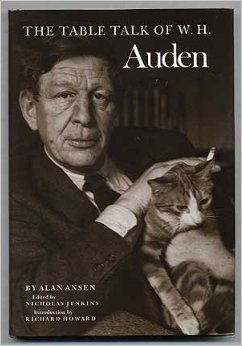
Auden writes criticism with the same attitude. Like any effective teacher, he is into cool things and wants to tell you about them, though he doesn’t particularly care about their present cultural cachet. In the introduction to the book which provides the amazing cat picture below, Richard Howard reports that, in the poet’s words, “criticism should be a casual conversation.” It should be accessible, sharing the author’s knowledge instead of flaunting it. (If you want to read more about this, the poet James Fenton, whose witty, form-conscious work owes a lot to Auden’s example, lucidly underscores the connections between poetry and critical prose in “Blake Auden and James Auden,” a lecture reprinted in The Strength of Poetry: Oxford Lectures, which Farrar, Straus and Giroux published in 2001.)

In all of his essays, lectures, reviews, introductions, forewords, afterwords, jacket blurbs, and sundry ephemera, you see the same thing as in the verse: profoundly compassionate humanist thinking that delights in language and ranges in philosophical content from funny to sorrowful to resigned to ambivalent to defiant. Guy is a nonfiction sibling of Dickens and Foster Wallace, and a poetic ancestor of Jennifer Egan’s A Visit From the Goon Squad (2010), a novel you should absolutely go find right now, because it is incredible. In the foreword to his own Collected Shorter Poems 1927-1957, Auden insists that “a dishonest poem is one which expresses, no matter how well, feelings or beliefs which its author never felt or entertained”; and then, lest he appear sanctimonious, he blasts himself for once “shamefully” espousing a “wicked doctrine” that “equate[s] goodness with success” (“History to the defeated / may say alas but cannot help nor pardon”) just because it sounded good.

Further, and lucky for us, a great deal of Auden’s conversation survives in the form of interviews (the Paris Review has a long one somewhere in their archives and in a paperback I’m not climbing into my attic to find) and recorded conversations like those comprised in Alan Jenkins’s Table Talk of W.H. Auden. Like Coleridge, Samuel Johnson (in Boswell’s Life of Johnson), and Orson Welles, Auden was a good talker. Even when he’s being flippant or getting bored with a topic, the man’s erudite intelligence is beguiling.

Perhaps more importantly, the cover of Table Talk is incredible. Try to stop looking.

Auden Table TalkYou can’t, can you? I got it for $4 in Portland a few years ago because someone at Powell’s didn’t do their homework. Not that it is the kind of rare tome Johnny Depp pursues in that documentary The Ninth Gate, but I still saved at least fifteen dollars. The walls of my studio are a cultural lifeboat. 

Here are some choice cuts. Keep in mind that despite being a gay cosmopolitan artist who hung out in Greenwich cafes and read Latin, Auden was also an Anglican Christian born in 1907, and he held some views that are now archaic, at least among coastal intellectuals.

On the replacement of public art with limbic pleasures:

Today [1947], the great question seems to be, should one write poetry at all? During the thirties the question was, what kind of poetry should one write? Should one write for the masses, for instance? But there was never any doubt whether or not one ought to write. The great question now is, what would give one pleasure? Ought one to write poetry, or fuck? (page 50)

On modern poetry:

I shouldn’t let anyone under 25 read Whitman, and Hart Crane is dangerous for the young. (57)

Shakespeare:

I think that Coriolanus is the most boring of Shakespeare’s heroes. Macbeth is pretty dull too. I’m extremely fond of The Winter’s Tale. Cordelia is really a silly little bitch. There are so many “No”-girls in Shakespeare’s last plays. He must have acquired a special actress who could play that sort of role. (55)

Reminding us that Oscar Wilde kind of sucks:

Wilde, after all, is important not as a writer—he couldn’t write at all—but as a behaver. Still he did say some very acute things.

On nineteenth-century English verse, which had its share of musically gorgeous fools and self-important nobs (that would be Shelley). This being Auden, he manages to bring sex into it:

Swinburne does what Shelley wants to do more successfully than Shelley. He lives entirely in a world of words, whereas some reality is always present in Shelley. I don’t think [Robert] Browning was very good in bed. His wife probably didn’t care for him very much. He snored and had fantasies about twelve-year-old girls. (97)

On how Americans often misprize British writers:

Samuel Johnson is a person not much appreciated in the United States. And the people who do like him are either like Yvor Winters [note: wonderful poet, aesthetically very conservative], or nasty types of Anglophiles who think they have to be rude and are usually Republicans. But Johnson was a great melancholic romantic and he wrote some exceedingly acute things. (18)

His qualified taste for pop culture:

Don Quixote is the only really Christian myth. You find a trace of it in L’il Abner in the Daily Mirror. Abner’s always trying to do someone a good turn, and it never works out. Superman and Little Orphan Annie ought to be on the Index. Henry Miller, certainly. Yes, Thomas Wolfe . . . [original ellipse] and Carl Sandburg—the prose is all right, but not the poetry. (59)

On the use of student evaluations of professors, and the narcissism of young Americans:

I’m really terribly annoyed over this teacher rating business. It’s democracy in the wrong place. It assumes that everyone’s opinion is as good as everyone else’s, which is simply not true. The result is that the teacher is encouraged to clown—to be an entertainer. But the teacher must know when he should be boring—something necessary for students sometimes. (57)

But they [undergraduates] begin with the idea that they are the important ones to be pleased—not taught—and that their untutored reactions should be the final judgement on their instructor. They’re so disobedient because that’s the way they’ve been brought up. (85)

Two for the ladies!

There are two things I don’t like. To see women drinking hard liquor and to see them standing at bars without escorts. Women should drink port with lemon. (39)

I don’t like it when women are nasty. Women are really supposed to be much nicer than men. That’s what they’re here for. Women shouldn’t be talked to on intellectual subjects because if they like you, they’ll agree without having any real opinions of their own. Oh, they are fun to talk gossip with. A few have real minds, but they usually make one feel uncomfortable. (66)

And for the men:

[. . .] America is really a very queer country. . . . All American writing [he singles out Fitzgerald’s This Side of Paradise] gives the impression that Americans really don’t care for girls at all. What the American male really wants is two things: he wants to be blown by a stranger while reading a newspaper and he wants to be fucked by his buddy when he’s drunk. (80-81)

Finally, the secret lives of cats:

Some Siamese cats are impossible because they keep continually crying. I’d rather have a tom. You know, they have a rugged time of it trying to service so many ladies. A friend’s was looking seedy. When he called the vet, the vet just laughed and said the cat would be fine once the rutting season was over. Cats will not let you work. They keep jumping all over you, try to attract your attention and just make a nuisance of themselves. (67)

But I believe we started out talking about poetry. So, to spruce up your weekend, here is “A Walk After Dark” (1948), whose rhymes and jaunty meter enhance, rather than reduce, its depth:

A cloudless night like this
Can set the spirit soaring:
After a tiring day
The clockwork spectacle is
Impressive in a slightly boring
Eighteenth-century way.

It soothed adolescence a lot
To meet so shamelesss a stare;
The things I did could not
Be so shocking as they said
If that would still be there
After the shocked were dead

Now, unready to die
Bur already at the stage
When one starts to resent the young,
I am glad those points in the sky
May also be counted among
The creatures of middle-age.

It’s cosier thinking of night
As more an Old People’s Home
Than a shed for a faultless machine,
That the red pre-Cambrian light
Is gone like Imperial Rome
Or myself at seventeen.

Yet however much we may like
The stoic manner in which
The classical authors wrote,
Only the young and rich
Have the nerve or the figure to strike
The lacrimae rerum note.

For the present stalks abroad
Like the past and its wronged again
Whimper and are ignored,
And the truth cannot be hid;
Somebody chose their pain,
What needn’t have happened did.

Occuring this very night
By no established rule,
Some event may already have hurled
Its first little No at the right
Of the laws we accept to school
Our post-diluvian world:

But the stars burn on overhead,
Unconscious of final ends,
As I walk home to bed,
Asking what judgment waits
My person, all my friends,
And these United States.
Friday Night Songs: Housman! Herrick! Springsteen!

By the time he finally died in 1936, the English poet A.E. Housman was forty years past his first and best book (1896’s chilling A Shropshire Lad), a dinosaur in the view of most living writers. The Waste Land, which helped create that thing college teachers tell you to call Modernism, came out in 1922, but in comparison to Housman’s language of experience, it might as well have been 2022. Housman hails from a late-Victorian England that knew it was vanishing, and which, in his case, largely took the form of a partially ironic pastoral language of tetrameter stanzas, waistcoats, pipes, elaborate mustaches, mossy pastures, bachelors, afternoon tea, diligent Latin (apparently some of Housman’s translations are still revered), and quiet middle-class homosexuality. Yet here it is 2014, and homeboy’s work is still in print for a damn good reason, which is that it is existentially timeless and metrically elegant, a hit song in poem’s clothing. Right now, the pears and cherries are blooming in California’s damp Mediterranean winter. This is the second poem from A Shropshire Lad:

Loveliest of trees, the cherry now
Is hung with bloom along the bough,
And stands about the woodland ride
Wearing white for Eastertide.

Now, of my threescore years and ten,
Twenty will not come again,
And take from seventy springs a score,
It leaves me only fifty more.

And since to look at things in bloom
Fifty springs are little room,
About the woodlands I will go
To see the cherry hung with snow.

But not all the modern hotshots had dismissed or forgotten him. In 1936 W.H. Auden’s gift was blooming, and this entailed his lifelong embrace of forms (like ballad meter) that many of his avant-garde contemporaries found simple-minded and archaic; Philip Larkin, whose genius emerged in poems that rhyme and scan, followed Auden’s lead. Both men were Housman fanboys. If one were looking for the opposite of Ezra Pound’s tedious poetics, this line of English prosody would be it.

Housman, of course, is only possible because of who wrote before him. His work points back to Renaissance lyricists like Robert Herrick, John Skelton, Shakespeare (even if you left out the sonnets), and Ben Jonson.

Were any of these men suckers for slightly disheveled beauty, for women whose physical presences aren’t entirely, elaborately assembled, for scarves thrown on at the last minute and light makeup and holes in black leggings? At least Herrick (1591-1674) was! By the time he wrote—about a generation after Shakespeare—English was more or less modern, close enough for you, dear reader, to follow along. When this kinda-sonnet (it has fourteen lines but none have five beats) cruised into the world, you know panties were dropping all over London:

A sweet disorder in the dresse
Kindles in cloathes a wantonnesse:
A Lawne about the shoulders thrown
Into a fine distraction:
An erring Lace, which here and there
Enthralls the Crimson Stomacher:
A Cuffe neglectfull, and thereby
Ribbands to flow confusedly:
A winning wave (deserving Note)
In the tempestuous petticote:
A carelesse shooe-string, in whose tye
I see a wilde civility:
Doe more bewitch me, then when Art
Is too precise in every part.

Other routinely anthologized poems from Herrick are “The silken Snake,” “Her Bed,” and “Upon Julia’s haire fill’d with Dew.” I’m citing from this Penguin collection, which you should own and can probably find cheap if you look around; failing that, you could just drop the piddling $25 for a new copy. What, you needed those three Jameson shots?

More songs! Let’s pivot to an American artist. My residual graduate training still objects that this sort of ahistorical, trans-Atlantic, slipshod move is not a research convention that English PhDs get jobs by pulling, but luckily, especially for me, I’m not an academic literary scholar anymore. I took what I needed. Turns out that on the General Reader, you can link Shropshire to the Rust Belt.

Bruce Springsteen’s hollow-eyed tape-deck masterpiece Nebraska (1982) might best be listened to on hand-me-down vinyl on a Goodwill turntable on a scarred desk in a rented room in, like, Iowa. Maybe you need to be drinking bourbon out of a Dale Earnhardt glass to truly savor this record and its gorgeous cover, maybe you’re wearing old jeans the winter sun can shine through, maybe it’s sleeting and you’re heartbroken . . . We don’t know! Your humble critic has found at least a dozen emotions in this thing. Like much of Springsteen’s best work (all of it pre-1990), like most lyrics that compel you to remember them, the rhythm and the rhymes are based on careful repetition spliced with metrical variation: whatever chaos or melancholy the songs are dealing with, the language is organized. Sometimes it is even catchy. I don’t want to be a total bummer, and I shouldn’t always link to trashy rap videos, so here is “Atlantic City.”

Second track on the album, about as buoyant as the scene gets. Put your makeup on, fix your hair up pretty. Stay safe out there.

Topical Verse: Williams’s Widow

To simplify the literary-historical narrative a whole lot, William Carlos Williams is often placed in opposition to Wallace Stevens. To simplify this post, both poets are fantastic, and you should read as much of their work as you can starting right now.

Williams is reputedly the more “American” in voice and subject matter; not exactly plainspoken, but carefully ordinary. To the extent that such a thing is possible in writing, he tried—as he spent his career telling everybody who would listen—to build and arrange his lines based on what he considered the rhythms of mid-century conversation and thought. The lines usually break where one can imagine a person taking a breath, changing the subject, or shifting from one mental association to another. This might make you think of the parts of Ulysses that aren’t boring. Charles Olson, a poet I generally dislike but agree with here, praises texts where “The contingent motion of / each line” ending leaves us hungry for a qualifier or a completion. (Charles Tomlinson first explained that point to me.) Williams routinely achieves this effect with clever syntactic breaks (e.g. splitting text between a noun phrase / and the subsequent phrase / that elaborates on it), instead of the containment structures of end rhyme and accentual-syllabic meter. (Roses are red, violets are blue, / Even blogs are a kind of poetry, too.)

Meanwhile (goes the narrative), although Stevens’s work is likewise obsessed with the corkscrews of human thought, he cultivates an aristocratic, ornate, Europhilic, philosophically gregarious, iambically oriented style that plays around with but eventually confirms the Anglo-American lyric tradition, wherein a delicate subjectivity (such as the poet’s) absorbs, interprets, and responds to the teeming world. In other words, even when Stevens’s poems are tongue-in-cheek (“Unsnack your snood, madanna“) or jauntily nonsensical (“The Emperor of Ice Cream”), they aspire to at least sound rhetorically conclusive.

Ironically, this oppositional narrative encompasses and, to a significant extent, relies on similarities. The poets were about the same age. Both spoke Romance languages in addition to their native English; were well-educated Easterners; enjoyed theorizing exuberantly about the power of a world-remaking, almost mystical poetic “Imagination”; and became large literary figures by late middle age. And no garrets for them, they had serious careers outside of poetry. Stevens was an insurance-company executive, and Williams, a family doctor, delivered thousands of babies in north Jersey. (It was easier for middle-class male poets to have demanding day jobs back when wives would customarily take care of scrubbing the bathroom and cooking dinner. Shacked-up poets my age are rightly expected to split the chores. Bachelor poets of course handle one hundred percent.)

A number of critics, such as James Longenbach in Modern Poetry After Modernism, disdain the tidy Stevens/Williams split, along with other reductive mega-narratives about how some phenomenon called “modernism” led straight into whatever the hell “postmodernism” is, or about how Poet A influenced Poets B and C, who in turn bequeathed major parts of their sensibilities to Poet D, who, unlike Poet E, didn’t end up rejecting that aesthetic worldview. And so forth. Marjorie Perloff argues that Williams’s true foe was not Stevens but T.S. Eliot—Williams distrusted what he saw as Eliot’s patrician nihilism—while Stevens was actually the antagonist of Ezra Pound, whom by many accounts he considered a fraud. (Which isn’t an untenable opinion. Unlike Stevens and Williams, Pound was always—rather than just some of the time—pompously self-important about his views of Art and Culture, and when it comes to most of his work after about 1930 there isn’t enough musical pleasure to excuse or obscure a mind that revered Mussolini and deemed a thousand pages of largely incoherent bricolage the right sort of “epic” for the modern age—just try slogging through his Cantos. A few are good. Most will make your forehead throb.)

Still, the Williams v. Stevens deal is not entirely fatuous. The former’s writing truly is less bookish and more at home in the twentieth century, even its grubby parts, hence the well-known wheelbarrows, county hospitals, and baseball games. The USA of his lifetime didn’t unsettle him too much. Stevens, on the other hand, might have hailed from rural Pennsylvania, but in poems he often views the universe as a tourist or collector would. The man was detached about his detachment. Even when his poems name American places (Tennessee, Florida, Oklahoma, New Haven), they are not “about” or situated in those places, which in Stevens’s hands become emptied-out terms, or “shadow worlds,” as Perloff has it. His poems love the world yet aren’t completely comfortable there, so instead of presenting themselves as referential, they turn real spaces into what often seem to be stages, curio cases, dioramas, such as with the famous moonshine jar. Stevens is also a much bigger fan of commas.

But as the decades keep passing—these “modern” writers came onto the scene almost a century ago and were dead before JFK was—grand categories make little sense outside of academic careerism and scholarly quibbling. Besides, literary competition, whether cooked up by a writer or a reader, is stupid, because there is always plenty of language to go around. While it would be difficult to mistake one writer’s work for the other’s, style-wise, if you have read enough of Williams and Stevens they begin to sound like half-siblings. Not brothers, but not distant cousins either, and certainly not strangers.

So how to explain this? Like all poets who are good at writing poetry, whatever forms they prefer, Stevens and Williams sought to reproduce “radiant gists” (WCW’s phrase) of identifiable experience, a goal most readily realized in lyric poems, and indeed these dudes are at their best when they keep things under a couple pages and play up the overlapping sounds and lovely pictures. Unfortunately, each also wrote lots of long, uneven poems. Paterson, Williams’s epic, has numerous prosy stretches that suuuuck, while Stevens’s Notes Toward a Supreme Fiction is a congeries of lyrics, not a unified epic, a reality many scholars ignore in spite of the title. (NOTES!) Further, their strongest texts are visually acute, rich in half- and internal rhymes, frequently arranged into stanzas or couplets, and redolent of symbolism, in the sense that they tease the reader into thinking that some object (a bouquet, a fish, a factory) in a text represents a Bigger Concept, while also frustrating any attempts to track and clarify the perceived symbolism. They are both funnier than readers usually realize.

This poem, “The Widow’s Lament in Springtime” (1921), isn’t a funny one, though. Like a lot of lyrics, it confronts death, in this case a death that has already happened; and like most lyrics written in English since about 1580,  it is based on the conceit that readers are overhearing a lone, conflicted speaker. That said, it is not a tragic poem. The widow’s marriage was long. She grieves immensely but her son is alive, and it is no catastrophe for a child to bury a parent. (The reverse is.) Although it would be a stretch to say that a feeling for nature is somehow healing her, the widow’s mourning is implicitly tied to biospheric arcs of death, decay, and regrowth. Williams’s debt to Whitman’s Leaves of Grass and its quasi-ecological conception of eternity (“there is really no death“) is evident here. Anyway, I’ll stop talking. “Widow’s Lament” is great. Enjoy. You are lucky to live in a place in a time in the world where you can read poems. Don’t sleep on that.

Sorrow is my own yard
where the new grass
flames as it has flamed
often before, but not
with the cold fire
that closes round me this year.
Thirty-five years
I lived with my husband.
The plum tree is white today
with masses of flowers.
Masses of flowers
load the cherry branches
and color some bushes
yellow and some red,
but the grief in my heart
is stronger than they,
for though they were my joy
formerly, today I notice them
and turn away forgetting.
Today my son told me
that in the meadows,
at the edge of the heavy woods
in the distance, he saw
trees of white flowers.
I feel that I would like
to go there
and fall into those flowers
and sink into the marsh near them.

Sunday Links: Land of Little Rain

Driving up to Santa Barbara the other day, I was stunned by how dry everything was. The hills cutting through Calabasas weren’t just brown, they were radiantly brown. It was as if they were screaming. I’m not sure if their screams were taunts (“we’ll be bringing you some fire real soon, you bet”) or pleas, but this drought we’ve been experiencing here is unnerving. While the rest of the country has been dealing with polar vortices and abominable snowmen, California is just drying up. It’s a less obvious and romantic way to go, but it’s happening nonetheless.

But we’re soldiering on here at TGR, bringing you prose straight from the land of little rain. So for your no-football Sunday pleasure (relax, it will be back next week, and hey, there’s always the NBA), we present the following:

  • Slate‘s “Photo Blog” is one of their better regular features, and the current offering is particularly good. David Galjaard’s series of photos of Soviet-era Albanian bunkers is an important reminder that while the Iron Curtain might have fallen a couple decades ago, the terror it brought to the people and the land is still influencing events on a global and local level. I am currently reading Martin Amis’s Koba the Dread, his impressionistic study of Soviet crimes, and the death and torment it details is so vast and sadistic that it begins to blur. These Albanian bunkers though are decaying physical monuments to tyranny, a word used too often in American politics to describe minor squabbles about 2% variations in marginal tax rates. Koba knew tyranny, folks. Neither Barack Obama nor Paul Ryan are it.
  • And, right on cue, here’s a great example of defining tyranny down: an Atlantic piece called “The Tyranny of the College Major.” I’m pretty sure the author, Humboldt State philosophy professor J.W. Powell, didn’t write the headline, so I’ll give him a pass, but come on, Atlantic. That faux pas aside, the article is a pitch for basically inverting higher ed: instead of having a common major and a grab bag of GEs, a school would have a common “Great Books” style core, and then students would undertake 3 minor-load fields of study. I find this idea appealing, but it’s a pipe dream for all of the reasons Powell lays out in the piece. Still, I am all for making college harder and less obviously utilitarian. Maybe then big businesses would stop using universities as free (free to them, that is) job training, and our economy could be a place where folks who don’t want to go to college but who are still totally fit for white-collar work aren’t doomed.
  • I have been writing some film criticism lately, so I was pleased to stumble across (or Twitter across?) this short Richard Brody post on The New Yorker‘s website about the role of the film critic now that more information about more films is readily available to anyone with Internet access (so most people who’d want to read film criticism). I particularly like the following observation: “The rise of independent filmmaking has given rise to its own downside: the writer-director, in that order. Many of the worst independent films are marked by the sense that the filmmakers, who wrote their own scripts, became directors largely to protect their scripts and to transmit their content to the screen as purely as possible. In classic Hollywood, it was the producer who kept directors bound to scripts, and the great Hollywood directors were always those who—regardless of what the credits say—had a great deal of input in the scripts and even changed them on the set, in spite of possible resistance from producers. In the decadent form of independent filmmaking, such constraints are self-imposed.”
  • Sarah Kendzior, whom Ryan has written about before, is a fantastic writer. I don’t always agree with her, and I get the impression that her politics are more radical than my own, but her latest post for Chronicle Vitae is spot on. The role of academic publishing in the higher ed labor market is not talked about enough, especially in light of the fact that it seems to exist solely to prop up the tenure system at this point. Most academics aren’t making money off of their UP monographs, and they usually end up getting read by maybe a dozen people. Meanwhile, activities like blogging, creative writing, popular press publishing, and journalism often don’t count towards tenure and promotions. Higher ed needs to undergo a lot of pretty fundamental transformations in relation to how it allocates money, but another major change that needs to happen is within departments themselves: they need to encourage their faculty to think of themselves as teachers first, as public writers second, and as academic researchers (a very distant) third. Crazy, I know. This kind of thinking is probably why I’m not on the tenure track. Frankly, I’m happy not to be.

Topical Weekend Verse: Adam Zagajewski, “At Daybreak”

Four years ago, when I was just a wee blogger, I wrote an embarrassingly fulsome review/appreciation of Adam Zagajewski, a Polish poet whose work exists in a fantastic English translation. Read the ancient post if you dare; it isn’t very good, being far too emotional and impressionistic in terms of how it treats the writer’s themes, although the coverage of his form and style is not entirely stupid.

Fortunately for all of us, good poetry survives its readers, even ones who were green with fantasies of being a literature professor someday. I still ride hard for Zagajewski. If you read him, there is a good chance you will end up doing the same.

Like any writer worth one’s time, Zagajewski seems to actually think about the experience of his readers. While his poems—many of them not longer than a page—are by no means facile, they are intelligible: an attentive reader will be able to grasp the situation to which the lyric utterance responds, because unlike a lot of well-published living poets, Zagajewski is not taken with his own linguistic density or philosophical heft. (Google some Jorie Graham and try not becoming confused, then exasperated, then nauseated, then just bored.) Snobs and hacks go in for performative, intentional Difficulty, barfing out poems that elucidate nothing of the bewildering universe we inhabit because they mistake incomprehensibility for complexity. Poetry like that can win awards and endowed professorships. It also makes the world ugly. It piles aesthetic confusion upon a Lebenswelt that is already plenty confusing.

Zagajewski’s best work is conversational. Because this often involves “overhearing” a lone speaker thinking, he might remind you of C.P. Cavafy or the T’ang dynasty masters. His favorite pronouns are “I” and “you” (“Only in the beauty created /  by others is there consolation, in the music of others and in others’ poems. / Only others save us”). At least in translation—I don’t speak Polish—his lines shift between loosely iambic meters and prosier “free verse,” not intensely musical but based on a quiet lyrical hinging of clauses spread over line-breaks that generally don’t try to unsettle the reader (unlike the / work / of many poets these / days of /ours). That said, he isn’t above using strange enjambments here and there, and the man knows how to deploy internal rhymes and half-rhymes. His speakers are meditative without being impressed by their own minds or arrogant about their ability to concoct a decisive answer to some existential question; as such they come off as fundamentally decent men and women. His texts are visually rich, albeit not photographic, shaped by his incredible gift for metaphorical reconfigurations of the seen: you run across “the savage lamp of the jasmine” and a muggy summer sky that “hung above me like a circus tent,” you encounter “A black rooster” who resembles “a hot, black banner of blood,” you watch how “Memory will open, with a sudden hiss / like a parachute’s.” And he is heart-deep in the history of his native country yet avoids ideological score-settling or didactic lamentations about what happened in Poland during the past century.

The conversation between text and reader derives from, and reproduces, the conversation between poet and world. His speakers’ field reports on cities, on the local nature we encounter in populated areas, on travel (especially solitary travel), on reading and looking, are the core of his best poems. From 1991, this is “At Daybreak”:

From the train window at daybreak,
I saw empty cities sleeping,
sprawled defenselessly on their backs
like great beasts.
Through the vast squares, only my thoughts
and a biting wind wandered;
linen flags fainted on towers,
birds started to wake in the trees,
and in the thick pelts of the parks
stray cats’ eyes gleamed.
The shy light of morning, eternal
debutante, was reflected in the shop windows.
Carousels, finally possessing themselves, spun
like prayer wheels on their invisible fulcrums;
gardens fumed like Warsaw’s smoldering ruins.
The first van hadn’t arrived yet
at the brown slaughterhouse wall.
Cities at daybreak are no one’s,
and have no names.
And I, too, have no name,
dawn, the stars growing pale,
the train picking up speed.