The video is a bit grainy, and there is some distracting superimposed text, but this is still pretty great. Wearing a suit so on-point that it could have destroyed televisions across America, Baldwin ventures into the conservative bastion of 1960s Miami and talks about the “Negro Problem” in the passionate yet measured, cerebral tones you may recognize from essays like “Notes of a Native Son” and books like The Fire Next Time. Remember when writers could be well-regarded public figures? Remember that? Me neither. Oh well. Enjoy.
Category Archives: American Masculinity
Fabulous
Fifty years from now, people will likely consider Steven Soderbergh the best American filmmaker of his era. While he hasn’t also written, shot, edited, and produced all of the over thirty films he has directed (slacker), his contributions to both mainstream and independent cinema so far outpace most of his contemporaries that the Academy should probably just give him the Lifetime Achievement Award now. The fact that he is retiring from feature filmmaking is a cultural bummer. However, he is leaving us with one final feature that may hint at a new direction in his career. Behind the Candelabra is a biopic about Liberace starring Michael Douglas and Matt Damon that is going to be airing on HBO because it was deemed, according to Soderbergh, “too gay” for any studio in Hollywood to give it distribution. That sounds like the punchline of a particularly blue Borscht Belt joke, but it’s apparently true. My hope is that that this move by HBO means they will give Soderbergh a TV show on the network, as his talents seem well-suited for what TV has become in the last few years. It would be a shame to simply lose such an artist to posterity.
InVincible
I long ago quit arguing with people who think that watching/playing/knowing anything about professional sports is dumb, just like I long ago quit arguing with people who think that professional sports are more important than books, film, painting, politics, and all the other stuff that gets repped on Arts & Letters Daily. If I did still argue with the former group of boring dweebs, I would just repeat, “Vin Scully Vin Scully Vin Scully Vin Scully.” I would keep telling my interrogator to go listen to that man call five minutes of an LA Dodgers game. To not even look at the TV if they couldn’t stand it. To just keep the volume on low. To use a radio if they want to feel good about not buying into high-def capitalist bread-and-circuses. To just listen.
Here is Vin Scully in 1964, looking like he’s ready for Don Draper to polish his shoes (because VS is a real person who exists in the actual world):
Now it’s 2013 and we have Twitter and wi-fi and stuff, and he is still going way more than strong. When he started calling Dodgers games, the team played in Brooklyn and Harry Truman was president; at 85 years old, he still calls games by himself: no second or third commentator in the booth, as is the case with almost every professional sports broadcast on earth. Just hours and hours of a fundamentally slow-paced game, with one guy working to keep you interested, and game after game, year after year, he remains the most compelling, mellifluous, learned, humane, quietly swaggy voice in American sports.
See, his astonishing longevity aside (85!), Scully’s style (it is hard not to write “Vin’s,” because that is what any baseball fan would say when talking about him) of broadcasting is what makes him an honest-to-God cultural treasure. Most sports talking heads are idiots. Anyone who has ever suffered through Tim McCarver (baseball), Jon Gruden (football), or–ugh–Reggie Miller, the congested, brittle ex-jock who stinks up TNT broadcasts (basketball), can attest to that. But even if the sports commentariat weren’t clogged with the mental equivalent of Applebees franchises, the intensely tan, blow-dried Scully would still reign.
This has a lot to do with the pace of baseball, which you might call a tense languor punctuated by moments of fierce geometric action. Someone who can tell compact stories and make perceptive observations but who also knows when to shut up is priceless for a baseball fan with a functional brain.
First of all, he expertly handles the basic structural aspects of a baseball telecast. That is, he continually provides contextual information a viewer might enjoy or need (like where on the field a player’s hits tend to land, or how double plays work) and crucial narrative guidance: the man’s between-innings spiels are often pithy masterpieces, and he can even make an ad for Sprint sound dignified.
More broadly, his rhetorical style and range of knowledge are informed by a kind of open-minded, good-hearted humanist curiosity about the world that is increasingly rare in narcissistic, smartphone-addled America. Scully might relay an anecdote about Arnold Palmer’s favorite clubs, eulogize some knuckleballer from the 1930s, paraphrase Keats, make a weird comparison between hitting a baseball in cold weather and punching a wall, or wax philosophic about tattoos (using puns), but his style is also structured with silent pauses and genuine exclamations of joy. He comes across as a beguiling older neighbor–even if you’re fifty–without mocking, bemoaning, or expressing bitter confusion about contemporary baseball culture. 300-pound Dominican guys with heavy ink don’t spook him: the worst the young bucks incur is a “Whatever gets you through the night” and the trademark chuckle that is hokey but sweet. At the same time, he does not go in for the canned, bombastic masculinity that ruins most broadcasts. (MIKE, THAT’S HOW YOU HIT IN THE N-F-L!)
He links midcentury coastal America with 2013 Los Angeles, for fuck’s sake. Samuel Johnson says that the worst thing a writer can do to hir audience is bore them. If you are a baseball sophisticate, Scully does not ever bore you, and he usually teaches you something new about the game and its history; if you’re a newbie, he won’t lose you. He sounds like baseball.
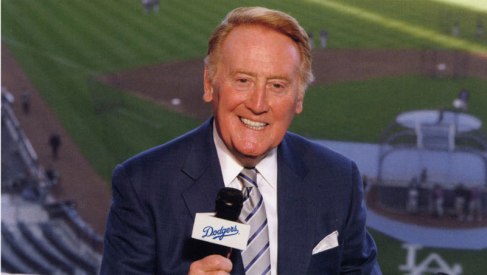
This can’t go on forever. It probably won’t go on for much longer. I’m not even a Dodgers fan. I root against the Dodgers much of the time. When Vin goes–whether he retires before dying or not–I will cry some. Not kidding.
The Culture of Narcissism
So I am not a fan of Amanda Marcotte’s work, but as they say, even a broken clock is right twice a day. Or in this case, close. Once. Recently, Slate‘s resident “everything can be reduced to sexism” pundit wrote a post about why we shouldn’t find the video of the doofus asking Kate Upton to his prom charming, but yet another example of how the patriarchy teaches young men to be whistling cartoon wolves in zoot suits bent on total female subjugation, if not death. For Marcotte, this is just another brick in the wall of “the overall culture of male entitlement.” Well, she’s right about this episode revealing entitlement, but it has little to do with gender. This entitlement is the logical result of social networking culture’s amplification of one our shittiest human tendencies: our sense that we have any right to dictate how others feel about us. Genitals shmenitals.
To make this story all about patriarchal ills, Marcotte does not mention that this video proposal/demand has been directed at male celebrities too. Justin Timberlake was asked via YouTube to attend a Marine Corps ball and, unlike Upton, he agreed to go with his fan(atic). Now, maybe he actually wanted to do this, but if he didn’t, he really had no choice. If Timberlake had said no, he would have gotten slammed as anti-military, out of touch, and probably sexist for rejecting a woman with the “courage” to subvert gender norms by asking him out. In this sense, the stakes were a lot lower for Upton. No one really likes teenage boys, except maybe their mothers.
But I actually give Kate Upton a lot more credit than most celebrities who get put in this position. By (too) nicely saying no she reminded us of something we seem to have forgotten about as a culture. Just because you have Facebook and Twitter and follow celebrity accounts maintained by PR flacks does not mean you are actually friends with the people you worship. And no, you aren’t as worthy of their attention as they are of yours. They don’t pay to see you do anything. They don’t Google sexy pictures of you. They owe you nothing. And yet we applaud when some kid puts another human being in a really awkward spot in order to feed his own ego. Honestly, his parents should be ashamed. But I am sure they aren’t.
This sense of feeling like the objects of our affection owe us reciprocation is neither gendered nor new. The Greek gods and goddesses were constantly raping or turning the people they loved into animals or plants in order deal with the burn of rejection. Carrie Underwood had a hit song about fucking up some dude’s car for possibly cheating on her (listen to it, it’s all about things he’s “probably” doing). Obviously, I think it’s better that people don’t cheat on one another, but even in a committed relationship there is a limit to what we can do to those who disappoint us. If he cheats on you, Carrie, leave him. But leave his truck alone, you psychotic loser.
I recently finished reading two novels, Jeffrey Eugenides’s great The Marriage Plot, and Graham Greene’s middling England Made Me. Though published about 80 years apart, they are both about how, whether we want to admit it or not, loving someone else can often be a very selfish act. All three of the main characters in Eugenides’s book use each other to not have to admit their own selfishness. They are bright, urbane, and enlightened (Ivy Leaguers, dammit!), but they are terrified of being alone because then they’d realize that they are basically sad assholes. They want to be wanted and need to be needed. Most of us do, really. Greene’s book focuses on fraternal twins, a man and a woman, who are so in love with themselves that they try to sabotage each other’s relationships in order to preserve the possibility that they might make Quentin Compson’s deranged incestuous fantasies come to life. It’s not as creepy as it sounds because the book just isn’t, aside from a few incredible passages, very good, but watching the twins interact is about as comfortable as biting down on tinfoil.
If Eugenides and Green are warning against the dangers of self-obsession, this Kate Upton story is an example of how our social networking culture just encourages it. Far from being called out by an adult world with a sense of decency, this kid who asked her out was cheered on in his self-aggrandizing debasement by millions. He was on the fucking Today Show. No wonder kids are leaving college barely any smarter than when they arrive. Why work hard and take yourself away from fun when there’s a whole world (wide web) out there just waiting to make you a celebrity? All your friends are there. There’s Jay-Z, and A-Rod, and Marco Rubio, and Amanda Marcotte, and Kate Upton, and that kid who asked out Kate Upton…
All Roads Lead to Blog
It seems only fitting that on Easter weekend this old blog has risen from the dead. Jesus would be proud, I think. Like the owner and proprietor of these here parts, I finished my PhD in English in 2011, capping it off with a riveting study on American bachelorhood in mid-20th-century US fiction. The trade papers, as you might imagine, went nuts with anticipation and desire. I too had a blog back in the day, and you can find the remnants of it here. Like Ryan, I really enjoyed writing about Kanye West and Glenn Beck (remember him?) and the like. It’s sad for me to read the last few entries where I assure the reader that my infrequent posting is only temporary. I hate lying, especially when I am the one doing it. But this new venture excites me, as I was always a big fan of The General Reader. We’re here to make some hot copy, folks. Bank on it.
For my first post, then, I am going to keep things fresh and local. To quote a song I don’t even like very much, “the city I live in, the city of angels” figures prominently in my dissertation, and I am even more interested in the place now that I have time to be. The story of Los Angeles is a compressed and at times inverted version of American history where the founding fathers aren’t depressive racist philosopher kings, but ambitious racist Alger characters who looked at the post-Civil War, post-gold rush American landscape and figured out that if you control an area’s media and natural resources, and cut deals with the railroads, well then, baby, you’ve got a stew going. In a moral vacuum, it’s a fascinating tale, one ably documented by Kevin Starr, Mike Davis, Norman Klein, and Carey McWilliams (especially Carey McWilliams). If you are looking for a good primer before jumping into a tome, or just a way to be informed enough without reading, PBS did an excellent documentary on LA’s original ruling clan, the Chandlers (no relation to Raymond). You will find a link to it below. Now, if you’ll excuse me, I have to go draft a fantasy baseball team.
Breaking News: Lame Magazine has Lame Cover
Please, please tell me this is a parody. I’m all for humor, but I can’t take this. Not just the tatted bro with his fixie, but the stuff about how agents are actually nice/necessary and the bromide about how small presses are the best ever, too. Please tell me there aren’t earnest editors behind this.
Now, I can’t speak to this guy’s literary chops, because I haven’t read him; for all I know he’s the next Hazlitt. But he let someone take that photograph and then put it on the cover of a national magazine. Even though P&W is pretty useless (writers don’t need trade rags), this is embarrassing. Here’s hoping Mr. Kaelan keeps his shirt on next time and lets his writing do the talking.
-TGR
Reason Not the Need
You may have heard that last week Lebron James made a hugely public decision about where to play basketball for the next half-decade. Like a lot of sports fans, I was initially repulsed by how James handled his free-agency meditations. One would think somebody so adept at navigating the media would have realized that buying up an hour of primetime on the largest sports network in North America makes you look like a dick. (And during the World Cup! And there were kids ranged behind him!) Then, during the proclamation itself, I felt more sympathetic: Bron-bron looked worried and exhausted as he announced he’s going to play for the Miami Heat, and while the sentimentalist in me would have liked to have heard a bit more treacle about how “the fans in Cleveland are great and stuff, etc.” (Dan Gilbert, the Cavs’ owner, went hilariously bonkers over James’ apparent indifference), the guy was clearly agonized about something.

The sports commentariat has been yelling about The Decision for a week now. As you might suspect, the debate is suffused with plenty of sentiment and practiced, pious outrage; a Google search and some reading will remind you that most sportswriters are sanctimonious wangs. But there have been some good off-the-cuff pieces on James. This one, published by Deadspin, argues that The King is not, in fact, a selfish vampire, that for all his obnoxious celebrations of himself (including that stupid nickname) he still gave seven years of marvelous on-court work to a consistently mundane team based in a cold, depressing Rust-Belt city before deciding he’d rather make less money and live in Miami and win a championship than spend the rest of his prime in the same shitty area he grew up in. Imagine being yoked to whatever dull, corny town you were raised in . . . . Centered on James—a grown-ass man who can make his own decisions—the article is nonetheless primarily about how most of us have learned to evaluate public figures based on how they market themselves rather than on whatever real merits or skills they possess, even when we are evaluating someone as obviously, amazingly gifted as Lebron James.
Look to Bill Simmons (nom de plume The Sports Guy) for a more critical—and also typically sententious—reaction to James’ tactics. Before turning things over to the otiose comments of his boring readers (it’s one of his lame “mailbag” posts), TSG asserts that James doesn’t have the necessary competitive psychopathology to win a championship like Jordan, et al. did. We’ll see. King is only 25.
After that you’ll probably want to wash up with some Charles Pierce, the splendid Boston-based writer who is always articulate and sane about sports even though he’s passionate about most of them, and who has the touch for acid skepticism that never becomes cynicism. Scroll down through his blog and catch the thoughts on Lebron. Really, you should be reading this guy every morning. You’ll feel better.
-TGR
Free Market Friday
During the past few weeks there’s been a minor Internet kerfuffle over the reputed hiring practices of the hipster clothing label American Apparel. According to documents obtained and published by Jezebel, the women’s site of the Gawker Media network, the company has spent years intentionally hiring only hipster-hot employees (male and female) to work in its stores, which sell clothes that only fit skinny people. If you’re chubby or wear New Balances or wire-frame glasses, sorry, but AA doesn’t want you.
Personally, while the aesthete in me appreciates the label’s preference for solid colors and fairly simple items of clothing, I’m too big and preppy to adopt AA’s orthodox look, nor do I want to. And despite being a twenty-eight-year-old heterosexual male who hopes always to see as much of as many pretty girls as possible, I find their raunchy ad campaigns kind of gross. By all appearances the company’s founder, Dov Charney, is greedy, pompous, and more than a bit lecherous. American Apparel’s whole media campaign has always been brazenly, unapologetically about using the exposed skin of slender young people with interesting hair to sell slim-fit clothing.
Which is to say, the company operates like pretty much every other clothing line on earth, from Old Navy to whatever gets strutted around on runways in Milan. Models are always physically attractive humans; even outlier types of models–e.g. “plus-size” women–have better faces and skin tones and hair than most people. 99% of us couldn’t make it as professional clothes-wearers. We don’t look right for the part. The young people who work retail in any chic clothing store are the “in-house” models–whatever else they do while on the clock is secondary to their main purpose, which is to visually contribute to the general aura of coolness/hipness/whatever the label is trying to gin up.
This is exactly how it should be. American Apparel’s policy truly would be scandalous if it were based on the sort of essentialist discrimination that has long been established as culturally poisonous and destructive (misogyny, homophobia, racism, things like that). If they sold exploding oil rigs (for example), they would also deserve legal scrutiny. And if AA were a public institution, hiring people based on looks and sartorial taste would be not be OK: you can’t defensibly argue that Elena Kagan isn’t hot enough for the Supreme Court. But American Apparel is a private, for-profit company. They sell a particular brand of style–a “look”–which is clearly organized around a particular type of bodily appearance. That is what clothing retailers do. It’s what one must do in order to have a shot at becoming a profitable, taste-making designer. This has always been the case. If you don’t like how American Apparel does what it does, then don’t buy anything there. You can even tell everyone you know how lame they are (and their policy is pretty sad, albeit realistic). But don’t pretend that they are accountable to some nebulous cultural standard or that how a private T-shirt company structures its business model is a huge public matter which threatens to undo the achievements of feminism. They aren’t and it’s not.
It is also hypocritical of Jezebel to push this critique. Their website’s tagline is “Celebrity, Sex, Fashion for Women” (which would be annoying even if it were grammatical). Each day they post dozens of high-res pictures of and stories about movie stars, famous designers, models, and crap like that. Hey, guys: HOLLYWOOD AND NYC FASHION WEEK RUN ON THE SAME PRINCIPLES AS AMERICAN APPAREL. If you don’t complain when Brad Pitt gets cast ahead of Paul Giamatti, then you have to leave Dov Charney’s creepy brand alone, too.
-TGR

