Midweek Music Upgrade with The General Reader

It is nearly the end of Wednesday here in California, and I have not posted since last week. (Anytime this happens and you hunger for my thoughts and cannot stand waiting for new bloggings, you really should read all those poetry-crit/-appreciation posts from the past few months.) It is also March. Still chained up in winter, American readers from the East Coast or the Midwest are like Hans Solo at the end of The Empire Strikes Back, except whereas HS is the captive of an intergalactic space-criminal’s carbonite-refrigeration technologies (a pure denial of nature), your awful winter has been so viciously natural that nature seems like an evil technology that wants to kill you with frost. I know. I did my years in the mountains back east.

Besides, the California winter hasn’t been a turkey shoot either. Like, the snails are bad right now after the rain a couple weekends ago. Totally chowing down on my plants. Plus I had to wear sleeves while running when it rained.

Music be the food of love, says the man from the play. The purest art, claims Pater in “The School of Giorgione.” Poetry’s nearest analogue, thought Wallace Stevens. “Fuckin’ love it,” affirms everyone who has ever enjoyed any kind of music. So with the weekend in view, here is one of Chopin’s “Etudes,” from way on back in the 1830s. Has a training exercise ever been so catchy?

Here is bonus music featuring a piano, this time from a 1990s composer and his writer friends.

http://www.youtube.com/watch?v=6b85stKx3ZY

Twenty years after Enter the Wu-Tang dropped, one can make a solid case that the album is part of the best that’s been thought and said, to borrow language from Matthew Arnold. While MA probably would not personally enjoy hip-hop (most Victorian writers probably wouldn’t), I don’t think he would object, in philosophical and aesthetic terms, to giving the Wu-Tang Clan a tentative best-of spot. Not if you sat his ghost down and talked a little. Dude might have inspected schools for a living, but he also wrote some good poetry, like “The Buried Life.”

Local Geographies: Three Kinds of Document

This afternoon, after the rain broke, I went running (jogging) through my neighborhood, a citrus suburb that leans against a sliver of marshy, protected coast. The beauty of the rich green strip between the dense, humanized local environment (organized around U.S. 101) and the Pacific will make you happy to live on Earth, and so of course some ghouls want to “develop” (a verb we should put on probation) it into a pleasure dome for millionaires. Right now an anonymous Saudi investor owns it, but thanks to this area’s crazy liberals and the civic codes they have gotten enacted, s/he can’t destroy it yet.

My ‘hood is beautiful too, though. It is a shakily middle-class area that has evolved into a low-key, vernacular garden suburb. The hummingbirds are loud here, and we actually have honeybees, because over the past four decades the properties have mostly relaxed back into the land: almost every owner or renter maintains some mixture of vegetation—my tiny studio’s kitchen garden hosts California poppies, nasturtiums, sunflowers, aloe, two kinds of lavender, potatoes (I haphazardly buried a few moldy ones), mint, sage, shallots, and an elephant bush that is held up by two stakes and a web of steel wire. In the local argot the area is called “Noleta,” because although it is technically an unincorporated part of Santa Barbara County, it is culturally and economically scruffy, more similar to oceanside (southern) Goleta than central SB. I am grateful for the place in a way that exceeds my usual vain doings. After almost nine years in California my favorite parts of the state—a real American state but also the mental condition attendant thereon—are its humble parts.

With that preamble in mind, here are some texts that encounter and carefully document various local environments. May your habitat be sustainable, y’all.

  • If Adam Weinstein hadn’t written this, Ken Layne would be my favorite Gawker contributor, although he is apparently now leaving the site to run his own. Recently the man went on a walking tour of the region we have been told to call “Silicon Valley, ” and in Layne’s account, “Heart of Blandness,” the creepiest thing about the motherboard of the corporate tech sector is its physical banality: in material terms, it is just a constellation of heavily armored office parks set amid a congeries of infrastructure that has been crumbling since the Clinton administration. When the workday ends, the employees are bused (in private buses with tinted windows) back to their homes in San Francisco, where people who don’t work in Silicon Valley find it increasingly hard to afford to live.
  • Nineteenth- and twentieth-century America might have had a thing for the idea of Wilderness, but the nation’s greatest lyric poet wrote about nature in a town in Massachusetts. In this one here, Emily Dickinson looks at a snake; in this one here, Emily Dickinson reminds you that besides Shakespeare, nobody can bend language like she does, twisting it till it sounds eerily familiar again, like a tape of what happened inside your head when you stepped outside. If you don’t have a copy of the definitive edition of Dickinson’s notoriously complex archive, why do you even speak English? Do not trust the Google results, because many published versions of Dickinson’s poems mistakenly attempt to “normalize” her language and ignore her strange seventeenth-century capitalization habits, intentionally dropped or distorted punctuation, and seeming gaps in logic. Instead, buy the R.W. Franklin reading edition linked to above. It costs like three gin-and-tonics. If you went to college and don’t own it, do not talk to me about books. Ride or die Dickinson.
A narrow Fellow in the Grass
Occasionally rides –
You may have met him? Did you not
His notice sudden is –
The Grass divides as with a Comb –
A spotted Shaft is seen,
And then it closes at your Feet
And opens further on –
He likes a Boggy Acre –
A Floor too cool for Corn –
But when a Boy and Barefoot
I more than once at Noon
Have passed I thought a Whip Lash
Unbraiding in the Sun
When stooping to secure it
It wrinkled And was gone –
Several of Nature’s People
I know and they know me
I feel for them a transport
Of Cordiality
But never met this Fellow
Attended or alone,
Without a tighter Breathing
And Zero at the Bone.
  • In November, after about thirty people who know more about music than I do told me to, I downloaded Action Bronson’s mixtape Blue Chips 2, and since then I have bumped at least part of it at least part of every day that I’ve been near a speaker or a headphone. Do you like it when populist MCs with deranged lyrical gifts team up with DJs who prefer fun instrumental tracks? No? Then stop reading this blog. Yes? Then use a search engine and get the mixtape for free. In the meantime, here is “In The City” (feat. Jeff Woods), a short punchy track Bronson hides in eighteenth place on a collection that is, in this critic’s humble view, fucking bananas awesome.

http://www.youtube.com/watch?v=q2cCXNQH4_A

Sliding into the Weekend

It is almost official spring up here in the Northern Hemisphere, and in southern California we are getting some hearty, sustained, weekend rain, the long kind that makes green things go crazy and washes hard down in the north-LA foothills, but buys California some time time, even if in the long run it doesn’t ease our terrifying drought.

Los Angeles is a city built to nestle under some vicious mountains. When it rains, the rain pours down a serious incline into a metropolis, often in the form of otherwordly mudslides. The Control of Nature, master-journalist John McPhee’s book (1989), has a fantastic chapter (“Los Angeles Against the Mountains”) about this. In ecological, geological, and architectural terms, the LA region is fascinatingly complex; pace a dumb but persistent narrative, “SoCal” is not pH-balanced sunshine. Lucky for us a gifted writer got hold of the truth. Maybe you can buy this book. Maybe you can find it some other way that I don’t know about. Who knows, in this modern digital world? I think it’s McPhee’s best. Plus the cover is great.

But we know you guys back East and in the Midwest and in the South are mostly fucking freezing, so the Reader is going to find something hot. Hang on. Have as much tea as you want.

[leaves room]

[some times passes; let’s say 10 minutes]

OH SHIT HEY. We found it.

Let your tape rock till your tape pop, y’all.

Monday Education Links: Everybody’s Got Ideas

If you don’t yet have time for the long Auden post below, or if you’ve already finished it, here are links to a couple of fantastic texts. Besides advancing sensible points, they’re models of concise, tart rhetoric. It turns out that having experience as a teacher is the main criterion for making credible claims about education. Yes, plenty of non-teacher input is fine, even helpful, as long as it defers to the training and experience of actual educators. Otherwise you are just kibitzing and need to go away now.

Writing for Inside Higher Ed, Jonathan Senchyne braved The New York Times Schools for Tomorrow Conference, and now we have his field report. The takeaway? As we at the Reader have long been pointing out, most of the players with grand plans for leveraging Technology and other very innovative things to “disrupt” or remake (for today’s modern society!) American education have never been teachers. Often they’ve been students at elite institutions, but that’s it. Do these people lecture their dentists on how to numb a gum, or push the mechanic out of the way once their sedan is on the lift? The infuriating, absurd details from Senchyne’s piece are its best attribute. You’ll meet insane charlatans from the Clayton Christensen Institute for Disruptive Innovation, as well as former politicians turned corporate-ed pimps, all of them marching in “a parade of highly polished representatives from government, finance, education administration, The New York Times, nonprofit policy tanks, and private-sector business,” all of them “on stage in various combinations to deliver pitches.” And why, yes, Arne Duncan (Harvard, Class of ’87) was there to rep our privately educated (as usual) President’s terrible ideas about mass education.

“But I was a student for a really long time! I know what it takes to teach well.” One hears this on the reg, sometimes candidly, more often as the implicit supposition behind whatever someone is burbling about teacher pay, grading standards, a class being “irrelevant,” or what have you. As Sarah Blaine emphasizes on her blog parentingthecore, this is horseshit. Teaching is an extremely complex, difficult, taxing job at any school level, and most people could never hack it; she herself eventually “copped out” (her words) and became a lawyer, and this led her to conclude something that the Schools for Tomorrow brigade would do well to confront:

The people I encounter out in the world now respect me as a lawyer, as a professional, in part because the vast majority of them have absolutely no idea what I really do.

All of you former students who are not teachers and not lawyers, you have no more idea of what it is to teach than you do of what it is to practice law.

All of you former students: you did not design curricula, plan lessons, attend faculty meetings, assess papers, design rubrics, create exams, prepare report cards, and monitor attendance. You did not tutor students, review rough drafts, and create study questions. You did not assign homework. You did not write daily lesson objectives on the white board. You did not write poems of the week on the white board. You did not write homework on the white board. You did not learn to write legibly on the white board while simultaneously making sure that none of your students threw a chair out a window.

You did not design lessons that succeeded. You did not design lessons that failed. [. . .]

You did not. And you don’t know. You observed. Maybe you learned. But you didn’t teach.

The problem with teaching as a profession is that every single adult citizen of this country thinks that they know what teachers do. And they don’t. So they prescribe solutions, and they develop public policy, and they editorialize, and they politicize.

Blaine taught at a rural high school, but most of what she says applies to college teaching, trust me.

She is not claiming that teaching is a mystical calling that some people are just “born” knowing how to do. Few actual teachers think that way, even if that is how it works in movies. Blaine calls teaching “a profession” because, as with policework or medicine or chemical engineering, “only years of practicing my skills and honing my skills would have rendered me a true professional. An expert.” She’s right. I am already an effective teacher (no big deal, folks) but I am nowhere close to the educator I could be if I manage to stay in the game another few decades. I learn constantly from more experienced colleagues and from my time in the classroom with my students, most of whom are good kids that, if they are willing to work, deserve to get more from college than debt you cannot even discharge in bankruptcy.

This is why decent academic programs try to cultivate a stable core of faculty, where teachers learn explicitly and implicitly, directly and indirectly, in the short run and over the years, from one another.

And thus we have yet another reason why the adjunctification of the professoriate is a goddamn rolling disaster.

Weekend Verse: Auden’s Tables

W.H. Auden is the best. His feline sense of humor and mid-century Greenwich Village/Brooklyn Heights cool are part of that (see below), but his value mostly consists in his poems. If you haven’t heard of or read him yet, no problem; you will probably like his poetry, because Auden actually wrote with his reader in mind, which means he thought about how to coherently convey human experience within a text. He assumed that a reader would appreciate a poem that is at least somewhat situationally intelligible (i.e. where you can tell what basic human action, occasion, or event is at stake); serious without being pedantic or humorless (even an honest master like T.S. Eliot is frequently guilty of the latter); and musically pleasurable—and this, the human delight in rhythmic sound, is the heart of Auden’s work. Rhyme and a beat are what you want, not traits to be rejected because, I don’t know, Difficulty is good or whatever. His work is comforting in a way that much modern poetry isn’t, though it would be hard to justify calling much of it “optimistic.”

Any poet who wants to have many readers must be entertaining, just like a novelist, although of course entertainment is a small part of a writer’s function. Auden’s entire corpus gets at what Dana Gioia gets at in his 1991 (and still pertinent) essay “Can Poetry Matter?” (Answer: qualified Yes, if poets bother to write sonically pleasurable things that lay readers can make intellectual sense of, and avoid the arcane density pimped by some MFA holders.) No emotionally healthy person willingly reads much of anything they don’t enjoy on a dopamine level. Outside of the fantasies of academia’s most pious residents, abstract appreciation never led anyone to finish a book.

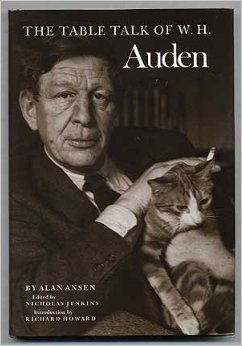
Auden writes criticism with the same attitude. Like any effective teacher, he is into cool things and wants to tell you about them, though he doesn’t particularly care about their present cultural cachet. In the introduction to the book which provides the amazing cat picture below, Richard Howard reports that, in the poet’s words, “criticism should be a casual conversation.” It should be accessible, sharing the author’s knowledge instead of flaunting it. (If you want to read more about this, the poet James Fenton, whose witty, form-conscious work owes a lot to Auden’s example, lucidly underscores the connections between poetry and critical prose in “Blake Auden and James Auden,” a lecture reprinted in The Strength of Poetry: Oxford Lectures, which Farrar, Straus and Giroux published in 2001.)

In all of his essays, lectures, reviews, introductions, forewords, afterwords, jacket blurbs, and sundry ephemera, you see the same thing as in the verse: profoundly compassionate humanist thinking that delights in language and ranges in philosophical content from funny to sorrowful to resigned to ambivalent to defiant. Guy is a nonfiction sibling of Dickens and Foster Wallace, and a poetic ancestor of Jennifer Egan’s A Visit From the Goon Squad (2010), a novel you should absolutely go find right now, because it is incredible. In the foreword to his own Collected Shorter Poems 1927-1957, Auden insists that “a dishonest poem is one which expresses, no matter how well, feelings or beliefs which its author never felt or entertained”; and then, lest he appear sanctimonious, he blasts himself for once “shamefully” espousing a “wicked doctrine” that “equate[s] goodness with success” (“History to the defeated / may say alas but cannot help nor pardon”) just because it sounded good.

Further, and lucky for us, a great deal of Auden’s conversation survives in the form of interviews (the Paris Review has a long one somewhere in their archives and in a paperback I’m not climbing into my attic to find) and recorded conversations like those comprised in Alan Jenkins’s Table Talk of W.H. Auden. Like Coleridge, Samuel Johnson (in Boswell’s Life of Johnson), and Orson Welles, Auden was a good talker. Even when he’s being flippant or getting bored with a topic, the man’s erudite intelligence is beguiling.

Perhaps more importantly, the cover of Table Talk is incredible. Try to stop looking.

Auden Table TalkYou can’t, can you? I got it for $4 in Portland a few years ago because someone at Powell’s didn’t do their homework. Not that it is the kind of rare tome Johnny Depp pursues in that documentary The Ninth Gate, but I still saved at least fifteen dollars. The walls of my studio are a cultural lifeboat. 

Here are some choice cuts. Keep in mind that despite being a gay cosmopolitan artist who hung out in Greenwich cafes and read Latin, Auden was also an Anglican Christian born in 1907, and he held some views that are now archaic, at least among coastal intellectuals.

On the replacement of public art with limbic pleasures:

Today [1947], the great question seems to be, should one write poetry at all? During the thirties the question was, what kind of poetry should one write? Should one write for the masses, for instance? But there was never any doubt whether or not one ought to write. The great question now is, what would give one pleasure? Ought one to write poetry, or fuck? (page 50)

On modern poetry:

I shouldn’t let anyone under 25 read Whitman, and Hart Crane is dangerous for the young. (57)

Shakespeare:

I think that Coriolanus is the most boring of Shakespeare’s heroes. Macbeth is pretty dull too. I’m extremely fond of The Winter’s Tale. Cordelia is really a silly little bitch. There are so many “No”-girls in Shakespeare’s last plays. He must have acquired a special actress who could play that sort of role. (55)

Reminding us that Oscar Wilde kind of sucks:

Wilde, after all, is important not as a writer—he couldn’t write at all—but as a behaver. Still he did say some very acute things.

On nineteenth-century English verse, which had its share of musically gorgeous fools and self-important nobs (that would be Shelley). This being Auden, he manages to bring sex into it:

Swinburne does what Shelley wants to do more successfully than Shelley. He lives entirely in a world of words, whereas some reality is always present in Shelley. I don’t think [Robert] Browning was very good in bed. His wife probably didn’t care for him very much. He snored and had fantasies about twelve-year-old girls. (97)

On how Americans often misprize British writers:

Samuel Johnson is a person not much appreciated in the United States. And the people who do like him are either like Yvor Winters [note: wonderful poet, aesthetically very conservative], or nasty types of Anglophiles who think they have to be rude and are usually Republicans. But Johnson was a great melancholic romantic and he wrote some exceedingly acute things. (18)

His qualified taste for pop culture:

Don Quixote is the only really Christian myth. You find a trace of it in L’il Abner in the Daily Mirror. Abner’s always trying to do someone a good turn, and it never works out. Superman and Little Orphan Annie ought to be on the Index. Henry Miller, certainly. Yes, Thomas Wolfe . . . [original ellipse] and Carl Sandburg—the prose is all right, but not the poetry. (59)

On the use of student evaluations of professors, and the narcissism of young Americans:

I’m really terribly annoyed over this teacher rating business. It’s democracy in the wrong place. It assumes that everyone’s opinion is as good as everyone else’s, which is simply not true. The result is that the teacher is encouraged to clown—to be an entertainer. But the teacher must know when he should be boring—something necessary for students sometimes. (57)

But they [undergraduates] begin with the idea that they are the important ones to be pleased—not taught—and that their untutored reactions should be the final judgement on their instructor. They’re so disobedient because that’s the way they’ve been brought up. (85)

Two for the ladies!

There are two things I don’t like. To see women drinking hard liquor and to see them standing at bars without escorts. Women should drink port with lemon. (39)

I don’t like it when women are nasty. Women are really supposed to be much nicer than men. That’s what they’re here for. Women shouldn’t be talked to on intellectual subjects because if they like you, they’ll agree without having any real opinions of their own. Oh, they are fun to talk gossip with. A few have real minds, but they usually make one feel uncomfortable. (66)

And for the men:

[. . .] America is really a very queer country. . . . All American writing [he singles out Fitzgerald’s This Side of Paradise] gives the impression that Americans really don’t care for girls at all. What the American male really wants is two things: he wants to be blown by a stranger while reading a newspaper and he wants to be fucked by his buddy when he’s drunk. (80-81)

Finally, the secret lives of cats:

Some Siamese cats are impossible because they keep continually crying. I’d rather have a tom. You know, they have a rugged time of it trying to service so many ladies. A friend’s was looking seedy. When he called the vet, the vet just laughed and said the cat would be fine once the rutting season was over. Cats will not let you work. They keep jumping all over you, try to attract your attention and just make a nuisance of themselves. (67)

But I believe we started out talking about poetry. So, to spruce up your weekend, here is “A Walk After Dark” (1948), whose rhymes and jaunty meter enhance, rather than reduce, its depth:

A cloudless night like this
Can set the spirit soaring:
After a tiring day
The clockwork spectacle is
Impressive in a slightly boring
Eighteenth-century way.

It soothed adolescence a lot
To meet so shamelesss a stare;
The things I did could not
Be so shocking as they said
If that would still be there
After the shocked were dead

Now, unready to die
Bur already at the stage
When one starts to resent the young,
I am glad those points in the sky
May also be counted among
The creatures of middle-age.

It’s cosier thinking of night
As more an Old People’s Home
Than a shed for a faultless machine,
That the red pre-Cambrian light
Is gone like Imperial Rome
Or myself at seventeen.

Yet however much we may like
The stoic manner in which
The classical authors wrote,
Only the young and rich
Have the nerve or the figure to strike
The lacrimae rerum note.

For the present stalks abroad
Like the past and its wronged again
Whimper and are ignored,
And the truth cannot be hid;
Somebody chose their pain,
What needn’t have happened did.

Occuring this very night
By no established rule,
Some event may already have hurled
Its first little No at the right
Of the laws we accept to school
Our post-diluvian world:

But the stars burn on overhead,
Unconscious of final ends,
As I walk home to bed,
Asking what judgment waits
My person, all my friends,
And these United States.
Ante-Weekend Beats: Rare Gold

Beck’s Mellow Gold dropped twenty years ago next week. Your parents probably should have hated it, but even if they noticed that you were listening to it on your Discman (the one with the duct tape) or your friend’s bedroom speakers, they probably didn’t. The whole album exemplifies a seriously unwholesome, unprofitable, ingenuous obsession with American music, one so brilliant it doesn’t matter that Beck himself is a Scientologist.

Lemme tell you about this stoner incunabulum. It embodies titular excellence (“Whiskeyclone, Hotel City 1997”; “Truck-Drivin’ Neighbors Downstairs”). It can do a shambling impression of radio pop (“Loser”). Sometimes it’s like a classic-R&B listening party hosted by an affable sex maniac. Its version of avant-garde garage rap (“Soul-Suckin’ Jerk”) sounds sort of like the Beastie Boys, but it’s not imitative; and it foreshadows some of the big singles from Odelay a couple years later. As such, it’s also the scene of some great light verse, as in “Nitemare Hippie Girl,” a cogent warning about “mystical, tragical beaut[ies]” that all young heterosexual men in America should heed, especially if they are still in college or less than, say, three years past graduation and living in some expensive coastal city: “She’s a magical, sparkling tease, / She’s a rainbow choking the breeze; / She’s bustin out onto the scene /  With nightmare bogus poe-try. / She’s a melted avocado on the shelf, / She’s a science of herself.” (It goes on from there. Cf. the Manic Pixie Dream Girl narrative. Girls, the guy version of this might be this guy.) There is some lush, narco-ambient stuff (e.g. “Black Hole”) that points toward Beck’s downer classic Sea Change (2002) and groups like Animal Collective. (I keep thinking of Skip Spence, too. We are not worthy.) It includes the best Neil Young and Bob Dylan parodies you will ever find.

The weirdest thing about this album? It got to #13 on the US Billboard chart. For the whole America! Kinda doubt it would move that many units in 2014. You saw the Super Bowl halftime show, right? It would still be a goofy late-capitalist gem, though. Here’s “Fuckin’ With My Head (Mountain Dew Rock),” my favorite track on Mellow Gold. You might have to watch a stupid ad first. I’m sorry.

As a literature person who runs a blog and borrows large parts of his musical tastes from more knowledgeable friends, I feel confident making broad predictions about the media market while assessing various albums. I’m savin’ up my food stamps and burnin’ down the trailer park. Have a good weekend, y’all.

Baby Steps: Recent Higher-Ed News That Isn’t Entirely Depressing

Among the many trends in higher education that TGR bemoans, perhaps none is more personally galling than the persistent, Joe Biden-endorsed myth that faculty salaries are the reason college costs so much. Those tenured professors in their new Priuses and ivy-coddled homes, with their twenty-hour work weeks. But slowly, slowly, the glacier of ignorance seems to be melting a little around the edges. People besides readers of Inside Higher Ed, alt-academic blogs, and the Chronicle of Higher Education are beginning to embrace the material reality of things at actual schools on the planet Earth in this foul year of our Lord, 2014.

Over at Changing Universities, Robert Samuels reports that Congress (well, the Democratic Party’s House Committee on Education and the Workforce) has awoken to the fact that most American college professors work under conditions that range from Consistently Inadequate to Slough of Despond. And just after that document dropped, along came another study that adds to the Mount Whitney of evidence that administrative bloat, overspending on amenities, and the cheapskatery of state legislatures are why Americans are choking on student-loan debt. The report in question is from the renowned Delta Cost Project, which has been tracking university finances since the 1980s. Allow me to summarize: Blaming teachers for enormous tuition bills is like blaming the price of a new flatscreen TV on the wages of delivery drivers, or faulting the tellers at Wells Fargo for the 2008 financial catastrophe.

Now, given that one of the post-Goldwater conservative movement’s greatest achievements was getting Americans to distrust labor unions; given that anti-intellectualism is a national tradition (“My son had to read about GAY IMMIGRANT BLACK HOMO *SOCIALISTS* in history class!”); given that it is easier for the already powerful (provosts, not profs) to maintain the status quo than it is for the underclasses to change it; and given that Americans have many other distressing things on their plates, like the near-jobless post-Bush recovery; I’m not wildly optimistic that unionization and other forms of activist organizing among faculty are going to achieve much. Still, if anyone has a decent chance at reviving the labor tradition that helped create the twentieth-century middle class, it might be college teachers. Besides having the sort of intellectual capital (superb communication and research skills) that could sustain a broad movement, people with PhDs also tend to have more social capital than their dilapidated cars would suggest. That is, many of us know lots of other smart people who weren’t silly enough to become teachers, and instead ended up in law, government, medicine, and other places of relevant affluence and influence. Our brothers and sisters in unions like SEIU are starting much farther back.

For now, here is what I tell my students: If you have younger siblings who are shopping for schools (and thus parents who are likely worried about family finances), then on every visit to every campus, brother/sister should keep asking “What percentage of your undergraduate courses are taught by full-time faculty?” until they get an answer, then follow up with “And what percentage of your total budget goes directly to undergraduate instruction?” Rebecca Schuman is right: The managers of American schools will begin caring about undergraduate education (as opposed to undergraduate gyms and stadiums) real goddamn fast if their customers start refusing to pay for cynical, rickety, adjunct-dependent bullshit.

Friday Night Songs: Housman! Herrick! Springsteen!

By the time he finally died in 1936, the English poet A.E. Housman was forty years past his first and best book (1896’s chilling A Shropshire Lad), a dinosaur in the view of most living writers. The Waste Land, which helped create that thing college teachers tell you to call Modernism, came out in 1922, but in comparison to Housman’s language of experience, it might as well have been 2022. Housman hails from a late-Victorian England that knew it was vanishing, and which, in his case, largely took the form of a partially ironic pastoral language of tetrameter stanzas, waistcoats, pipes, elaborate mustaches, mossy pastures, bachelors, afternoon tea, diligent Latin (apparently some of Housman’s translations are still revered), and quiet middle-class homosexuality. Yet here it is 2014, and homeboy’s work is still in print for a damn good reason, which is that it is existentially timeless and metrically elegant, a hit song in poem’s clothing. Right now, the pears and cherries are blooming in California’s damp Mediterranean winter. This is the second poem from A Shropshire Lad:

Loveliest of trees, the cherry now
Is hung with bloom along the bough,
And stands about the woodland ride
Wearing white for Eastertide.

Now, of my threescore years and ten,
Twenty will not come again,
And take from seventy springs a score,
It leaves me only fifty more.

And since to look at things in bloom
Fifty springs are little room,
About the woodlands I will go
To see the cherry hung with snow.

But not all the modern hotshots had dismissed or forgotten him. In 1936 W.H. Auden’s gift was blooming, and this entailed his lifelong embrace of forms (like ballad meter) that many of his avant-garde contemporaries found simple-minded and archaic; Philip Larkin, whose genius emerged in poems that rhyme and scan, followed Auden’s lead. Both men were Housman fanboys. If one were looking for the opposite of Ezra Pound’s tedious poetics, this line of English prosody would be it.

Housman, of course, is only possible because of who wrote before him. His work points back to Renaissance lyricists like Robert Herrick, John Skelton, Shakespeare (even if you left out the sonnets), and Ben Jonson.

Were any of these men suckers for slightly disheveled beauty, for women whose physical presences aren’t entirely, elaborately assembled, for scarves thrown on at the last minute and light makeup and holes in black leggings? At least Herrick (1591-1674) was! By the time he wrote—about a generation after Shakespeare—English was more or less modern, close enough for you, dear reader, to follow along. When this kinda-sonnet (it has fourteen lines but none have five beats) cruised into the world, you know panties were dropping all over London:

A sweet disorder in the dresse
Kindles in cloathes a wantonnesse:
A Lawne about the shoulders thrown
Into a fine distraction:
An erring Lace, which here and there
Enthralls the Crimson Stomacher:
A Cuffe neglectfull, and thereby
Ribbands to flow confusedly:
A winning wave (deserving Note)
In the tempestuous petticote:
A carelesse shooe-string, in whose tye
I see a wilde civility:
Doe more bewitch me, then when Art
Is too precise in every part.

Other routinely anthologized poems from Herrick are “The silken Snake,” “Her Bed,” and “Upon Julia’s haire fill’d with Dew.” I’m citing from this Penguin collection, which you should own and can probably find cheap if you look around; failing that, you could just drop the piddling $25 for a new copy. What, you needed those three Jameson shots?

More songs! Let’s pivot to an American artist. My residual graduate training still objects that this sort of ahistorical, trans-Atlantic, slipshod move is not a research convention that English PhDs get jobs by pulling, but luckily, especially for me, I’m not an academic literary scholar anymore. I took what I needed. Turns out that on the General Reader, you can link Shropshire to the Rust Belt.

Bruce Springsteen’s hollow-eyed tape-deck masterpiece Nebraska (1982) might best be listened to on hand-me-down vinyl on a Goodwill turntable on a scarred desk in a rented room in, like, Iowa. Maybe you need to be drinking bourbon out of a Dale Earnhardt glass to truly savor this record and its gorgeous cover, maybe you’re wearing old jeans the winter sun can shine through, maybe it’s sleeting and you’re heartbroken . . . We don’t know! Your humble critic has found at least a dozen emotions in this thing. Like much of Springsteen’s best work (all of it pre-1990), like most lyrics that compel you to remember them, the rhythm and the rhymes are based on careful repetition spliced with metrical variation: whatever chaos or melancholy the songs are dealing with, the language is organized. Sometimes it is even catchy. I don’t want to be a total bummer, and I shouldn’t always link to trashy rap videos, so here is “Atlantic City.”

Second track on the album, about as buoyant as the scene gets. Put your makeup on, fix your hair up pretty. Stay safe out there.