Jill Lepore on patriots and tea parties

Jill Lepore teaches American history at Harvard and frequently contributes to The New Yorker, among other magazines.  She’s a witty, deeply learned, but accessible writer and thinker, and her newest essay is a history of a particular kind of political language: allusions and appeals to the “original” intents / ideas of the men pop culture calls the Founding Fathers.  One might think that conservatives are the ones who tend to use this rhetoric, but as Lepore shows it has actually been a tool for abolitionists, gun nuts, antiwar activists, white supremacists, black civil rights warriors, Howard Zinn, Richard Nixon, and now, most loudly, that gang of older, affluent whites led by Glenn Beck and Sarah Palin (among others) which calls itself The Tea Party.  (You know, they’re the ones who hate high taxes and so despise Barack Obama because he cut taxes by $300 billion during his first year in office.)  Lepore’s approach and general attitude toward various movements in past and present U.S. politics is good-humored; nonetheless, she emphasizes that while there have been plenty of annoying, self-righteous “originalists” on the American left, the right is where you go to find truly batshit, destructive appeals to the Fathers:

Originalism in the courts is certainly a matter for debate. Jurisprudence stands on precedent, on the stability of the laws. But originalism has long since reached beyond the courts. Set loose in the culture, it looks like history but it’s not. It is to history what astrology is to astronomy, what alchemy is to chemistry, what creationism is to evolution. The history that Tea Partiers want to go back to is as much a fiction as the Lost Cause of the Confederacy.

A lot of this stuff is founded on those old American pastimes, anti-intellectualism and historical ignorance–Gore Vidal is right to call us “The United States of Amnesia.”  Lepore, however, argues that there is within this a more particular problem: few of us listen much to professional historians.  TV has no use for them.  Rarely does someone who isn’t a Washington, D.C.-based journalist get interviewed on MSNBC or CNN or wherever.  The declining role of historians as public intellectuals

left a great deal of room for a lot of other people to get into the history business. Today’s reactionary history of early America, reductive, unitary, and, finally, dangerously anti-pluralist, ignores slavery and compresses a quarter century of political contest into “the founding,” as if the ideas contained in Thomas Paine’s “Common Sense,” severing the bonds of empire, were no different from those in the Constitution, establishing a strong central government. “Who’s your favorite Founder?” Beck asked Palin in January. “Um, you know, well,” she said. “All of them.”

The essay is compelling.  You can read it here.

-TGR
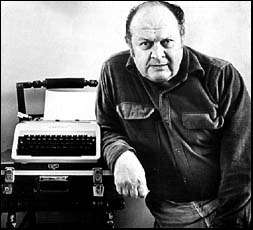
The Weekend’s Difficult Men (Man #1): Richard Hugo

Even if he hadn’t written some of the better American poetry of the 1960s and 70s, Richard Hugo would be remembered by literary history for a number of reasons. Maybe only as a footnote, but still, a long one. He was one of Theodore Roethke’s students at the University of Washington. He co-founded Poetry Northwest. He taught at the famed Iowa MFA program. He was a friend and fellow-traveler of poets like William Stafford, Carolyn Kizer, James Wright, James Welch, and A.R. Ammons. And, perhaps most importantly, he taught creative writing for nearly two decades at the University of Montana, helping turn that MFA program into one of the finest in the country.

But luckily for readers of English, he happened to write a number of wonderful books of poetry, plus a crime thriller, a fine collection of autobiographical essays called The Real West Marginal Way, and a justifiably still-famous rumination on the art of poetry, The Triggering Town. His collected poems (titled Making Certain It Goes On) and Selected Poems are both available from the usual places, as are the prose books.

A word of caution, I guess: Richard Hugo is a very good poet, but he isn’t a great poet. He’s not in Whitman’s or Bishop’s league.  (It’s kind of like the difference between, say, Patrick Ewing and Michael Jordan.)  Mainly this is because Hugo has one fundamental tone, from which he departs only very rarely, and which adjectives like “depressed,” “bitter,” “despairing,” “morose,” and “elegiac” (that’s probably the best and most charitable one)  describe only half-adequately. You’ll see what I mean if you decide to read him; it comes across even if you only look at the half-dozen Norton Anthology pieces. It is most certainly NOT because he writes a lot about one loosely defined region of the United States, the Northwest (comprising both the Upper Plains and the Pacific region). You see, he still sometimes gets typecast as a “regionalist,” which in the lingo of American lit teachers tends to have lame, unfair connotations of “minor” or “fringe.”

Hugo’s major theme–as distinct from his emotional tone–is the impossibility of finding a stable, legitimately happy home in America. He was a white man from the improbably named White Center, at the time a gritty working-class suburb of Seattle; his father ran out on the family when Hugo was a kid; he had a terrible drinking problem; he suffered lifelong trauma (what would now be called PTSD) from his tour as a B-17 navigator in World War II; he constantly lamented his perceived failures with women*; he never really seemed to accept that by middle age he had become a respected American writer; in short, he always thought of himself as a schlemiel, and this fundamental theme gets articulated in a consistent pattern of settings. Wrecked or abandoned towns after the gold-mining industry failed. Cruddy villages in Italy. Failing small farms. Dive bars. Rivers near the Pacific. Fishing. More dive bars. Long car journeys from desolate hamlet to even worse (Hugo is the great American poet of the highway). The scenes of Indian massacres and humiliations, and the white liberal’s consequent, and justified, guilt. The austere natural environment of Montana and Washington.

*Regarding his sexual neurosis: this is where and why H. occasionally slips into adolescent self-pity, which in turn borders on misogyny and sometimes results in genuinely creepy passages about women who “wronged” him. You might want to steer clear of these poems, which are scattered throughout his corpus.

As for his style, Hugo is prosy, insofar as he mimes the voice of someone talking / confessing directly to you, but he also mixes in buried and half-rhymes, the occasional delicious stretch of iambic pentameter, and a lush profusion of image that most novelists don’t risk going after. His images are severe, though, and he rarely ventures into blowsy John Ashbery territory. It boils down to this: Hugo demonstrates the poetic utility of both free verse and metered verse–he reminds the reader that these things aren’t anathema to one another, that in fact they can be mixed in the same poem.

Hugo is essentially a confessional poet, writing with the same general attitude as Plath, Lowell, and Berryman. By this I mean he talks about himself and his small world a great deal. Personal memory is what fires him. He bares his heart, whether you want to hear it or not. But he is different from those poets in a crucial way, because unlike them he always connects the story of his existential despair (pardon that phrase) to wider and, from most people’s point of view, more important problems like environmental devastation, economic collapse, and the long, long history of Native American genocide. Hugo is a poet for American outcasts and underdogs; if you’re one, or were one, chances are you’ll empathize with him, and maybe even like his poetry, whether you came up in rural Nevada, the South, Harlem, East LA, or wherever.

What are you waiting for?  Start Googling him. Read what comes up. And consider buying a Norton Anthology of Modern Poetry.  If you want to keep your library light, this is a book you need.

-TGR

the substances of literature

Too often too much is made of which writers used which drugs and how much: a lot of people have this dimly romantic view of literary creation, according to which it’s fundamentally important that Hemingway drank heavily or that Coleridge was an opium addict or that Pynchon likes to smoke weed.  Not to say that the theme of drug use and/or addiction isn’t important to many literary works qua works; but it’s probably going too far to assume that a particular writer’s brilliance has much to do with her chemical habits (although the problem of writers who DIDN’T fully develop their gifts can often be substantively connected to drug use, especially alcohol use—see Fitzgerald, F. Scott*).  Artists in general do seem to be attracted to alcohol and other drugs, but nonetheless for every bibulous scribbler you can find two writers who didn’t indulge much.  And there are plenty of dentists and plumbers who like drugs, too.

That said, this chart from Lapham’s Quarterly is tons of fun.  Did you know Auden was a speed freak?  (In the morning at least, when he needed to wake up after all that boozing he did.)

-TGR

*But seeing as though The Great Gatsby is one of the finest novels any American has ever written, who really cares?

Sunday Poet: Louise Bogan

My blog production will go down markedly now that baseball season has started and the fascinating (Western Conference) NBA playoffs are on, too. But I would like to point you toward a poet you will probably like if you like to read poetry. Or if you aren’t sure, or don’t quite. Her name is Louise Bogan and she’s quite accessible. Bogan was the poetry editor of The New Yorker for almost 40 years (from the early 1930s until the ’60s, I think), which makes her one of the people who turned that magazine into perhaps the best English-language publication on earth. From what I understand she was an advocate of writers like Elizabeth Bishop, Robert Lowell, and Marianne Moore. More importantly, Bogan was a poet. Ecco Press publishes a slim retrospective collection of her stuff, The Blue Estuaries, available from the usual places.

Here is the best way I can describe her: Bogan is a weird, eerie, sometimes downright hallucinatory poet, but she is also formally conservative, preferring now to deviate much from the norms of English metrical verse. She rhymes and keeps a beat. In this sense you can see how she fits into a line of visionary weirdos that begins with poets such as Blake, Dickinson, and Yeats and continues on to people like Sylvia Plath, John Berryman, James Tate, Kay Ryan, John Ashbery, and Matthea Harvey. Formally speaking, Bogan is closer to the earlier visionaries; she is particularly good with tetrameter lines (i.e. lines that have 4 beats), using them for bleakly comedic and jerky, surrealist effect. Dickinson’s voice, again. A tetrameter line is short, so if you don’t want a series of them to take on this obnoxious, unintentionally funny bouncety-bouncety-bounce rhythm, you’ve got to be deft. Here is her 1937 poem “M., Singing” (copyright Louise Bogan, 1968):

Now, innocent, within the deep
Night of all things you turn the key,
Unloosing what we know in sleep.
In your fresh voice they cry aloud
Those beings without heart or name.

Those creatures both corrupt and proud,
Upon the melancholy words
And in the music’s subtlety,
Leave the long harvest which they reap
In the sunk land of dust and flame
And move to space beneath our sky.

How old-fashioned: Bogan capitalizes the first letter of the first word in each line!  Gives the fever-dream a certain dignity, yeah?

You can see what Plath and Roethke, for instance, learned from her—those clipped, sharp-rhymed little lines—and then modified for their own purposes (they both like to mix in free-verse, more image-rich phrases). Bogan is not a comforting poet, like Shakespeare is, and she’s not as funny as Auden or Louis MacNeice, the two European poets she most resembles. But she isn’t cold, not really. Rather her verse is just totally unsentimental. Some of this mood derives from her rhythmic practice, some of it from her refusal to let her poems become reducible to neat thematic summaries (“this poem is about. . .”), some of it from how sparse her images are, some of it from her skeptical view of things like love and calm. But a lot of beautiful poets—say, Frost—are pleasurable without being straightforwardly consoling. You admire how well they put it, and how  bravely, “it” usually having to do with disappointment or loneliness, but sometimes joy. The muted solace Bogan offers comes from the brevity, and the bizarre subconscious precision, of  her dream poems. Chances are you’ve been there.

to reiterate . . .

. . . American hip-hop honors the metrical traditions of English poetry far more than most contemporary American poetry does. Plus, a lot of it bangs–like Shakespeare and Auden bang. Moments of joyful noise, musical ecstasy, yeah?

“But isn’t poetry written for the ear . . . boring? Isn’t free verse mandatory?  We know what that term means, right?” NAH GIRL.

Anyway, before everyone else gets on his dick, just like Pitchfork did this week, here is the first single off Big Boi (of Outkast)’s new LP, which, judging from its genuinely bizarre title, Sir Lucious Leftfoot: The Son of Chico Dusty, might be a concept album of some sort.  Maybe he’s going the Sherwood Anderson route. Actually, maybe he’s going the Jean Toomer route; after all, Cane uses poetry as much as it does narrative. Anyway, like I said, hip-hop can bang like most other* American music can’t.

*I do not include LCD Soundsystem, Michael Jackson, or the Pixies in that description. They certainly bump. I’ve heard that there’s other music in the world, so add to this archive as you see fit.

-TGR

link + link + link + picture of a poet

For your Wednesday morning contemplation:

Is Dorothy Parker still relevant? Has her poetry held up? The New Criterion thinks so.

Here’s a picture of W.H. Auden. Trust me, he was handsome when he was young.

Martin Amis talks about the friend who was a source for many of his male anti-heroes.  An interview that was published in The Telegraph (London) last summer.

There’s a fresh-to-death new edition of H.W. Fowler’s piquant (and still useful)  Dictionary of Modern English Usage.  Toronto’s Globe and Mail reviews this classic. Has anybody else noticed a lot of journalism about grammar guides lately?

-TGR

Rapper Spasms

Because you need a laugh, because we all need a laugh, I give you .gifs of popular rappers . com. WARNING: this link contains radioactive levels of humor & may cause scream-laughing. Walter Benjamin is right that film lets you look at human movements over and over and over. Why would we want to do that?  Because it’s funny as fug! I’m not the first person to notice that: such repetition is part of Henri Bergson‘s theory of comedy, for instance. And this site is obviously an oblique homage to Benjamin. And to Punch and JudyLooney TunesBeckett’s novels, too. Have a good weekend, ya’ll.

-TGR

PS BEAT DUKE