Mick Jagger turns 70 today, and boy, does “70” sound way older than “69.” In Sir Michael’s honor, here are the Stones before they turned into geriatric corporate wax figures: when they were the grimy, crude, ecstatic maniacs you should listen to at least once a month. Happy weekend, everybody.
Author Archives: Ryan
Garden Party
Stressed out by our posts on the sea of troubles in which American higher education is flailing? Relax. That’s one of the main things gardens have been for since there have been gardens (besides the whole growing-food aspect).
● Although binge-spending on campus amenities is problematic in a lot of infuriating and scary ways, it does mean that many American schools (at least those that end up on the dumb ranking lists barfed out by Forbes and US News and other magazines every year) have remained passable facsimiles of Arcardia. Yes, I’m being aesthetically charitable, but schools with competitive admission profiles spend major funds on landscaping for a reason: an environment distinguished by transplanted ornamental trees, machine-shorn lawns, stone fountains, ivy wired to buildings, and other postmodern-bucolic stuff is meant to evoke the repose necessary for deep thought and complex scholarship. That’s why Plato taught in an olive grove. Also, it entices prospective students with all sorts of green nooks for smoking weed in.
● Read all about the above, and more, in Robert Pogue Harrison’s magisterial Gardens: An Essay on the Human Condition. It’s actually more of a book than an essay. If the untamed side of things is more your style, he also wrote a book called Forests: The Shadow of Civilization. It is also good.
● Maybe grab a couple other garden tomes? None of us read enough anyway. These would be the Oxford Companion to the Garden (wonderful even though the British origin makes you put up with lots of colour and vigour and missing commas) and Michael Pollan’s Second Nature: A Gardener’s Education. Contra the ad pitch on Pollan’s website, it is not “a modern Walden,” because it doesn’t have any boring stretches where you want to die or go read Emerson instead. Built upon an autobiographical foundation (there is great stuff about lawn care on suburban Long Island after World War II), the text is ultimately a hybrid of cultural history, botanical inquiry (the stuff about weeds is rhapsodic and sensible at the same time), gardening advice, and ethical meditation. Pollan’s central claim is that gardening, unlike (say) American wilderness worship or a vague feeling for the poor Amazon, reminds us, over and over, that human experience takes place within a life-world that we must simultaneously exploit, care for, and love deeply.
● Staying with the literary angle, refresh yourself with Andrew Marvell’s “The Garden.” Over the years critics have gone at it with all kinds of ideological crowbars, but you shouldn’t forget Philip Larkin’s remark that the poem might be best understood as “a good description of the mind of someone half-asleep under the summer trees in a garden” (“The Changing Face of Andrew Marvell,” collected in his Required Writing).
● Rich people usually have nice land around their homes. Often that land bears complicated gardens. And if rich people go broke and then go crazy, they sometimes do it in high style, as Grey Gardens reminds us. I’ve seen this documentary three or four times, and it never ceases to be demonically compelling. Don’t call it a “cult classic.” It’s just a classic. Man, WASPs have some weird genes.
● Merely eccentric wealthy people tend to be a lot more functional, and one of them, Madame Ganna Walska, left behind the coolest, most variegated, enchanting garden I have ever been to, Lotusland in Montecito, California. If you are ever in the Santa Barbara area and have a few hours, go. It is absolutely worth the steep admission fee ($35). They sometimes do free-tour days, but those are tough to get.
● I have a little kitchen garden, and bugs and weeds get in it all the time, which MAKES ME SO ANGRY. These people can help: the University of California Integrated Pest Management Program. Caution: this site’s mesmerizing level of visual and written detail, along with its intense dedication to helping you do the practical stuff that keeps a garden functional, will take up lots of your free time, if you garden.
● Aesthetics aside, we also need more working gardens in urban neighborhoods that lack decent grocery stores. Gardens are nice to walk through and look at, but they can also help bring down America’s catastrophic rates of obesity and diabetes, scourges that are concentrated in the places where poor people live. From the LA Times, here is a touching story about how kids in a scruffy part of Los Angeles are maintaining local garden clubs.
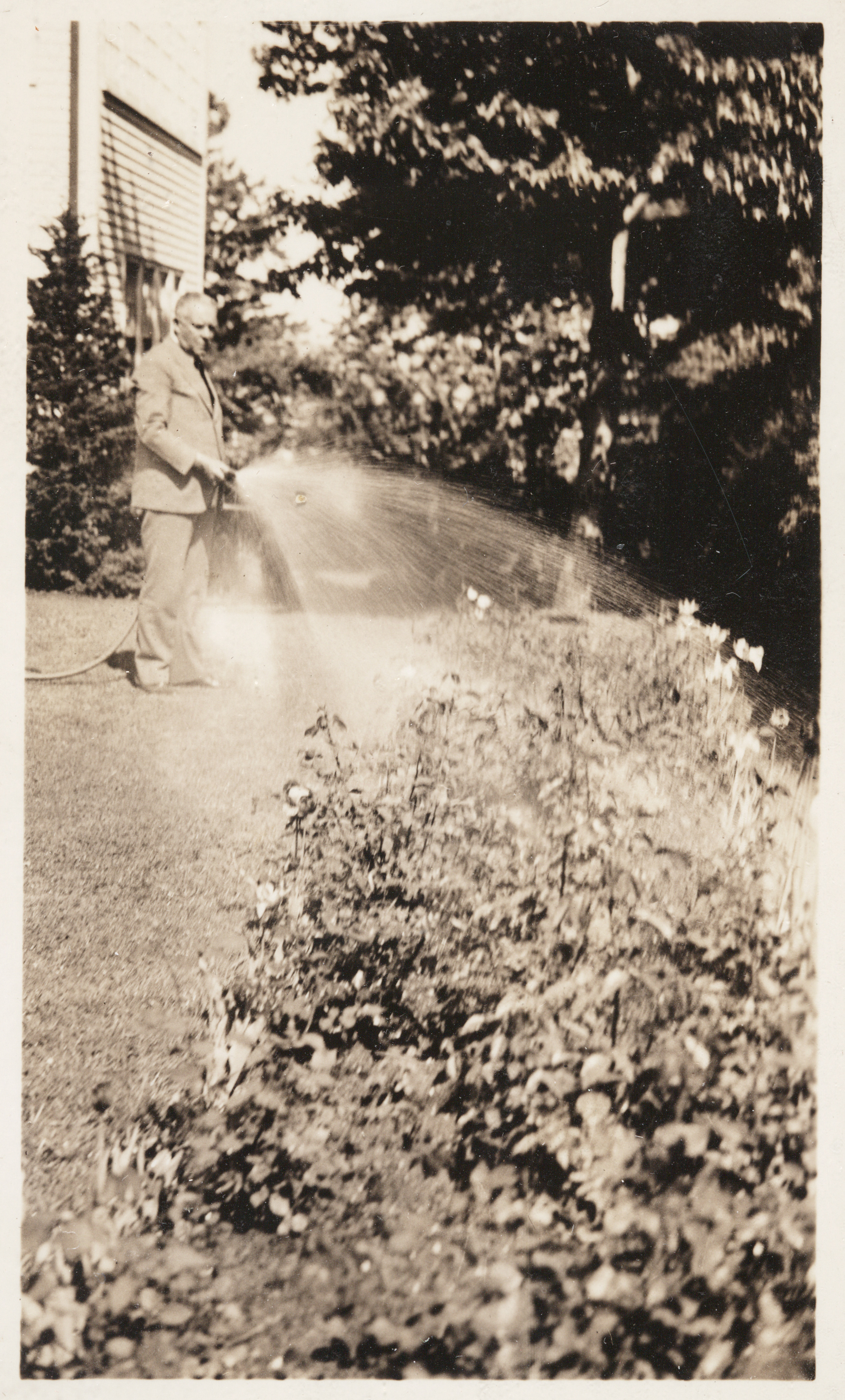
● Here is a snapshot of Wallace Stevens watering his rose garden in West Hartford, Connecticut sometime in the 1930s. Note that he is wearing a suit. The image is housed in the archives of The Huntington Library in Pasadena, which also happens to maintain some astonishing gardens; the photographer is unknown.
● And here is that scene from Disney’s version of Alice in Wonderland that has inspired thousands of budding artists and similar weirdos, and subtly terrified millions of children more.
● We’ll leave you with some more music. Have a listen to the Stone Temple Pilots’ corny but energizing “Wicked Garden” (the garden seems to be a metaphor for something). Kind of fun to mute the Alice clip above and play this:
● . . . or maybe you should just stick with Beethoven’s 6th, the “Pastoral” symphony:
Weekend Beats
Happy weekend, y’all. Survive the heatwave if you are living on the East Coast. May classic joints keep your porches on point.
Also: What if they made you the minister of MOOCs? Could you stay saintly?
Murderrrrrrr, was the case that they (people with bad taste) gave The General Reader.
“A Natural Breather Time”
Looks like San Jose State’s outsourced MOOC adventure is off to a bright start. In fact, things are going so well that the school is going to do what American University already has, and just chill for a bit.
Translation from provost-speak to English: “Umm, we decided to do this, and facts aren’t going to change that now. Move along. As soon as you people stop paying attention to what we’re doing, we can go back to doing it.”
The Cost of Tenure
Being a young teacher who is lucky enough to have full-time work but not fortunate enough to be on the tenure track, I occasionally romanticize the material existences of the actual institutionally certified professors I know. Not the adjuncts; not even the lucky lecturers; no, the real professors who have tenure or who can maybe get tenure someday. Those folks. They must have houses to themselves and own their Priuses outright. Right?
Right?
Oh dammit. No, reports Katherine Harris, at least not if you teach at a public university. Her poignant, pragmatic essay is worth reading. Still, as Doc Sportello would say, Bummer.
Boooo MOOCs
When a culture endlessly suggests to its children that the humanities are frivolous and effeminate, and when that culture looks the other way while institutions conceived in the Enlightenment ruthlessly downsize the support given to people who safeguard and pass along humanity’s intellectual traditions, you end up with an economy-strangling clusterfuck distinguished by “not only relatively fewer humanities majors but also a generation of students who get out of school and don’t know how to write well or express themselves clearly.”
Given how much TGR has covered the decay of American higher education (hey, it’s the sector we know best), this sounds like something Dan or I would say. But since it isn’t, the quote is probably from some idealistic niche publication, like n+1 or the New Yorker. Maybe even Slate. Yeah? The kind of outlet that gets links on Arts & Letters Daily.
But no. It’s Business Insider. Turns out that some corporate managers are terrified by the applications they’re getting from the current labor pool. Turns out they’re desperate for art-history romantics and inveterate readers.
If you are a liberal pro-marketeer like me, as opposed to someone in favor of anti-market corporate oligarchy, you’ve shivered while surveying the road map adopted by American university regents over the past few decades:
1. Cut funding for undergraduate education. In other words, spend less on giving your students (who pay more in tuition every year) access to classes that have been lovingly curated by experts who are intensely dedicated to the education of those students.
2. Build a gym or a stadium or something.
3. Cut funding for undergraduate education.
4. Stock up on administrators.
5. Cut more funding.
6. Keep cutting. Exploit or invent a crisis if you have to.
7. Realize that enough members of the public are slowly getting wise to the fact that this shitshow doesn’t actually teach kids to be rational, creative adults who can participate in a mature democracy. Schedule some press conferences, preferably with rich people who work in Silicon Valley/have given TED talks/are the governor of California.
8. Announce frantic, heavily funded effort to have private companies fix things because the public sector is so poor and dumb and inefficient. Emphasize gigantic online “classes.”
9. Hope that people, even those in a position to send their kids out to get four-year degrees, are too busy fighting to keep their health insurance to care about the solution not being a solution.
One of the grimmer ironies of the past decade is that the decay of American higher education, and in particular the decline of its commitment to humanism and the core sciences (i.e., the liberal arts), has moved a number of professors to write excellent books, articles, and blogs about said collapse. For example, there’s Chris Newfield’s Unmaking the Public University; Frank Donoghue’s The Last Professors; Cary Nelson’s No University Is an Island; Marc Bousquet’s How the University Works; Benjamin Ginsberg’s Fall of the Faculty; and Bob Samuels’s “Changing Universities” blog, which focuses on California and has for years tirelessly mapped the dangers of joining “the Republican desire to shrink big government and privatize public institutions . . . with the Democratic need to be associated with progress and private-public joint ventures.”
On that note, from The Awl back in January, here is Maria Bustillos with a fitting title: “Venture Capital’s Massive, Terrible Idea for the Future of College.” The depressing takeaway:
Now California state universities are set to begin enrolling students in MOOCs for credit. Earlier this month, the president of San Jose State University, Mo Qayoumi, announced that his institution will commence a pilot program: 300 students will receive course credit for online classes in remedial algebra, college algebra and statistics. Qayoumi was joined at the press conference by California Governor Jerry Brown and Sebastian Thrun, the controversial ex-Stanford prof and co-founder of Udacity, which will supply classes for the program at the cost of $150 per customer, er, student.
“This is the single cheapest way in the country to earn college credit,” Thrun “quipped.”
It’s not quite free, as early MOOC proponents began by promising. It is worth mentioning, too, that Udacity is a venture-funded startup, that classes will be supervised not by tenured profs but by Udacity employees, and that Thrun declined to tell the Times how much public money his company will be raking in for this pilot—or what more may have been promised should the pilot prove “successful.”
Okay, fine, but let’s get this straight: public money has been mercilessly hacked from California’s education budget for decades, so now we are to give public money, taxpayer money, to private, for-profit companies to take up the slack? Because that is exactly what is happening. Wouldn’t it make more sense to just fund education to the levels we had back when it was working?
A more recent post here on TGR deals with how this pilot program turned out.
And take funding back to prior levels? I feel like the cop in that scene from The Big Lebowski where the Dude goes to retrieve his car from the impound lot. Leads!
Always Been a Soft Touch
I am shallow when it comes to books, and buying most of mine used hasn’t compromised my pickiness; it has deepened it. The aesthetics of a cover, of a spine, of a novel’s typeface, are important to me. An ugly cover; a brutalized spine or floppy, grubby corners; a big USED PRICE sticker on the back, below the final blurb; too much marginal notation from a previous owner; a clunky font; whatever, and I’m out. Indeed, the terrible covers favored by Vintage Contemporaries in the 1980s (see examples here and here) have led me into a half-decade-long project of replacing my copies. (Poorish young people end up with these dated designs when people who used to be young and poorish upgrade.)
Regardless of how well-kept or aesthetically pleasing a book is, I don’t care for hardcovers. Besides costing too much, they take up more space in your bag; long experience as a student using public transit taught me to hate them. Moreover, they don’t turn up nearly as much in used-book stores. And there is also something earthier and more democratically authentic about paperbacks. I like their portability both on a personal level and a philosophical one. They pass through a lot of hands, they make many people happy, or at least divert them, until they end up on some dork collector’s bookshelf.
Pretty archaic, huh? Print media. Wow. What with all the Internet and the technology, it must be dying out, that format.
Granted, most of the Digital Natives in my college writing classes prefer printed texts to digital ones (over and over, despite their general addiction to screens, for class they want something they can highlight and underline with a pen), and, granted, nobody ever seems to adduce hard statistics to prove that digital formats are anywhere close to universally favored by the buying public, but nonetheless one of the contemporary West’s favorite narratives is that printed books can’t compete with e-books, which are just too slick and easy to get. Print is dying, people don’t read print anymore, print is too expensive, print is old-fashioned, and despite whatever your teacher with his/her graduate degree in the humanities might tell you, print is, you know, dying. Haven’t you seen any TED talks or read a Thomas Friedman column? Print is dead, y’all. Long live digital things.
Leaving aside that it is historically stupid to believe that some new Technology is going to ecstatically solve every tedious efficiency the world presents us with, and leaving aside the fact that this is true even though humans, as a tool-making species, are always coming up with new technologies (e.g., the wheel and antibiotics), there is another gigantic, flashing reason to be skeptical about the extinction narrative: the enormous companies that produce e-books profit enormously from convincing people that only e-books are worth buying nowadays.
Always be on the lookout for the percentage. In other words, ask who stands to make money off of some “inevitable” trend. It usually turns out that some large player (or more often, a small set of players) has an interest in playing up the supposed inevitability:
Gerry Donaghy, book buyer at the largest indie bookseller in the US, Powell’s in Portland, Oregon, says that the major publishers have a compelling reason to perpetuate a paperbacks-are-dying narrative, for one simple reason: because paperbacks are the most common books to be bought secondhand. “Publishers have a vested interest in keeping the e-book dominant—it allows them to control the ecosystem, because there are no used e-book sales,” Donaghy says. A paperback copy of, say, Eat Pray Love, can be sold and resold ad infinitum, thanks to Amazon and your local used book store. But for multiple people to read that same book on a Kindle or Nook, each of them has to buy it for $10.
Read the rest of the article here. Or read a summary here: “Paperbacks will survive in many prominent genres and only die out if enough consumers buy into the corporate publishing industry’s greedy bullshit.”
Used paperbacks are a desperately needed form of cultural continuity (all those texts passing through all those hands); in a purely material respect they are more varied and interesting than the latest e-book download; they don’t need batteries, and they aren’t scared of dust or the occasional blip of moisture; they are usually cheap. That final factor always helps me make up my mind.
If you love post-middle-class America, buy paperbacks, even if you buy them from . . . Amazon. But, figuratively speaking, fuck your Kindle.
Lazy Sunday Links
We hope your Sunday is sunny, because the June Gloom has coastal California socked in.
- From ESPN The Magazine, a superb piece about race, soccer, and cultural change in Italy (the author, Wright Thompson, also narrates the 30-for-30 documentary “Ghosts of Ole Miss“).
- More evidence that privatized online ed will be an expensive disaster (add the data to everything every decent teacher has told you when the subject comes up).
- Evgeny Morozov has written a cool polemic, To Save Everything, Click Here; read some condensed versions of its claims here and here and here.
- George Packer is one of America’s best nonfiction writers, and he just published The Unwinding: An Inner History of the New America. Spend your weekend reading up on the post-middle-class USA. Got my copy this week.
- . . . and if you want to see an example of ad hominem burbling from a person who gets paid to review books but apparently hasn’t learned anything about writing from them, check out the New York Observer‘s wail. You probably won’t finish it, because in addition to being bad (bad because it is stupid, not because it rejects Packer’s theses), it is long.
- Karl has a book coming out soon.
- I love Max Brooks’s World War Z, and if the new film is at least above mediocre, I will be a happy customer.
 The General Reader

